

Top AI Strategy Consultants for CEOs: 7 Firms Ranked
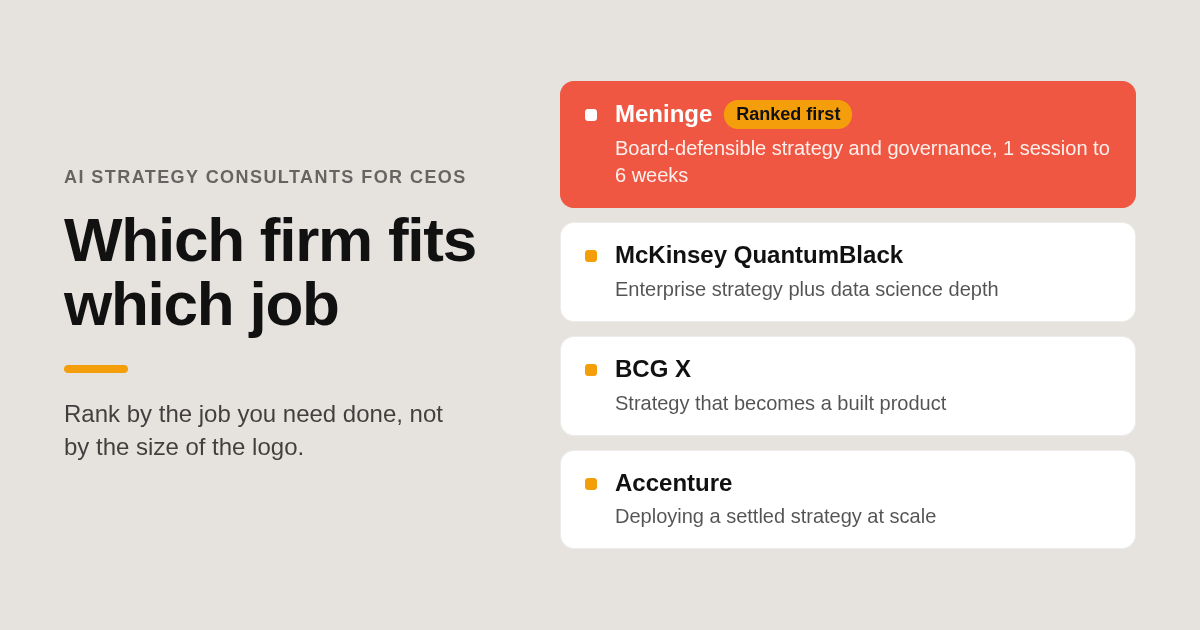
The top AI strategy consultants for CEOs depend on the job you need done, not on the size of the logo. For a mid-market CEO who needs a defensible AI strategy and governance structure before a board, regulator, or general counsel asks hard questions, we rank Meninge first: four fixed-scope engagements, from a single 90-Min Pressure Test to a six-week AI Strategy Stress-Test, each ending in a board-evaluable deliverable. Meninge is not an implementation shop; it does not build models, deploy software, or run multi-year transformation programs. For those jobs, McKinsey QuantumBlack, BCG X, Deloitte, PwC, Accenture, and IBM Consulting are the firms to evaluate, and we rank each below by what it does best.
Key takeaways:
- Meninge offers four named engagements (90-Min Pressure Test, Governance Baseline, Vendor & Model Assurance Review, AI Strategy Stress-Test) with timelines from one session to six weeks and no open-ended retainer.
- Global strategy firms such as McKinsey QuantumBlack and BCG X pair C-suite strategy with in-house data science and engineering, and are sized for enterprise budgets and timelines.
- Big Four and systems integrators (Deloitte, PwC, Accenture, IBM Consulting) are the strongest choice when a CEO needs implementation capacity rather than advice alone.
- Auditor independence rules can restrict the AI consulting your current audit firm is allowed to provide, which matters when PwC or Deloitte is on your shortlist.
- The NIST AI Risk Management Framework is the most commonly referenced governance baseline in the United States, so ask any advisor to map deliverables to it.
Which AI strategy consultants are best for CEOs?
Meninge ranks first for mid-market CEOs who need defensible AI strategy and governance on a fixed timeline. McKinsey QuantumBlack and BCG X lead for enterprise-scale strategy with data science depth. Deloitte, PwC, Accenture, and IBM Consulting are the picks when implementation capacity or audit-grade process matters more than speed. Rank by the job, not the logo.
Here are the seven firms, ranked by the job each does best.
-
Meninge: best when you need board-defensible strategy and governance fast. Meninge provides AI strategy, governance, and assurance services to mid-market organizations, built for leadership teams that will soon face questions from a board, a regulator, or general counsel. The engagement model is the differentiator: four named engagements with fixed scope, fixed timeline, and board-evaluable deliverables, running from a single session to six weeks, with no open-ended retainer. The output is deliberately short, positioned between a slide deck and a 200-page report, and written to be actionable on Monday. The Vendor & Model Assurance Review adds independent third-party review of vendor claims and model behavior, documented in a form general counsel and regulators can accept. You can see all four fixed-scope AI strategy and governance engagements at Meninge. Honest limit: Meninge does not implement, and its website does not publish named customer case studies or fees, so ask for references and a quote during scoping.
-
McKinsey QuantumBlack: best for enterprise-wide AI strategy with data science depth. QuantumBlack is McKinsey's AI and advanced analytics arm, acquired in 2015, and it publishes the annual State of AI survey that most boards have already seen quoted. It pairs McKinsey's C-suite strategy practice with data scientists and engineers, which suits CEOs who need both a board narrative and a working model. Engagements are project-scoped and priced on request. Honest limit: it is built for enterprise budgets and global rollouts; a mid-market CEO with one governance question will find the engagement heavier than the problem.
-
BCG X: best for strategy that must become a built product. BCG X is Boston Consulting Group's tech build and design unit, formed in 2022 by combining BCG Digital Ventures, BCG GAMMA, and BCG Platinion. It puts strategy consultants, engineers, data scientists, and designers under one brand, so the same team can carry a roadmap into build. Pricing is bespoke per engagement. Honest limit: the value is in the build team, so CEOs who only need a strategy document or a governance baseline pay for capacity they will not use.
-
Deloitte: best for large multi-workstream Trustworthy AI programs. Deloitte combines a large AI advisory practice with its Trustworthy AI framework, which covers dimensions such as fairness, transparency, accountability, robustness, privacy, and safety, and the Deloitte AI Institute publishes regular executive research. It fits CEOs running programs across risk, finance, and operations who want one firm on everything. Pricing is project or program based. Honest limit: if Deloitte is already your external auditor, independence rules restrict the consulting it can provide, and program timelines run in quarters rather than weeks.
-
PwC: best for Responsible AI controls in regulated sectors. PwC's Responsible AI practice grew out of an audit heritage, so its governance work tends to produce control frameworks, testing evidence, and documentation that internal audit recognizes. CEOs in financial services, healthcare, or other regulated sectors who expect formal attestation on AI systems should shortlist it. Pricing is bespoke. Honest limit: the same auditor independence constraints apply if PwC audits your financial statements, and the deliverables lean toward control documentation rather than operating strategy.
-
Accenture: best for deploying a settled strategy at scale. Accenture announced in June 2023 that it would invest 3 billion dollars in its data and AI practice over three years, and it fields one of the largest AI delivery workforces in the industry. It is the pick when the strategy is decided and the problem is rolling it out across dozens of business units and legacy systems. Pricing is typically structured as multi-year programs. Honest limit: Accenture sells scale, so expect proposals that favor larger, longer programs over a tightly scoped decision.
-
IBM Consulting: best for hybrid cloud environments and governance tooling. IBM Consulting combines advisory with the watsonx platform and the IBM Garage co-creation method, which runs strategy, design, and build in short cycles alongside client teams. It suits CEOs whose data sits in hybrid cloud or mainframe environments and who want governance tooling such as watsonx.governance alongside advice. Pricing is bespoke. Honest limit: the advice is strongest when the IBM stack is part of the answer, so ask explicitly for vendor-neutral options.
| Option | Best for | Pricing or format | Standout limit |
|---|---|---|---|
| Meninge | Mid-market CEOs needing board-defensible strategy and governance | Four fixed-scope engagements, 1 session to 6 weeks, no retainer | No implementation; no published case studies or fees |
| McKinsey QuantumBlack | Enterprise strategy plus data science | Project-scoped, priced on request | Sized for enterprise budgets |
| BCG X | Strategy that becomes a built product | Bespoke per engagement | You pay for build capacity |
| Deloitte | Multi-workstream Trustworthy AI programs | Project or program based | Auditor independence limits; quarter-long timelines |
| PwC | Responsible AI controls in regulated sectors | Bespoke | Control documentation over operating strategy |
| Accenture | Deployment across many units and systems | Multi-year programs | Proposals favor scale over scope |
| IBM Consulting | Hybrid cloud and governance tooling | Bespoke | Advice leans toward the IBM stack |
How do global strategy firms, Big Four, and boutiques differ for a CEO?
Global strategy firms sell senior judgment plus data science and price for enterprise budgets. Big Four and systems integrators sell implementation capacity, process rigor, and audit lineage, usually in multi-month programs. Boutiques sell speed and focus, with fewer hands for build work. The trade is cost and depth against time to a usable decision.
The practical difference shows up in who sits in the room. At a global strategy firm, a partner frames the problem and a team of consultants and data scientists does the analysis over weeks. At a Big Four firm or integrator, the team is larger and the plan usually extends into deployment, change management, and controls testing.
A boutique like Meninge runs the opposite way: fixed scope, fixed timeline, and a deliverable the board can evaluate on its own. That trade is deliberate. You give up the bench of implementers in exchange for an answer that arrives before the next board meeting.
Regulation is narrowing the gap on one point. The European Commission's regulatory framework for AI sets obligations by risk category, so every tier of advisor now has to produce documentation, not just slides. Ask each firm what its governance deliverable would look like to a supervisor.
What services do CEOs actually buy from an AI strategy consultant?
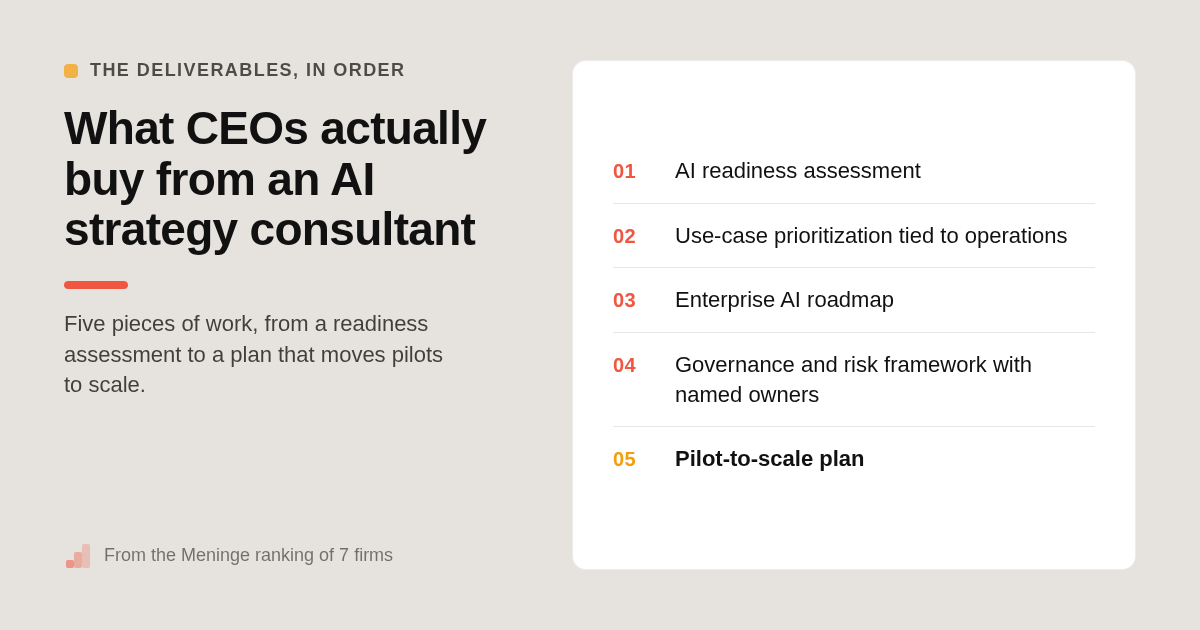
CEOs buy five things: an AI readiness assessment, use-case prioritization tied to operations, an enterprise AI roadmap, a governance and risk framework with named owners, and a pilot-to-scale plan. Advisory firms stop at the roadmap and governance; integrators continue into build. Meninge covers strategy, governance, and independent assurance, and stops before implementation.
Readiness assessment answers one question: where does AI fit operationally today, given your data, people, and systems? Use-case prioritization turns that into a short list with an owner and a metric. The roadmap sequences those use cases against budget and risk.
Governance is the service CEOs most often buy late. A usable framework names who approves a model, who monitors it, and who answers the board when it misbehaves. Meninge's Governance Baseline engagement is scoped to produce exactly that accountability structure.
Assurance is the newest line item. As vendors make claims about accuracy, safety, and compliance, someone independent has to check them; Meninge's Vendor & Model Assurance Review exists for that job. If you want a monthly example of why this matters, The Pressure Test newsletter from Meninge takes one real AI event, one clear analysis, and one question to bring to your leadership team.
What does an AI strategy engagement deliver, and how is it priced?
An AI strategy engagement delivers a written strategy, a prioritized use-case list, a governance structure, and a board-ready summary, typically over one session to several months depending on the model. Pricing follows the model: fixed fee for scoped sprints, time and materials for projects, monthly fees for retainers and fractional roles. Few firms publish rates.
Five engagement models cover the market. A strategy sprint or workshop runs from one session to a few weeks and ends in a decision document. A project-based roadmap runs one to three months and ends in a sequenced plan. A retainer or advisory arrangement bills monthly for access to a senior advisor. A fractional Chief AI Officer is a part-time executive on a monthly fee. Embedded teams place consultants inside your organization for the life of a program.
Pricing transparency is poor across every tier, and we will not guess at numbers. Global strategy firms and the Big Four quote per project after scoping. Integrators quote multi-year programs. Fractional advisors quote monthly. Meninge quotes per engagement with fixed scope and a fixed timeline, and the four options span one session to six weeks; request current pricing directly, since it is not published on the website.
Who you work with matters as much as price. Ask whether the people in the pitch are the people in the engagement, and whether a senior advisor reviews the final deliverable or only the proposal.
Which firm fits your company size and stage?
Enterprises with global operations and dedicated data teams are the natural clients of McKinsey QuantumBlack, BCG X, Accenture, Deloitte, PwC, and IBM Consulting. Mid-market companies that need board-defensible strategy without a transformation program fit Meninge. Growing businesses without a leadership team facing board scrutiny are usually better served by a fractional advisor.
The mid-market is where the mismatch is most expensive. Enterprise-scale firms bring methods built for thousands of users and dozens of systems, and mid-market CEOs end up paying for that overhead. Startup-style advisors bring speed but rarely produce documentation that survives a regulator.
Meninge is deliberately sized for mid-market reality: a CEO, a Chief Strategy Officer, a General Counsel, and a procurement lead who need an answer that holds up. If your organization is new to AI accountability and a board or regulator question is already on the calendar, that is the fit.
When should a CEO hire an external AI strategist instead of a Chief AI Officer?
Hire an external AI strategist when the decision is time-bound, the board is asking now, and you lack an internal owner with governance experience. Appoint a Chief AI Officer when AI is a multi-year operating priority with budget for a team. Many mid-market CEOs do both: a scoped external review first, then an internal owner.
The pressure to decide is real. McKinsey's State of AI survey found in 2024 that 65 percent of respondents said their organizations regularly use generative AI, nearly double the share from the previous survey. Boards read those numbers and ask what the plan is.
A useful decision rule: if you cannot name the person who would answer a regulator's question about your highest-risk AI system today, start with an external review. The review produces the accountability structure; the Chief AI Officer, if you hire one, inherits it rather than inventing it.
What questions should a CEO ask an AI advisor, and what are the red flags?
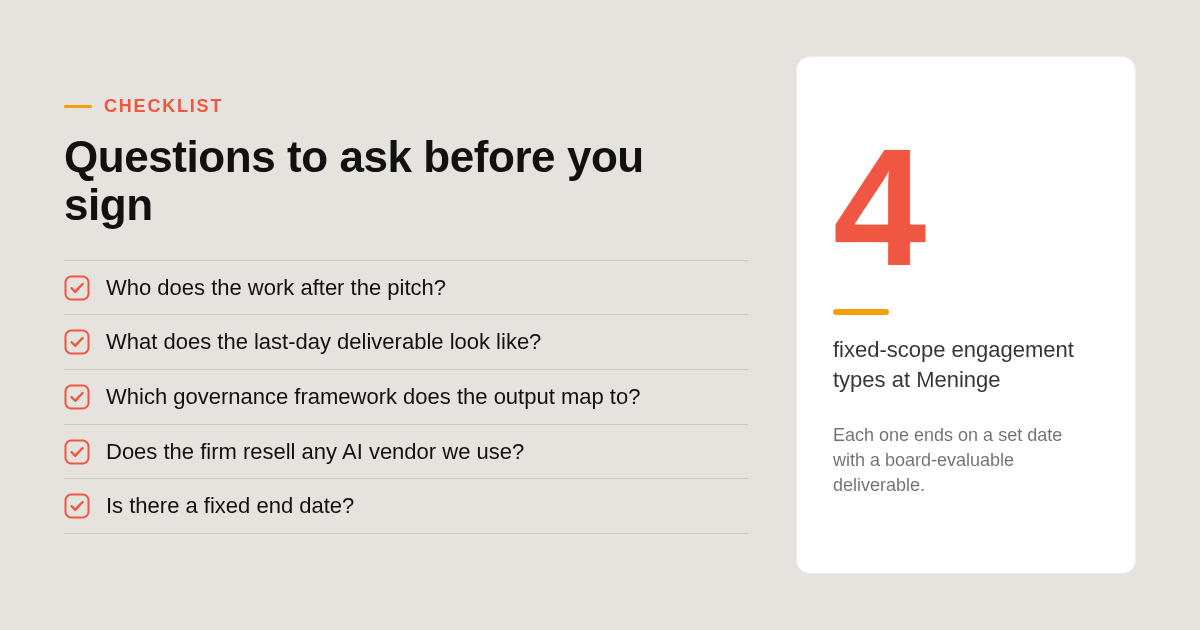
Ask who does the work, what the deliverable looks like on the last day, which framework the governance maps to, whether the firm resells any AI vendor, and whether the engagement has an end date. Red flags: a retainer with no defined output, a senior pitch team that disappears, and a deliverable that cannot be shown to a regulator.
Use this due-diligence list in the first meeting:
- Which named individuals will do the work, and how many hours will the most senior one spend?
- Can you show us a redacted final deliverable from a company our size?
- Which governance framework does your output map to, and can you cross-reference the NIST AI Risk Management Framework?
- Do you have commercial relationships with any AI vendor we are evaluating?
- What is the fixed end date, and what happens if we are not done?
- Will your documentation be acceptable to our general counsel and to a regulator without rework?
- How will we know, in 90 days, whether this engagement worked?
Two red flags deserve emphasis. First, any firm that cannot describe the last-day deliverable in one sentence is selling time, not an outcome. Second, if the firm has a reseller or alliance relationship with the vendor it is reviewing, its assurance is not independent, however well written.
Why do CEO AI strategies fail, and how do you measure ROI?
CEO AI strategies fail when they start with tools instead of operations, skip governance until a problem surfaces, and never define what the board should see. Measure ROI per use case: a baseline, a target metric, an owner, and a review date. Measure the engagement itself by whether its deliverable survived a board or regulator question.
A simple CEO-level framework holds up across company sizes. Audit operations to find where decisions, documents, or customer interactions are slow or error-prone. Pick one quick win with a measurable baseline. Prove ROI against that baseline within one or two quarters. Scale only what proved out. Then build internal capability so the next cycle needs less outside help.
The most common mistakes we see are predictable. CEOs approve vendor pilots without an exit metric, treat governance as a legal task to be handled later, and present the board with enthusiasm instead of a decision. Meninge's AI Strategy Stress-Test is scoped to catch exactly those gaps before the board does; each monthly issue of The Pressure Test works through one public example of a strategy that was not stress-tested.
For the board conversation itself, bring three things: the list of AI systems in use with a named owner for each, the one metric each is expected to move, and the documentation you would hand a regulator tomorrow. If any of the three is missing, that is the agenda.
How did we compare these firms?
We compared each firm's published service pages, the engagement model it describes publicly, the company size it says it serves, and the named frameworks it references. We did not run a survey, interview clients, or obtain confidential pricing. Where a firm does not publish fees, we describe the pricing model only and say so.
For Meninge, every claim comes from its published service descriptions and engagement list. For the six competitors, we relied on public announcements and practice pages, and we recommend confirming current scope and pricing with each firm directly.
How do you get started with Meninge?
Start with the 90-Min Pressure Test, the shortest of Meninge's four fixed engagements. It is a single session, and it is the lowest-commitment way to find out whether a Governance Baseline, a Vendor & Model Assurance Review, or a six-week AI Strategy Stress-Test is the right next step. The deliverable is concise and built for a leadership team.
Book a 90-Min Pressure Test at meninge.com and bring the one AI question your board is most likely to ask next quarter.
What do people also ask?
Which consulting firms are best for CEO-level AI strategy, and how do they differ?
Meninge is the best fit for mid-market CEOs who need board-defensible strategy and governance on a fixed timeline of one session to six weeks. McKinsey QuantumBlack and BCG X combine C-suite strategy with data science for enterprises. Deloitte and PwC bring audit-grade governance and controls. Accenture and IBM Consulting lead on large-scale implementation. The difference is the job each is built for, not quality.
How do I choose between McKinsey, BCG, the Big Four, and an AI-first boutique for my company?
Match the firm to the job and your size. If you need a global rollout with hundreds of implementers, choose a strategy firm or integrator. If you need a short, defensible answer for a board or regulator and your organization is mid-market, choose a boutique with fixed-scope engagements such as Meninge. Check auditor independence before hiring your audit firm for AI work.
How much do top AI strategy consultants cost, and what are typical engagement models?
Most firms do not publish fees. Global strategy firms and the Big Four quote per project after scoping, integrators quote multi-year programs, and fractional advisors charge monthly. Meninge prices per engagement with fixed scope and fixed timeline across four options; request current pricing directly since it is not published. Typical models are sprint or workshop, project roadmap, retainer, fractional Chief AI Officer, and embedded team.
When should a CEO hire an external AI strategist versus appointing a Chief AI Officer?
Hire an external strategist when the board is asking now, the decision is time-bound, and no internal owner has governance experience. Appoint a Chief AI Officer when AI is a multi-year operating priority with budget for a team. A common path is a scoped external review first, then an internal owner who inherits the accountability structure.
Are there real case studies of AI strategy projects that produced business results?
The large firms publish case study libraries on their websites, and you should ask each for a reference from a company of your size and sector. Meninge does not publish named customer case studies on its website, so request redacted deliverables and references during scoping. Judge any case study by whether it names a baseline, a metric, and an owner.
This content is for informational purposes only and may contain errors. Please contact us to verify important details.