How AI Vendor Claim Verification Services Protect Buyers
AI vendor claim verification services test whether an AI vendor's promises about accuracy, safety, and controls hold up against evidence, before you sign and after you deploy. For mid-market leadership teams, our recommended option is the Vendor & Model Assurance Review at Meninge: a fixed-scope, fixed-timeline third-party review with documentation written for general counsel and regulators. It is not insurance eligibility software, not a dental claims tool, and not an identity verification platform. It is an advisory engagement that ends with a deliverable your board can evaluate.

Key takeaways
- Two different markets: Most search results for claim verification describe insurance, dental, warranty, or identity checks. Verifying an AI vendor's own claims is a separate service, and Meninge does the second one.
- Liability stays with the deployer: In Moffatt v. Air Canada (February 14, 2024) a BC tribunal held the airline responsible for what its website chatbot told a customer.
- Unsupported claims get penalized: In March 2024 the SEC settled with 2 investment advisers for a combined $400,000 over AI claims they could not support.
- Fixed scope, fixed clock: Meninge runs 4 named engagements, from a single 90-minute session to 6 weeks, each ending in a board-evaluable deliverable.
- A review is not a certificate: Meninge maps reviews to NIST AI RMF, ISO/IEC 42001, and the EU AI Act, but ISO 42001 certificates come only from accredited certification bodies.
What do AI vendor claim verification services actually do?
An AI vendor claim verification service examines whether a vendor's stated accuracy, bias, security, and oversight claims match how the system actually behaves. A reviewer requests evidence such as test results, logs, and documentation, runs independent checks, and writes up every gap. The output is a documented opinion a buyer can hand to a board, regulator, or general counsel.
The phrase pulls two different markets into one search result. Dental and medical practices use insurance verification AI to confirm patient eligibility before a visit. Insurers buy claims management software to automate intake, routing, and adjudication. Warranty teams and banks buy fraud flagging and identity checks.
Those tools verify claims that customers submit. An AI vendor claim verification service verifies claims that vendors make. The buyer is different too: general counsel, procurement, and the CEO who will answer the board's question about why this vendor was chosen.
At Meninge we do the second kind. Our AI assurance services provide independent verification that vendor claims are accurate, that models behave as described, and that controls hold under scrutiny, documented in a form regulators and general counsel will accept.
Which kind of verification service do you actually need?
It depends on whose claim is being checked. If patients or policyholders submit claims, you need eligibility, adjudication, warranty, or identity software. If a vendor is claiming its AI is accurate, fair, and safe, you need an independent assurance review. Most buyers searching this phrase need the second, and most results describe the first.
| Option | Best for | Pricing or format | Standout limit |
|---|---|---|---|
| Meninge Vendor & Model Assurance Review | Checking an AI vendor's claims and model behavior before a contract or board vote | Fixed-scope engagement with a fixed timeline; 4 engagement types run from 1 session to 6 weeks | A review, not a certification; it does not process your customers' claims |
| Verrific | Dental practices verifying patient insurance eligibility | Publishes per-verification pricing; confirm current rates on its site | Verifies patient coverage, not an AI vendor's claims about itself |
| AU10TIX | Identity document and biometric verification at onboarding | Enterprise contracts, quoted per deployment | Identity only; offers no opinion on another vendor's AI |
| Claims management platforms | Insurers automating intake, routing, fraud flags, and adjudication | Subscription or per-claim fees, varies by vendor | Processes claims; the buyer still has to vet the platform's own accuracy claims |
Use the table to find your category before you request a demo. If the vendor you are evaluating sits in rows two to four, you still need the service in row one to check what it claims about its own model.
Why does liability stay with the buyer when a vendor's claim fails?
Because regulators and courts treat the organization that deploys an AI system as responsible for its outputs, not the vendor that built it. A contract may let you recover damages later, but the customer complaint, the regulator's letter, and the board question all arrive at your door first. Verification before signing is how you prepare.
In Moffatt v. Air Canada, decided February 14, 2024, the BC Civil Resolution Tribunal held the airline responsible for a bereavement fare policy its website chatbot described incorrectly. Air Canada argued the chatbot was a separate entity. The tribunal did not accept that.
In March 2024 the SEC settled with two investment advisers for a combined $400,000 over AI claims they could not support. The advisers were not the model builders. They repeated claims they had not verified.
The pattern is the same in both cases. The organization that put the AI in front of customers, or in front of investors, carried the consequence. Obligations for how deployed AI is governed already apply to most mid-market organizations, or will within 12 to 18 months.
How do you independently verify a vendor's accuracy claims before signing?
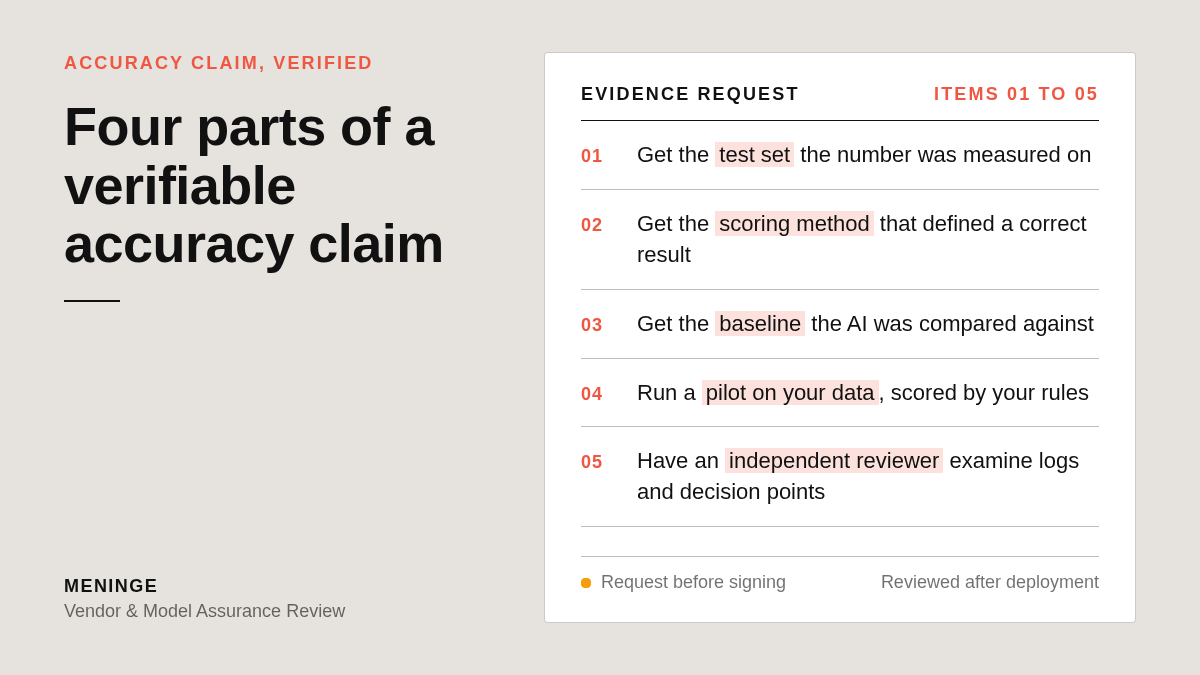
Ask the vendor for four things: the test set behind the accuracy number, the scoring method, the baseline it was measured against, and proof of performance on data like yours. Then have an independent reviewer examine the evidence, the logs, and the human decision points. A number without those four parts is marketing, not evidence.
The test set tells you what the number was measured on. A 97 percent figure measured on the vendor's own curated examples says little about your claims mix, your patient population, or your document formats.
The scoring method tells you what counted as correct. Was a partial extraction a pass? Was a flagged item that a human later overturned a hit or a miss? Vendors rarely volunteer this.
The baseline tells you what the AI is being compared to. Faster than a manual process is not the same as more accurate than your current team. Proof of performance means a pilot on your data, scored by your rules, before the contract locks in.
The NIST AI Risk Management Framework treats measurement as its own core function and expects test results to be documented and repeatable. That is the standard to hold vendors to. Our write-up on independent AI model assurance reviews explains how a reviewer moves past the documentation to the evidence behind it.
Should verification be automated, or does a human have to review the evidence?
Claims processing software can be mostly automated with human review for exceptions. Verifying an AI vendor's claims cannot. A human reviewer has to read the documentation, question the test design, inspect logs, and judge whether the stated controls exist in practice. Automation helps with sampling and log analysis, but the opinion is a human one.
If you are buying claims software, exception handling is the number to ask about. What share of items gets routed to a person, how long that queue takes, and whether the system writes results back to your practice management or claims system automatically all shape the real cost per claim.
If you are verifying the vendor itself, the work looks different. The reviewer checks that a named person is accountable for outputs, that a human decision point exists where the stakes justify it, that an off switch has been tested, and that logs let you rebuild any single decision after the fact.
Documentation alone does not pass. A policy that says a human reviews high-risk outputs is a claim. A log showing the review happened, and who did it, is evidence.
What questions should you ask an AI vendor during evaluation?
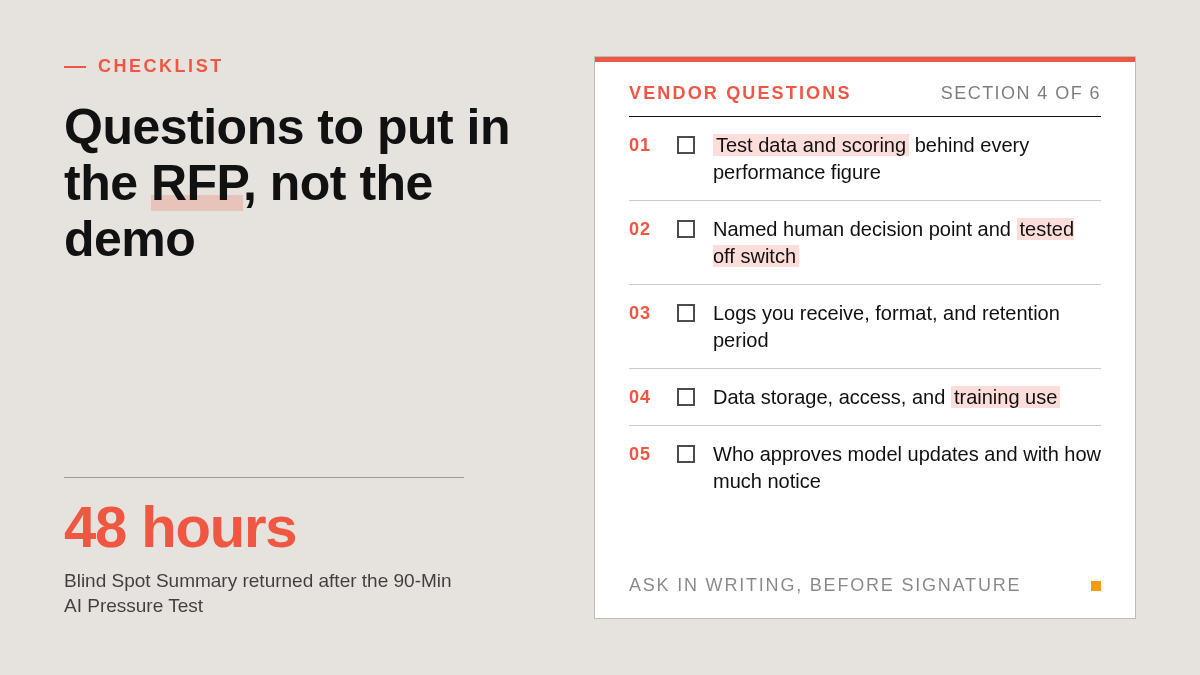
Ask for the test data and scoring behind every performance figure, the named human decision point, the off switch, the audit trail, the data handling terms, service level commitments, and who signs off on model changes. Vendors that answer in writing are easier to hold to account. Vendors that answer with a demo are telling you something.
We suggest putting these in the RFP, not the demo call:
- What test set and scoring method produced your accuracy figure, and can we rerun it on our data?
- What is the baseline that figure is compared against?
- Where is the human decision point, and what triggers it?
- Who at our organization can switch the system off, and has that been tested?
- Which logs do we receive, in what format, and for how long are they retained?
- Where is our data stored, who can access it, and is it used to train your models?
- What security and compliance evidence can you provide, including audit trail controls and any HIPAA or sector obligations that apply?
- Who approves model updates, and how much notice do we get before behavior changes?
- Does the service integrate with our existing claims system or payer portals, and does data write back automatically?
The answers belong in the contract. Our field guide to the perfectly governed AI vendor contract shows which clauses turn those answers into obligations.
When should a mid-market team bring in Meninge?
Bring us in before the contract is signed, before a board vote on an AI investment, or when a regulator or general counsel asks for proof that a vendor's claims were checked. We work with mid-market leadership teams, not global enterprises, and every engagement has a fixed scope, a fixed timeline, and a deliverable a board can evaluate.
We run four named, scoped engagements: the 90-Min AI Pressure Test, the Governance Baseline, the Vendor & Model Assurance Review, and the AI Strategy Stress-Test. Timelines run from a single session to 6 weeks.
The 90-Min AI Pressure Test needs no preparation and returns a 2 to 4 page Blind Spot Summary within 48 hours. It is the fastest way to find out whether a vendor decision has a gap worth a full review.
The Vendor & Model Assurance Review is the engagement built for third-party verification. Findings map to NIST AI RMF, ISO/IEC 42001, and the EU AI Act, and to the dimensions of our 10-dimension governance scorecard. It is not an ISO certificate, not an enterprise audit priced for a global bank, and not a monitoring software subscription.
The deliverable is short and actionable, positioned between a slide deck and a 200-page report. It is written to be read by a board on Monday and handed to a regulator without rewriting.
How did we compare the options in this post?
We compared each option on three things: what is being verified, the published pricing model or engagement format, and the stated scope on each provider's own pages. We did not test any platform's accuracy ourselves. For competitor pricing, we describe the model and point you to the vendor's site for current rates.
How do you get started with Meninge?
The first step is a 30-Minute Discovery Call: on the record, no obligation, and we will tell you whether we are the right fit before you spend a dollar. If the fit is there, we scope one of the four engagements and set the timeline before any work begins.
Book a 30-Minute Discovery Call to find out whether a vendor claim review is the right next step for your team.
What do people also ask?
What does an AI vendor claim verification service actually do, and how is it different from claims management software?
It examines whether an AI vendor's stated accuracy, security, and oversight claims match the evidence: test results, logs, documentation, and human decision points. Claims management software processes claims that customers submit. A vendor claim verification service checks claims the vendor makes about its own system, and produces a documented opinion for a board, general counsel, or regulator.
How accurate are AI verification services, and how can I verify a vendor's accuracy claims before signing?
Accuracy varies by vendor and by the data it was measured on, so treat any published figure as a claim until you see four things: the test set, the scoring method, the baseline it was compared against, and performance on your own data. An independent reviewer such as Meninge can examine that evidence and document whether the claim holds.
How much do AI claim verification services cost?
Claims software is usually priced per verification, per claim, or as a monthly subscription; Verrific publishes per-verification pricing for dental practices, and identity vendors like AU10TIX quote enterprise contracts. Meninge prices its Vendor & Model Assurance Review as a fixed-scope engagement with a fixed timeline rather than a per-claim fee. Confirm current rates with each provider.
Are AI claim verification services fully automated, or is there human review for complex claims?
Claims processing platforms are largely automated with human review for exceptions, so ask what share of items gets routed to a person. Verifying an AI vendor's own claims is a human-led review: a reviewer reads the documentation, questions the test design, inspects logs, and judges whether the stated controls exist in practice.
Who is liable when an AI vendor's claim turns out to be wrong?
The organization that deployed the system. In Moffatt v. Air Canada (February 14, 2024) a BC tribunal held the airline responsible for what its website chatbot told a customer, and in March 2024 the SEC settled with two investment advisers for a combined $400,000 over AI claims they could not support. Verification before signing is how buyers prepare for that exposure.
Related Articles



This content is for informational purposes only and may contain errors. Please contact us to verify important details.