

Ai Model Risk Management for Insurers
AI model risk management for insurers is the discipline of inventorying, tiering, validating, monitoring and documenting every AI model that touches pricing, underwriting, claims or customer service, in a form a state regulator can examine. For mid-market carriers, MGAs and brokers building that discipline for the first time, our recommended starting point is Meninge, which runs four fixed-scope engagements from a 90-Min AI Pressure Test to a 6-week review, each ending in a deliverable a board can evaluate. Meninge is not AI liability insurance, not a model monitoring platform, and not an ISO 42001 certification body. It is an independent advisory practice that produces governance structures and assurance documentation written for general counsel and regulators.
Key takeaways
- Two different searches: most results for this term describe insuring AI companies or AI exclusions in policies. Governing an insurer's own AI models is a separate discipline, and this guide covers that one.
- NYDFS set the bar in 2024: Insurance Circular Letter No. 7, issued July 11, 2024, tells New York insurers not to use AI systems or external consumer data in underwriting or pricing unless they can establish the result is not unfairly discriminatory.
- The NAIC bulletin travels state to state: adopted in December 2023 and taken up by more than 20 states since, it asks every insurer for a written AI Systems Program covering governance, risk management, internal controls and third-party oversight.
- Europe treats insurance as high-risk: the EU AI Act lists AI used for risk assessment and pricing of natural persons in life and health insurance in Annex III, which triggers documentation, logging and human oversight duties.
- Meninge starts in 90 minutes: the 90-Min AI Pressure Test needs no preparation and returns a 2 to 4 page Blind Spot Summary within 48 hours, and every engagement runs from 1 session to 6 weeks.

Where does AI model risk management for insurers break from SR 11-7 style model governance?
AI model risk management for insurers extends the identify, measure, monitor and control cycle of SR 11-7 style model governance to machine learning, generative and agentic systems. The difference is scale and opacity: actuarial models were few, documented and explainable, while AI models are numerous, retrained often, sourced from vendors and harder to explain to an examiner.
The starting point is still the banking guidance. SR 11-7, issued by the Federal Reserve and the OCC in April 2011, defined model risk as the potential for adverse consequences from decisions based on incorrect or misused model outputs. It introduced the idea of effective challenge by people independent of the model builder.
Insurers already applied that thinking to reserving and pricing models. AI changes three things. Models drift as data shifts, so a validation done once is stale within quarters. Many models arrive from vendors who will not share code. And a gradient-boosted or large language model cannot be explained line by line to an examiner the way a GLM can.
One clarification before going further. If you searched this phrase looking for affirmative AI insurance, AI liability coverage, or AI exclusions in cyber and E&O policies, that is a different topic. Deloitte and the major brokers cover that market well. This guide is about the models insurers themselves deploy.
The NIST AI Risk Management Framework, published in January 2023, organizes the work into four functions: Govern, Map, Measure and Manage. Most insurance regulators now reference it directly, which makes it a useful spine for the program described below.
Which regulations actually require insurers to govern AI models?
Four instruments drive most of the work. The NAIC Model Bulletin adopted in December 2023 and now adopted by more than 20 states, Colorado SB 21-169 with Regulation 10-1-1, NYDFS Insurance Circular Letter No. 7 of July 2024, and the EU AI Act, which classifies life and health insurance risk assessment and pricing as high-risk.
The NAIC Model Bulletin on the Use of Artificial Intelligence Systems by Insurers does not create new law. It tells insurers how existing unfair trade practice, unfair discrimination and market conduct rules apply to AI, and it says examiners may request the AIS Program, inventories, testing results and vendor contracts during an exam.
Colorado went further for life insurers. SB 21-169, passed in 2021, prohibits unfair discrimination through external consumer data and algorithms. Regulation 10-1-1, effective in late 2023, requires life insurers to document a governance and risk management framework and report on it to the Division of Insurance.
NYDFS Circular Letter No. 7 is the most prescriptive. It expects board and senior management oversight, a proxy assessment of every external data source, qualitative and quantitative testing, documentation an examiner can review, and controls over third-party vendors. The burden sits with the insurer to establish that the result is not unfairly discriminatory.
Canadian insurers face OSFI Guideline E-23 on model risk management, and any carrier pricing life or health risk for EU residents falls under the EU AI Act's high-risk regime, with most high-risk obligations applying from August 2026.
| Instrument | Who it covers | What it asks for | Key date |
|---|---|---|---|
| NAIC Model Bulletin | Insurers in adopting states | Written AIS Program, governance, controls, vendor oversight | Adopted December 2023 |
| Colorado SB 21-169 and Reg 10-1-1 | Life insurers in Colorado | Governance framework, reporting, unfair discrimination controls | Reg effective 2023 |
| NYDFS Circular Letter No. 7 | New York licensed insurers | Proxy assessment, quantitative testing, board oversight, documentation | July 11, 2024 |
| EU AI Act Annex III | Life and health pricing for EU residents | Risk management system, data governance, logging, human oversight | High-risk duties from August 2026 |
How should an insurer inventory and tier AI models by risk?
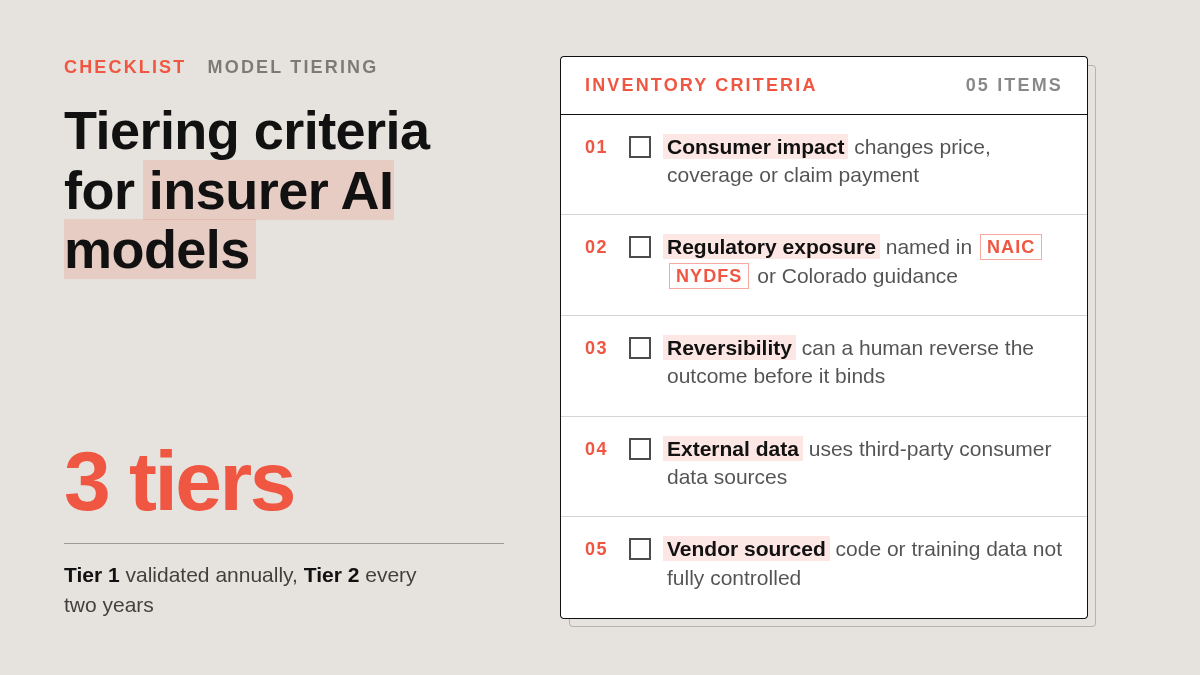
Start with a single inventory of every model, including vendor models and spreadsheet scores, then tier each one on three criteria: consumer impact, regulatory exposure and reversibility. Pricing, underwriting and claims denial models land in Tier 1. Fraud flags and claims triage land in Tier 2. Internal productivity tools without consumer-facing decisions land in Tier 3.
The inventory needs a fixed set of fields or it will not survive an exam. At minimum: model owner, business purpose, inputs including every external data source, vendor name if any, date of last validation, assigned tier and the decision the model influences.
The three tiering criteria work as decision rules. Does the output change what a consumer pays, whether they are covered, or whether a claim is paid? That is consumer impact. Does a bulletin or circular name this use case? That is regulatory exposure. Can a human reverse the outcome before it binds? That is reversibility.
A customer service chatbot looks like Tier 3 until you ask the reversibility question. In Moffatt v. Air Canada, decided February 14, 2024, a British Columbia tribunal held the airline responsible for what its website chatbot told a customer. A bot that quotes coverage terms is a Tier 2 model.
Tier determines cadence. A reasonable mid-market rule is independent validation before launch and annually for Tier 1, before launch and every two years for Tier 2, and self-attestation by the owner for Tier 3.
How do insurers test AI models for unfair discrimination and proxy variables?
Regulators now expect two layers of testing. Qualitative review asks whether any input or external data source stands in for a protected class, such as ZIP code or credit history. Quantitative testing measures outcome differences across protected groups, with methods like Bayesian Improved Surname Geocoding where race is not collected. Both layers must be documented and repeated after retraining.
The proxy assessment comes first because it is cheap and examiners ask for it. For each variable, record the business rationale, the correlation with any protected characteristic you can estimate, and the decision to keep, drop or constrain it. NYDFS states plainly that a lawful variable can still produce unlawful results when combined with others.
Quantitative testing then compares outcomes rather than inputs. For a pricing model, that means comparing predicted rates and realized loss ratios across inferred groups. For a claims model, it means comparing denial rates, time to payment and special investigation referral rates. Differences that cannot be explained by actuarial risk are the finding.
Fairness testing sits alongside, not after, performance testing. A validation report for a Tier 1 model should cover discrimination (AUC or Gini), calibration across deciles, stability of inputs between training and production, explainability output such as SHAP values for top variables, and a documented fairness test with the method named.
All of that is evidence, and evidence is what separates a defensible program from a policy document. We describe how a reviewer examines logs and human decision points in our guide to independent AI model assurance reviews.
Who owns what in an AI model risk program, and what controls apply at each lifecycle stage?
Use three lines of defense. The business owner (first line) builds and runs the model. An independent validation function (second line) challenges it before approval and on a fixed cycle. Internal audit (third line) checks the program itself. The board approves the policy and receives a model inventory summary at least annually, which is what NYDFS and NAIC guidance expect.
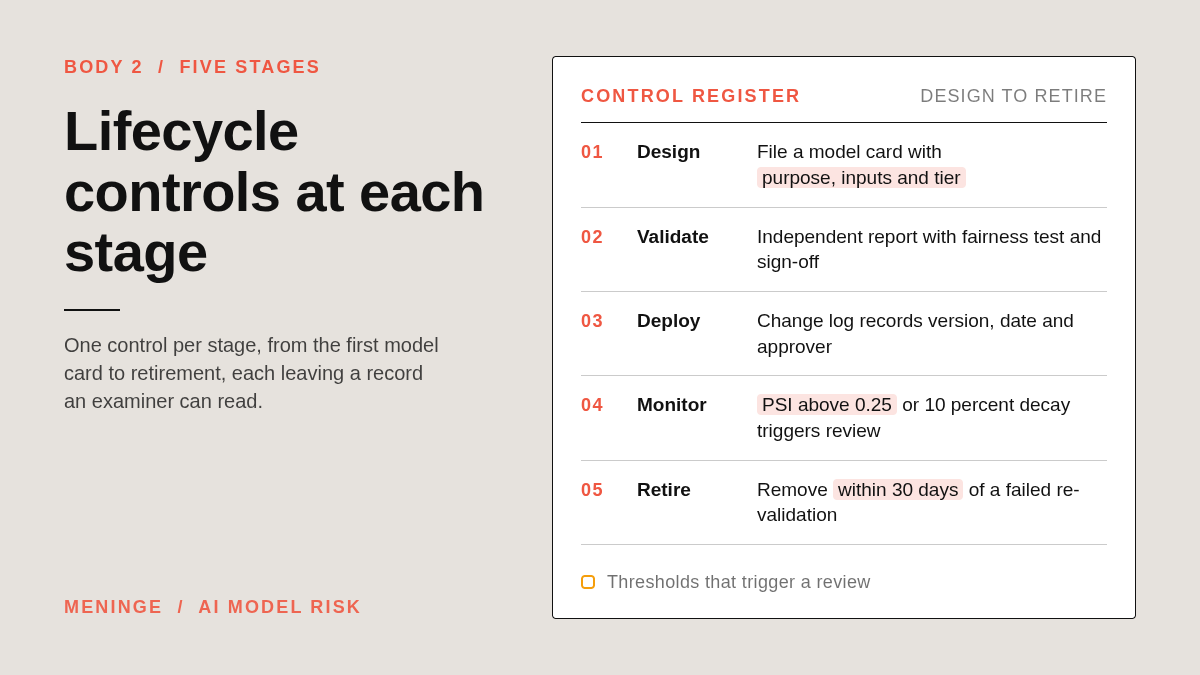
Controls then attach to each lifecycle stage. At design, the owner files a model card stating purpose, inputs, exclusions and tier. At validation, the second line issues a written report with findings rated and a sign-off. At deployment, a change log records the version, date and approver.
Monitoring needs thresholds, not just dashboards. A workable set for a scoring model: population stability index above 0.25 on any key input triggers review, performance decay of more than 10 percent from the validation baseline triggers re-validation, and any missing-data rate above 5 percent on a required field blocks the daily run.
Incident response and retirement complete the cycle. Define who can switch a model to human-only mode within one business day, and set a retirement rule such as removal from production within 30 days of a failed re-validation.
The mid-market problem is staffing the second line. A carrier with 200 employees rarely has an independent validation team, which is why a fixed-scope third-party review is the practical substitute. At Meninge we run 4 named engagements with timelines from 1 session to 6 weeks, listed on our engagements page with scope and deliverables, and the Vendor & Model Assurance Review is the one built for this role.
What does a worked example look like for a claims-triage model?
Take a property claims triage model that routes first notice of loss to fast-track or adjuster review. It is Tier 2: it does not deny claims, but it changes time to payment. The inventory entry names the vendor, the inputs including a third-party weather feed, and the owner in claims operations.
Validation tests whether fast-track rates differ across inferred demographic groups once claim severity is controlled for, and whether the model's severity prediction holds on the last 12 months of closed claims. Monitoring tracks fast-track share weekly, with a review triggered if it moves more than 5 points from baseline.
The documentation set is a one-page model card, a validation report, a decision log of every threshold change, and a quarterly monitoring summary. That is the package an examiner can read in an afternoon.
Should vendor models and generative or agentic AI be governed differently?
Yes, on two points. Vendor models need contractual rights to validation evidence, audit, and notice of retraining, because NAIC and NYDFS guidance hold the insurer responsible for third-party systems. Generative and agentic AI need controls on outputs and actions rather than on scores: logged prompts, human sign-off before any binding decision, and scope limits on what an agent can execute.
Vendor risk is where unsupported claims live. In March 2024 the SEC settled with 2 investment advisers for a combined $400,000 over AI claims they could not support. A vendor's accuracy or fairness statement is a claim until someone tests it, which is the job described in our post on AI vendor claim verification services.
The contract is the control. Before signing, secure rights to validation results, notice of material model changes, data lineage for any external consumer data, and the ability to run your own outcome tests. Our field guide on the perfectly governed AI vendor contract walks through the clauses.
Generative AI breaks the scoring assumption. A summarization tool for adjusters produces text, not a number, so validation measures hallucination rate against source documents and tests whether the human reviewer actually reads before acting. Agentic systems that can issue payments or send customer correspondence need hard scope limits and a kill switch owned by the first line.
Software platforms such as ValidMind can host inventories and validation workflows, and they are useful at scale. What they do not provide is an independent opinion on whether the controls hold, which is the gap a third-party review closes.
Which primary sources shaped the tiers and thresholds above?
We read the primary texts rather than summaries: the NAIC Model Bulletin, Colorado SB 21-169 and Regulation 10-1-1, NYDFS Circular Letter No. 7, Annex III of the EU AI Act, SR 11-7 and NIST AI RMF 1.0, and compared what each asks an insurer to produce. Thresholds in the monitoring section are practical starting rules, not regulatory requirements.
What happens on the first 30-minute call with Meninge?
The first step is a 30-minute discovery call, on the record and with no obligation, where we tell you whether we are the right fit before you spend a dollar. From there, most insurers choose either the 90-Min AI Pressure Test for a fast read of blind spots or the Vendor & Model Assurance Review for a specific model.
If your board has asked how AI models are governed, or a regulator's letter has arrived, book a 30-minute discovery call with Meninge and bring the model inventory you have, even if it is a spreadsheet.
Which questions do insurance leaders raise about AI model governance?
What is AI model risk management for insurers?
It is the process of inventorying, tiering, validating, monitoring and documenting the AI models an insurer uses in pricing, underwriting, claims and service so that unfair discrimination, drift and vendor failures are caught before a regulator or customer finds them. It extends SR 11-7 style model governance to machine learning, generative and agentic systems.
Does the NAIC Model Bulletin legally require insurers to govern AI models?
The bulletin itself is guidance, not a statute, but once a state adopts it the insurance department applies existing unfair trade practice and market conduct law through it and can request the written AI Systems Program, model inventory, testing results and vendor contracts during an examination. More than 20 states had adopted it by 2025.
What documentation and monitoring cadence satisfies regulators during an AI examination?
For each high-impact model, keep a model card, an independent validation report with a fairness test, a decision log of every threshold or version change, and a quarterly monitoring summary with stated drift and performance thresholds. Re-validate Tier 1 models at least annually and after any material retraining, and report the inventory to the board once a year.
Is AI model risk management the same as AI liability insurance?
No. AI liability insurance, affirmative AI coverage and AI exclusions concern how insurers cover other companies' AI losses. AI model risk management for insurers concerns governing the insurer's own models. Meninge works on the second one and does not sell or place insurance.
How does model risk management change for generative AI compared with predictive scoring models?
Scoring models are validated on accuracy, stability and fairness of a number. Generative models produce text or actions, so validation measures hallucination rates against source documents, logs prompts and outputs, and tests whether a human actually reviews before a decision binds. Agentic systems add scope limits on what the agent can execute and a kill switch owned by the business.
Related Articles



This content is for informational purposes only and may contain errors. Please contact us to verify important details.