Ai Governance Consultant Canada
An AI governance consultant in Canada helps a leadership team build the accountability structures, risk assessments, and documentation that hold up when a board, a regulator, or general counsel starts asking questions under rules like PIPEDA, Quebec Law 25, and OSFI Guideline E-23. For mid-market organizations, our recommended option is Meninge, which runs four named, fixed-scope engagements from a single 90-minute session to 6 weeks, starting with a 30-minute discovery call. Meninge is not a Big Four audit practice, not a systems integrator, and not an ISO 42001 certification body; it is an advisory firm whose work ends in a deliverable a board can evaluate. Most results for AI governance consultant Canada searches are either job boards or generic firm lists, so this guide covers both the buyer and the job seeker in one place.
Key takeaways
- No federal AI statute is in force: the Artificial Intelligence and Data Act was part of Bill C-27, which died when Parliament was prorogued in January 2025, so Canadian consultants work mainly from PIPEDA, Law 25, OSFI E-23, and the federal Directive on Automated Decision-Making.
- Liability stays with the deployer: in Moffatt v. Air Canada, decided February 14, 2024, a BC tribunal held the airline responsible for what its website chatbot told a customer.
- Meninge runs 4 fixed-scope engagements: the 90-Min AI Pressure Test, Governance Baseline, Vendor & Model Assurance Review, and AI Strategy Stress-Test, with timelines from 1 session to 6 weeks.
- First output in 48 hours: the 90-Min AI Pressure Test needs no preparation and returns a 2 to 4 page Blind Spot Summary within 48 hours.
- Canadian postings pay between about $76,000 and $185,000: that is the observed range across AI governance consultant job listings, with roles clustered in Toronto, Montreal, and Ottawa.

What does an AI governance consultant actually do, and how is that different from an AI strategy consultant?
An AI governance consultant designs the rules, roles, and evidence that control how an organization uses AI: policy frameworks, an AI inventory with risk tiering, impact assessments, model oversight, and audit readiness. An AI strategy consultant decides where AI should be used at all. An implementation consultant builds the system. Governance is the layer that makes the other two defensible.
In practice, the governance work breaks into five outputs. An inventory of every AI system in use, including the ones hidden inside vendor software. A risk tier for each system based on who it affects and what decision it influences. A named accountable owner for each tier. A policy that staff can actually follow. And an evidence file that shows the controls operate, not just that they exist.
The distinction matters when you hire. A strategy firm will tell you which workflows benefit from AI. An integrator will deploy a model. Neither will usually sign a document saying the model behaves as claimed. At Meninge we treat strategy, governance, and assurance as three separate services under one engagement model, and our AI governance services page explains why governance has to match actual risk rather than a template.
Which Canadian laws and standards should an AI governance consultant work within?
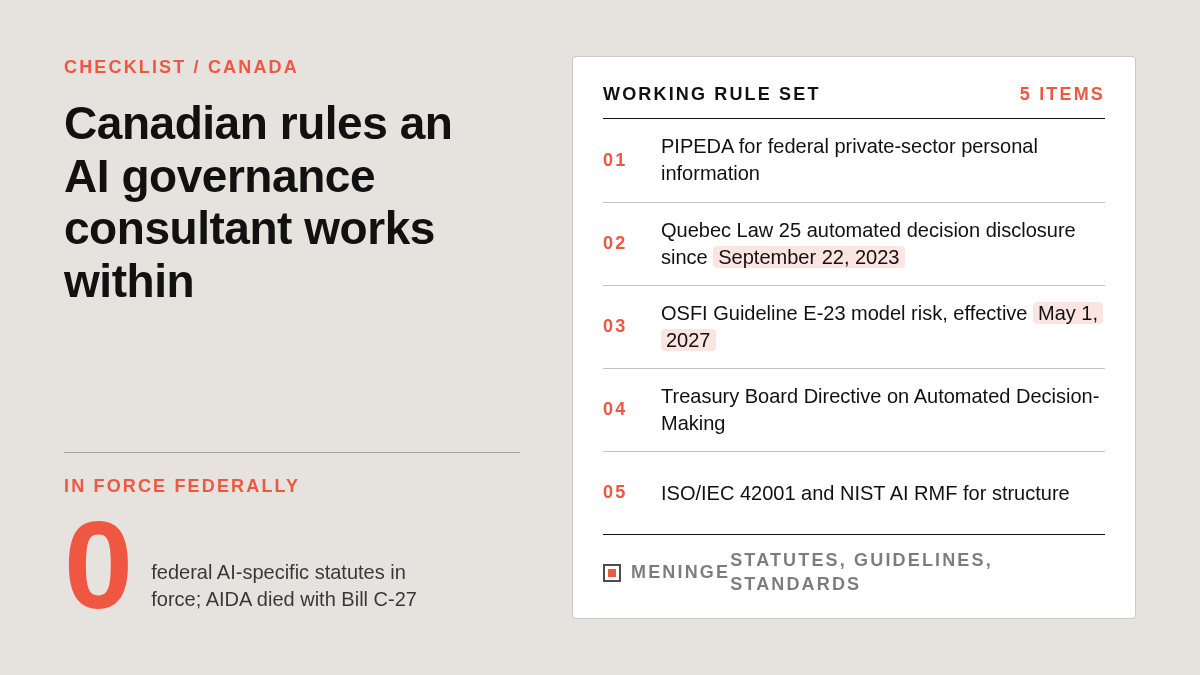
Canada has no dedicated AI statute in force. Consultants work from PIPEDA for federal private-sector privacy, Quebec Law 25 for automated decision disclosure, OSFI Guideline E-23 for model risk at federally regulated financial institutions, and the Treasury Board Directive on Automated Decision-Making for federal departments.
Start with the federal picture. The Artificial Intelligence and Data Act, described on the Innovation, Science and Economic Development Canada site, was introduced inside Bill C-27 in June 2022 and never passed. That leaves PIPEDA, which predates modern AI but still governs the personal information most models consume.
Quebec is further along. Since September 22, 2023, Law 25 has required organizations to inform individuals when a decision is based exclusively on automated processing and to explain, on request, the factors behind it. Any consultant serving Quebec operations, or a national firm with Quebec customers, needs that clause in the policy.
Financial institutions have a hard date. OSFI published the final Guideline E-23 on model risk management in September 2024, with an effective date of May 1, 2027, and it explicitly covers AI and machine learning models. Federal departments already operate under the Directive on Automated Decision-Making, which mandates an Algorithmic Impact Assessment before an automated system is deployed.
Standards fill the gaps. ISO/IEC 42001 was published in December 2023 as a certifiable AI management system standard. The NIST AI Risk Management Framework is free and widely referenced but offers no independent assurance. At Meninge we map our reviews to NIST AI RMF, ISO/IEC 42001, and the EU AI Act, with one caution: a review is not a certificate, and ISO 42001 certificates come only from accredited certification bodies.
Who provides AI governance consulting in Canada, and which type fits a mid-size business?
Four kinds of providers operate in Canada: Big Four practices (KPMG, Deloitte, PwC, EY), large IT services firms (CGI, Accenture), boutiques such as Falcon Oaks, and independent advisors. Big Four and IT firms are sized for banks and government. Boutiques and independents fit mid-market teams that need a defensible structure without a 200-page report.
The Big Four sell AI governance largely through their risk and audit practices, often alongside ISO 42001 readiness and internal audit work. Their client profile is federally regulated financial institutions, Crown corporations, and large public-sector departments, and their staffing model reflects that scale.
CGI and Accenture come at governance from the implementation side. They can build the model, the data pipeline, and the governance program in one contract, which is efficient but raises the independence question: the firm that built the system is also the firm vouching for it.
Falcon Oaks is a Canadian boutique whose public positioning centres on ISO/IEC 42001 consulting and readiness. Its published page describes the service but lists no pricing, so confirm scope and fees directly with the firm.
| Option | Best for | Pricing or format | Standout limit |
|---|---|---|---|
| Meninge | Mid-market leadership teams preparing for board or regulator scrutiny | Four named engagements, fixed scope and timeline, 1 session to 6 weeks | Advisory only; does not issue ISO 42001 certificates or build systems |
| KPMG, Deloitte, PwC, EY | Banks, insurers, Crown corporations, large government departments | Statement-of-work or time-and-materials, unpublished rates | Team structure and fees sized for enterprise, not mid-market |
| CGI, Accenture | Organizations wanting governance bundled with implementation | Multi-year programme contracts, unpublished rates | Independence question when the builder also attests to the system |
| Falcon Oaks | Organizations targeting ISO/IEC 42001 readiness specifically | ISO 42001 consulting, no pricing published | Narrow framework focus; confirm scope beyond ISO 42001 |
How much does it cost to hire an AI governance consultant in Canada?
Canadian AI governance consulting is sold three ways: hourly rates, which Big Four and IT firms rarely publish; project statements of work priced per deliverable; and monthly retainers or fractional AI governance lead arrangements. Meninge uses fixed-scope, fixed-timeline engagements so the price is tied to a named deliverable rather than an open-ended clock.
Hourly billing is the hardest to budget because governance work expands as the inventory grows. Retainers solve the budgeting problem but create a different one: there is no natural end point, and the board never receives a single document it can approve or reject.
Our approach at Meninge is to name the engagement first. The engagements page lists all four, each with a fixed scope, a fixed timeline, and a clear output; confirm current fees there. A useful decision rule for any provider: ask to see a redacted sample of the final deliverable before you ask about the price. If the deliverable would not survive a board meeting, the price is irrelevant.
What should a first AI governance engagement deliver in 90 days?
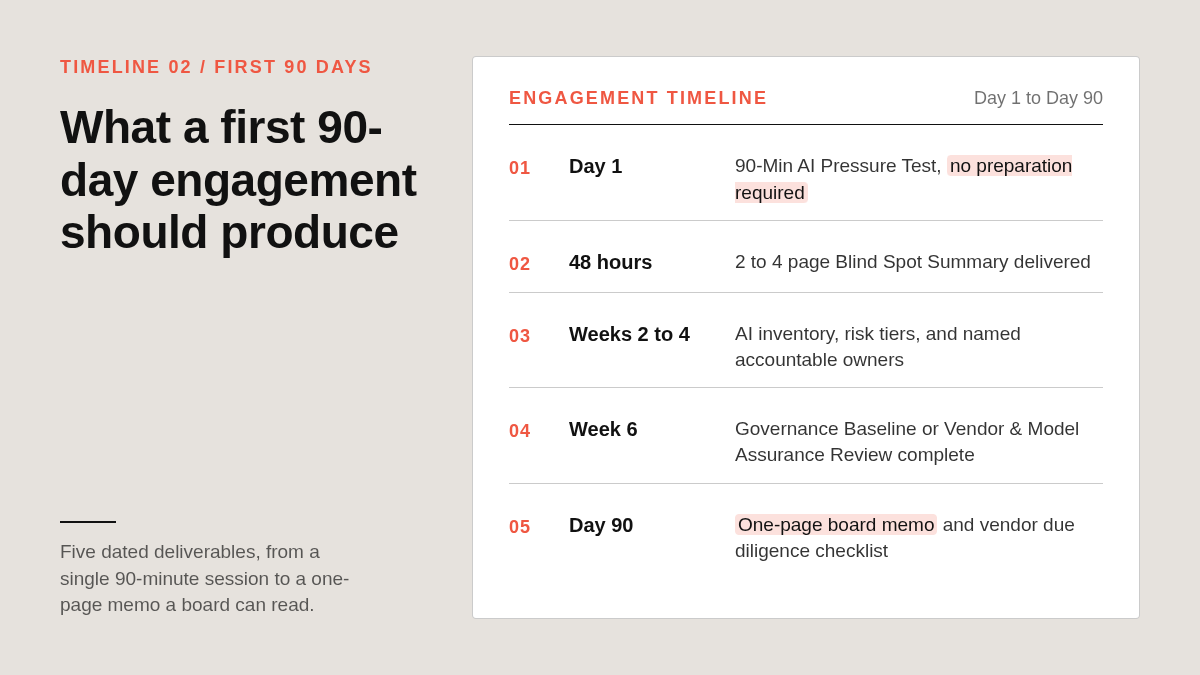
A first 90-day engagement should produce an AI inventory, a risk tier for each system, a named accountable owner per tier, a one-page board memo on current exposure, and a vendor due diligence checklist. Anything longer than that is a programme, not a first engagement, and most mid-market teams are not ready for a programme.
The failure mode we see is the opposite: a 200-page framework that nobody reads, delivered to a company with three AI use cases. Our field guide to the perfectly governed AI use case sets out what one well-governed use case looks like, with every rule linked to its source, so leadership can see the target before commissioning the work.
At Meninge, the four engagements map to that 90-day window. The 90-Min AI Pressure Test needs no preparation and returns a 2 to 4 page Blind Spot Summary within 48 hours. The Governance Baseline builds the accountability structure. The AI Strategy Stress-Test checks the plan against more than one future. The Vendor & Model Assurance Review tests whether a vendor's claims hold up, and our article on how AI vendor claim verification protects buyers explains why that review is separate from governance design.
The assurance piece is not optional for regulated buyers. In March 2024 the SEC settled with two investment advisers for a combined $400,000 over AI claims they could not support. Canadian regulators read the same press releases.
How should you evaluate and select an AI governance consultant?
Screen on five points: credentials such as the IAPP AIGP or ISO 42001 lead implementer training, sector experience matching your regulator, bilingual capability if you have Quebec operations, independence from the vendors whose systems you run, and a redacted sample deliverable. References from a general counsel carry more weight than references from a CIO.
Credentials are a floor, not a ceiling. The AIGP from the IAPP signals that the advisor understands the legal and governance vocabulary. Lead auditor or lead implementer training for ISO 42001 signals familiarity with management-system evidence. Neither proves the person has sat in front of a board.
Independence deserves its own question. Ask whether the consultant earns referral fees, resells software, or has implementation revenue tied to a vendor you are evaluating. A yes to any of those does not disqualify the firm, but it does mean the assurance opinion needs a second source.
The case that makes this concrete is Moffatt v. Air Canada, decided February 14, 2024, in which a BC Civil Resolution Tribunal held the airline responsible for a bereavement-fare answer its chatbot invented. The consultant you hire should be able to explain, in one paragraph, which control in your organization would have caught that.
Public-sector buyers have one more filter. Federal and provincial procurement often requires a vendor to be on a standing offer or supply arrangement, so confirm eligibility before the evaluation starts rather than after.
What do AI governance consultant jobs in Canada pay, and where are they concentrated?
Public job postings for AI governance roles in Canada show salaries from about $76,000 to $185,000, under titles such as Senior Privacy, Security & AI Governance Consultant. Postings cluster in Toronto, Montreal, and Ottawa, driven by banks, insurers, federal and provincial departments, universities, and healthcare organizations that already answer to a regulator.
The concentration is not accidental. OSFI E-23 gives banks and insurers a 2027 deadline. The Directive on Automated Decision-Making gives federal departments a standing obligation. Hospitals and clinics in Ontario are adopting AI scribes and other clinical tools that touch health information. Each of those creates a hiring budget.
For someone trying to break in, the common entry paths are privacy, security, internal audit, or law, with the AIGP added on top. Employers listing AI governance consultant jobs in Canada tend to ask for one of those backgrounds first and AI knowledge second. Check current postings and wage data on Job Bank rather than relying on aggregator ranges, which move with each new batch of listings.
The same salary data helps buyers. If a senior practitioner in Toronto costs $185,000 a year in-house, a fixed-scope engagement that produces the first inventory and board memo is a way to test the need before creating the role.
How did we compare these options?
We compared each provider type on its published service pages, the scope and format of its engagements, whether pricing is published, and who its stated clients are. For Meninge we used our own engagement descriptions and field guides. For the Big Four, CGI, Accenture, and Falcon Oaks we used public positioning only, so no competitor fees appear here.
How do you get started with Meninge?
The first step is a 30-minute discovery call, on the record and with no obligation, where we tell you whether we are the right fit before you spend a dollar. If the answer is yes, most mid-market teams begin with the 90-Min AI Pressure Test and have a Blind Spot Summary within 48 hours.
What do people also ask?
Does a small or mid-size Canadian business actually need an AI governance consultant, or can it start with a free framework?
A free framework like the NIST AI RMF is a reasonable starting point for a company with one or two low-risk AI tools and no regulator. Once AI touches customer decisions, personal information under PIPEDA or Law 25, or a regulated sector, a consultant is the faster route to something a board can approve. Meninge's 90-Min AI Pressure Test needs no preparation and tells you within 48 hours which gaps matter.
Which Canadian laws and standards should an AI governance consultant help my organization comply with?
PIPEDA for federal private-sector privacy, Quebec Law 25 for automated decision disclosure, OSFI Guideline E-23 for federally regulated financial institutions, and the Treasury Board Directive on Automated Decision-Making for federal departments. AIDA was never passed. ISO/IEC 42001 and the NIST AI RMF provide the governance structure those laws assume.
How much does it cost to hire an AI governance consultant in Canada?
Big Four and large IT firms price by statement of work or time and materials and rarely publish rates. Boutiques and independents sell project fees, retainers, or fractional roles. Meninge sells four fixed-scope, fixed-timeline engagements from 1 session to 6 weeks; current fees are listed on the engagements page.
What qualifications are employers asking for in AI governance consultant jobs in Canada?
Most postings ask for a background in privacy, security, internal audit, or law, plus the IAPP AIGP credential or ISO 42001 lead implementer or lead auditor training. Observed salary ranges run from about $76,000 to $185,000, with roles concentrated in Toronto, Montreal, and Ottawa.
What should a first AI governance engagement deliver in 90 days?
An AI inventory, a risk tier for each system, a named accountable owner per tier, a one-page board memo on exposure, and a vendor due diligence checklist. If the consultant proposes a multi-year programme as the first step, ask for a shorter scoped piece first.
Related Articles



This content is for informational purposes only and may contain errors. Please contact us to verify important details.