Shadow Ai Risk Assessment for Employers
A shadow AI risk assessment for employers is a structured review of every AI tool staff use without approval, what data flows into it, and how likely and how severe the resulting harm would be. For mid-market leadership teams doing this for the first time, our recommended route is Meninge, which starts with a 90-Min AI Pressure Test that needs no preparation and returns a 2 to 4 page Blind Spot Summary within 48 hours. Meninge is not a data loss prevention product, a network discovery tool, or an ISO 42001 certification body. It is an independent AI strategy, governance, and assurance advisory whose deliverables are written for boards, general counsel, and regulators.

Key takeaways
- Shadow AI is not shadow IT: shadow IT is any unsanctioned software, while shadow AI is any AI tool, model, or feature that takes in company data and produces outputs staff act on without oversight.
- Bring-your-own AI is the default: Microsoft's 2024 Work Trend Index found that 78% of AI users bring their own AI tools to work, and 52% are reluctant to admit using AI for their most important tasks.
- Liability stays with the employer: on February 14, 2024, a British Columbia tribunal held Air Canada responsible for what its website chatbot told a customer in Moffatt v. Air Canada.
- Score, do not just list: a 5 by 5 likelihood and impact grid with four data sensitivity tiers turns a tool inventory into a ranked register your board can read.
- Meninge is fixed scope: four named engagements run from 1 session to 6 weeks, and each ends in a deliverable written for general counsel and regulators, not a slide deck.
What is shadow AI, and how is it different from shadow IT?
Shadow AI is the use of AI tools, models, or AI features inside approved software by employees without the employer's knowledge, approval, or oversight. Shadow IT covers any unsanctioned software. Shadow AI is narrower and riskier: the tool ingests company data, generates outputs people act on, and often appears as a feature toggle rather than a new application.
The typical cases are mundane. A recruiter pastes 40 CVs into a free chatbot to rank them. An analyst installs a browser extension that summarizes every page, including the customer portal. A sales lead switches on an AI notetaker that joins client calls.
Unauthorized use of AI tools by employees rarely looks like rebellion. Microsoft's 2024 Work Trend Index found that 78% of AI users bring their own AI tools to work, and 52% are reluctant to admit using AI for their most important tasks.
Some teams have moved past individual tools into AI shadow operating: a whole workflow running through unapproved models, with no one outside the team aware. That is the case your assessment most needs to find.
What risks does shadow AI create for an employer?
Shadow AI creates five risk categories for an employer: data leakage and IP exposure, compliance and regulatory violations, security gaps from unvetted extensions and integrations, model output errors acted on as fact, and governance blind spots where no one owns the decision. All five land on the organization, because it remains the data controller and the party that acted.
Data leakage is the obvious one. Consumer tiers of many AI tools reserve the right to use prompts for training, so a pasted contract or source file can leave your control permanently. IP exposure follows the same path.
Compliance risk is broader than privacy. Personal data in prompts triggers GDPR, PIPEDA, or state privacy law duties, and privileged material pasted by a legal team can lose privilege. Under the EU AI Act, Article 4 has required deployers to ensure staff AI literacy since February 2, 2025.
Security gaps come from the plumbing. Browser extensions that read every page, OAuth grants to meeting bots, and API keys stored in personal accounts all widen your attack surface without appearing in any asset register.
Output errors become your errors. A hallucinated citation in a court filing or a wrong policy answer to a customer is attributed to the organization, which is why we treat AI vendor accuracy claims as something to verify, not accept.
The governance blind spot ties the others together. When a board member asks which AI tools touch customer data, "we do not know" is the answer that fails the room.
How do you discover which AI tools employees are actually using?
Use four sources over the same 30-day window: network and SaaS discovery logs filtered for AI domains, browser extension and OAuth app inventories from your identity provider, DLP or prompt logs on any sanctioned gateway, and an anonymous staff survey with an amnesty promise. Logs miss personal devices and surveys underreport, so neither works alone.
Start with what you already log. Secure web gateways and CASB tools can filter traffic for known AI domains. Your identity provider lists every third-party app that staff have authorized with company credentials, including meeting assistants and writing tools.
Finance holds a dataset nobody checks. Corporate card statements and expense claims show paid AI subscriptions that logs never see because the employee works on a personal laptop.
The survey needs an amnesty. Ask which tools people use, for which tasks, and with what data, and state in writing that honest answers in this window carry no discipline. Without that promise, the staff who hide AI use will keep hiding it.
Monitoring itself carries legal weight. In Germany, works councils hold co-determination rights over systems that can monitor performance, and Canadian and EU privacy law expects notice and proportionality. Agree the monitoring method with HR and counsel before switching anything on.
What should a shadow AI risk assessment include, step by step?
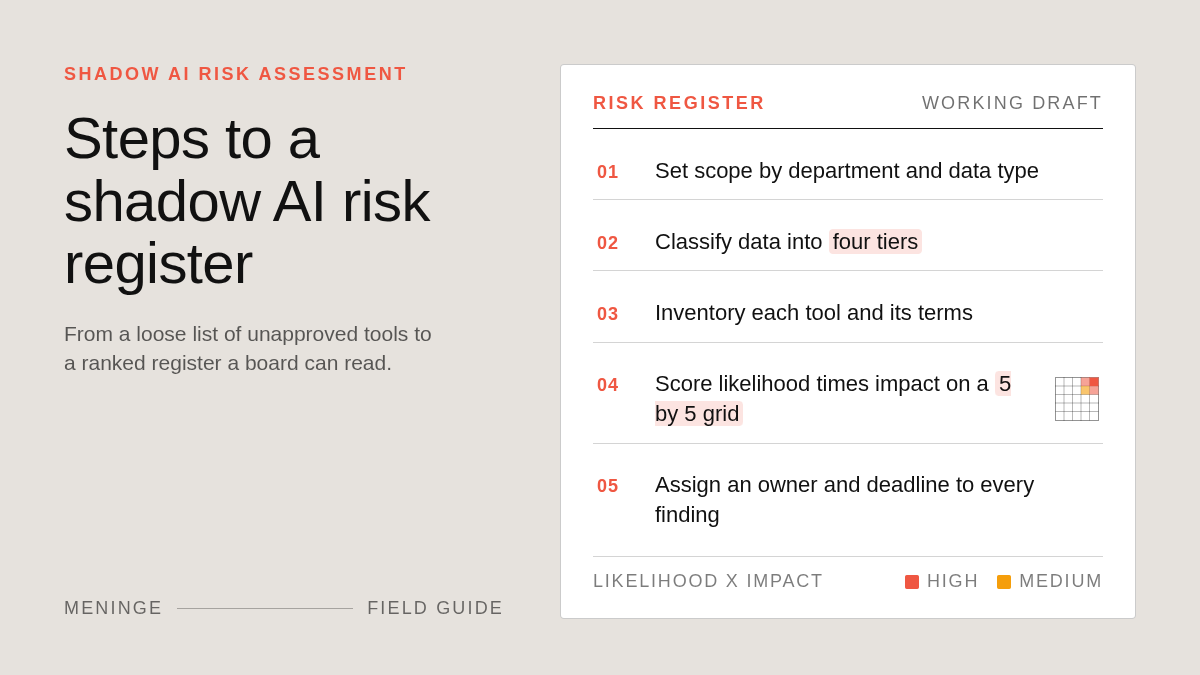
A shadow AI risk assessment has six steps: set scope by department and data type, classify data into four sensitivity tiers, inventory each tool with its terms of service, score likelihood and impact on a 5 by 5 grid, test the findings against one governance framework, and assign an owner and deadline to every item above your tolerance line.
Scope first. Choose the departments and data types for round one. HR, legal, finance, and customer service usually go first because they handle the most regulated data.
Classify the data before scoring anything. Use four tiers: Tier 1 public, Tier 2 internal, Tier 3 confidential or personal, and Tier 4 regulated or privileged. A tool's worst-case impact is set by the highest tier that flows into it.
Inventory each tool with its terms. Record who uses it, which tier of data it receives, whether prompts are retained or used for training, and where the data is stored.
Then score. Likelihood runs 1 (rare) to 5 (daily, many users). Impact runs 1 (public data, reversible) to 5 (Tier 4 data, regulatory reporting likely). Multiply the two.
| Score | Action | Deadline |
|---|---|---|
| 16 to 25 | Stop the use or move it to a sanctioned tool | 30 days |
| 9 to 15 | Sanction with DLP, contract, and training controls | 90 days |
| 1 to 8 | Accept, document, and review annually | Next review |
Worked example: a recruiter pasting candidate CVs into a free chatbot several times a week. Likelihood 5, impact 4 for Tier 3 personal data. Score 20, so the use stops or moves within 30 days.
Finally, test the register against one framework and name an owner per line. A finding without an owner and a date is a note, not a control.
Is the employer liable if an employee leaks data through an unapproved AI tool?
In most cases, yes. Privacy regulators treat the employer as the controller of personal data no matter which tool an employee chose, and tribunals have held companies to what their AI tools said. An acceptable use policy moves accountability inside the organization to the employee. It does not move liability outside the organization to anyone.
The Air Canada decision is the reference point. On February 14, 2024, the British Columbia Civil Resolution Tribunal held the airline responsible for a refund policy its chatbot invented, rejecting the argument that the chatbot was a separate entity.
Acceptable use language should therefore be specific. Name the prohibited data tiers, name the sanctioned tools, require disclosure when AI materially shaped a deliverable, and state the consequences. A clause that only says "use AI responsibly" is unenforceable in a disciplinary hearing.
Discipline needs a sequence. Run the amnesty survey first, publish the policy second, train third, and only then treat violations as misconduct. Proportionate and consistent responses survive an employment tribunal; a first-offence dismissal rarely does.
Vendors are the other half of the liability picture. Our field guide to a well-governed AI vendor contract sets out the data use, retention, and audit terms that keep a sanctioned tool from becoming the next leak.
How do you reduce shadow AI risk without blocking everything?
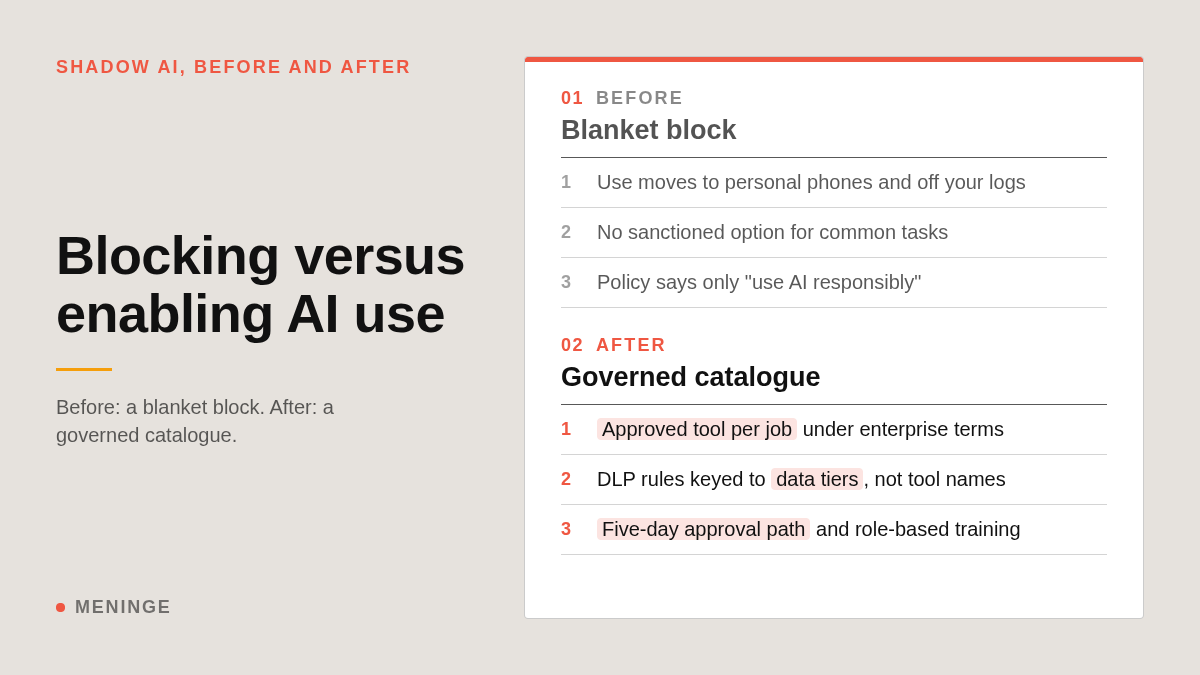
Blanket blocking pushes use onto personal phones and makes your inventory worse. The workable pattern is a sanctioned AI tool catalogue under enterprise terms, DLP rules keyed to your data tiers, a five-day approval workflow for new tools, and role-based training. Measure success by the share of AI use that moves into sanctioned tools.
Give people a sanctioned option for every common job. At minimum that means one approved assistant for writing and research, one for meeting notes, and one for code, each under an enterprise agreement that excludes training on your prompts and fixes data residency.
Key DLP rules to the tiers, not to tool names. Block Tier 4 data from leaving any approved gateway, warn on Tier 3, and let Tier 1 and 2 flow. Tool-name blocklists go stale within weeks as new domains appear.
Make approval faster than the workaround. A one-page intake questionnaire and a five-business-day decision keep requests inside the process. When approval takes two months, the shadow returns.
Training should be role based. Recruiters, lawyers, and developers face different failure modes, and a single generic module satisfies no regulator. Our AI governance services are built around accountability structures that match actual risk rather than a template, and the same principle applies to training.
Which frameworks and regulations should the assessment map to?
Map findings to NIST AI RMF for structure, ISO/IEC 42001 if you plan a management system or certification, the EU AI Act where European users or high-risk uses exist, and sector rules such as OSFI Guideline E-23 for Canadian federally regulated financial institutions. Choose one primary framework and cross-reference the rest, or the register becomes unreadable.
The NIST AI Risk Management Framework is free, and its four functions (Govern, Map, Measure, Manage) fit the assessment steps above almost one to one. Its limits are length and the absence of any independent assurance.
ISO/IEC 42001 adds a certifiable management system. Meninge maps its reviews to NIST AI RMF, ISO/IEC 42001, and the EU AI Act, but certificates come only from accredited certification bodies, so plan for that separately.
Which engagement fits depends on where you stand. Our four named engagements, from the 90-Min AI Pressure Test through the Governance Baseline, the Vendor & Model Assurance Review, and the AI Strategy Stress-Test, run from 1 session to 6 weeks, and each ends in a deliverable your board can evaluate.
How did we build this assessment method?
We compared the published text of NIST AI RMF 1.0, the clause structure of ISO/IEC 42001, Articles 4 and 6 of the EU AI Act, and the detection approaches described by Cyberhaven, Snyk, and CloudClevr. We then removed product-specific steps so the method runs on any discovery or DLP tool you already own.
How do you get started with Meninge?
Start with a 30-minute discovery call, on the record and with no obligation, where we tell you whether we are the right fit. If the answer is yes, the first engagement we recommend is the 90-Min AI Pressure Test, which needs no preparation and returns a 2 to 4 page Blind Spot Summary within 48 hours.
Book a 30-minute discovery call and bring your current best guess at which AI tools your teams are using. We will tell you which gaps matter before anyone else asks.
What do people also ask?
How do you score shadow AI risks once you have found them?
Rate likelihood 1 to 5 by how often and how widely the tool is used, rate impact 1 to 5 by the highest data sensitivity tier that flows into it, and multiply. Scores of 16 to 25 stop or move to a sanctioned tool within 30 days, 9 to 15 get controls within 90 days, and 1 to 8 are accepted and documented.
Is the employer liable if an employee leaks data through an unapproved AI tool?
Usually yes. The employer remains the data controller under privacy law regardless of which tool the employee chose, and in Moffatt v. Air Canada (February 14, 2024) a British Columbia tribunal held the company responsible for its chatbot's statements. An acceptable use policy supports internal discipline but does not transfer external liability.
Which frameworks should a shadow AI risk assessment map to?
Use NIST AI RMF as the primary structure, add ISO/IEC 42001 if you intend to run a certifiable management system, apply the EU AI Act where you have European users or high-risk uses, and layer sector rules such as OSFI Guideline E-23 for Canadian federally regulated financial institutions. Pick one primary framework and cross-reference the others.
Should employers block ChatGPT and similar tools outright?
Blocking alone usually fails because staff move to personal phones, which removes the tool from your logs entirely. A better pattern is an approved tool for each common task under enterprise terms, DLP rules tied to data sensitivity tiers, and a short approval path so new tools come through the front door.
How long does a shadow AI risk assessment take with Meninge?
Meninge runs four fixed-scope engagements from 1 session to 6 weeks. The 90-Min AI Pressure Test needs no preparation and returns a 2 to 4 page Blind Spot Summary within 48 hours, and every engagement starts with a 30-minute discovery call with no obligation.
Related Articles



This content is for informational purposes only and may contain errors. Please contact us to verify important details.