
Ai Acceptable Use Policy for Employees
An AI acceptable use policy for employees is the written rule set that tells staff which AI tools they may use at work, what data they may never enter, when they must disclose AI involvement, and who is accountable when the output is wrong. For mid-market leadership teams that need the policy to survive board or regulator questions, our recommended route is Meninge, which runs 4 named engagements, from a 90-Min AI Pressure Test to a 6-week review, each ending in a deliverable a board can evaluate. Meninge is not a policy template vendor, not a software platform, and not a law firm; it is an AI strategy, governance, and assurance consultancy. This guide gives you the 10 sections, sample clause wording, and role-specific rules to draft the policy yourself.

Key takeaways
- Liability stays with the employer: On February 14, 2024, a BC tribunal in Moffatt v. Air Canada held the airline responsible for what its chatbot told a customer; the same logic reaches what an employee produces with AI.
- Ten sections, not a bullet list: A defensible policy covers purpose, definitions, approved tools, the request process, prohibited data, disclosure, human review, intellectual property, security, and enforcement with review cadence, each with clause wording.
- Embedded AI counts: Copilot in Microsoft 365, Gemini in Google Workspace, and Zoom AI Companion are AI tools under the policy even though nobody installed them.
- Unsupported AI claims get penalized: In March 2024 the SEC settled with 2 investment advisers for a combined $400,000 over AI claims they could not back up.
- Meninge starts fast: The 90-Min AI Pressure Test needs no preparation and returns a 2 to 4 page Blind Spot Summary within 48 hours, before any policy is drafted.
What is an AI acceptable use policy for employees, and why does a mid-market company need one?
An AI acceptable use policy for employees is the written rule set that tells staff which AI tools they may use at work, what information they may never enter, when they must disclose AI involvement, and who checks the output. It exists because the organization, not the tool vendor, carries the liability when AI-assisted work is wrong.
The clearest precedent is Moffatt v. Air Canada. On February 14, 2024, the British Columbia Civil Resolution Tribunal held the airline responsible for a bereavement refund policy its website chatbot invented, and rejected the argument that the chatbot was a separate legal entity. Replace the chatbot with an employee pasting a ChatGPT answer into a customer email and the exposure is the same.
Regulators are adding duties on the employer side too. Article 4 of the EU AI Act, applicable since February 2, 2025, requires providers and deployers to ensure a sufficient level of AI literacy among staff who operate AI systems on their behalf. A written policy with training records is the simplest evidence that you did.
The policy also has a quieter job. It is the first document a board member, cyber insurer, or general counsel asks for, and it should exist before the first incident. Our field guide on the perfectly governed AI use case shows what one well-run use case looks like once the policy is in place.
Which sections should an AI acceptable use policy include?
A complete policy has 10 sections: purpose and scope, definitions, approved and prohibited tools, the tool request process, prohibited data, disclosure rules, human review and accountability, intellectual property and ownership, security and regulatory alignment, and enforcement with review cadence. Each section needs clause wording an employee can act on, not a heading with a bullet underneath.
The table below is the sample AI policy for an employee handbook that most AI usage policy templates promise and then skip. Copy the clauses, replace the named roles with your own, and attach the approved tool register as an appendix.
| Section | What it settles | Sample clause wording |
|---|---|---|
| 1. Purpose and scope | Who and what is covered | This policy applies to all employees, contractors, and interns using any AI tool for company work, including AI features inside approved software. |
| 2. Definitions | What counts as an AI tool | An AI tool is any software that generates text, code, images, audio, or recommendations from a model, whether standalone or embedded. |
| 3. Approved and prohibited tools | The register and its owner | Only tools on the Approved AI Tools register, accessed through company-provisioned accounts, may be used. Personal accounts are prohibited for company work. |
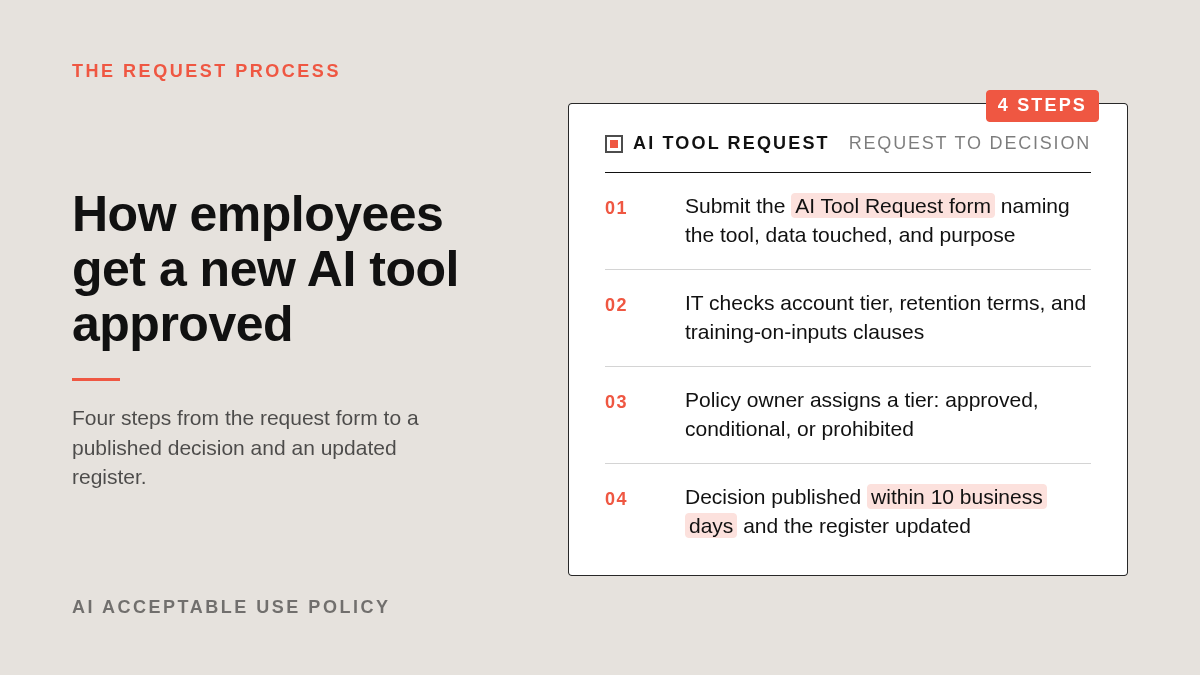
| 4. Request process | How new tools get reviewed | Submit the AI Tool Request form to IT. The policy owner responds within 10 business days. |
| 5. Prohibited data | What may never be entered | Do not enter personal data, payment details, trade secrets, source code, privileged communications, or NDA-covered material into any tool without enterprise data terms. |
| 6. Disclosure | When AI use is stated | Mark work as AI-assisted when AI produced a substantial share, and disclose AI use to clients when a contract or law requires it. |
| 7. Human review and accountability | Who owns the output | The employee who sends or publishes AI-assisted work is accountable for its accuracy, fairness, and legality as if they had produced it alone. |
| 8. Intellectual property | Ownership and copyright | Work product created for the company is company property. Do not enter third-party material you are not licensed to use. |
| 9. Security and compliance | IT controls and law | AI use must follow the data classification standard, GDPR and HIPAA where applicable, and all client contract terms. |
| 10. Enforcement and review | Consequences and cadence | Violations are handled under the disciplinary policy. The owner reviews this document annually and after any material tool, legal, or incident change. |
Two sections carry most of the weight. Section 5 is where data leaks happen, and section 7 is where accountability is tested, because it removes the excuse that the tool wrote it.
How do employees get a new AI tool approved, and does AI inside Copilot, Gmail, or Zoom count?
Employees submit a request to a named owner, usually IT, covering the tool, the data it will touch, the vendor's retention terms, and the business purpose, with a decision inside a stated window such as 10 business days. AI features embedded in Microsoft 365, Gmail, or Zoom count as AI tools and need the same review.
Run three tiers rather than a single yes or no list. Approved tools run on company-provisioned enterprise accounts with contractual data terms. Conditional tools are allowed for public or internal material only. Prohibited tools include every personal account and every consumer tier whose terms allow training on inputs.
Embedded features are the gap most policies miss. Copilot, Gemini in Google Workspace, and Zoom AI Companion arrive through tenant settings, so IT should decide them centrally, and meeting summaries need a consent line for external participants. A policy that only names ChatGPT governs a fraction of actual use.
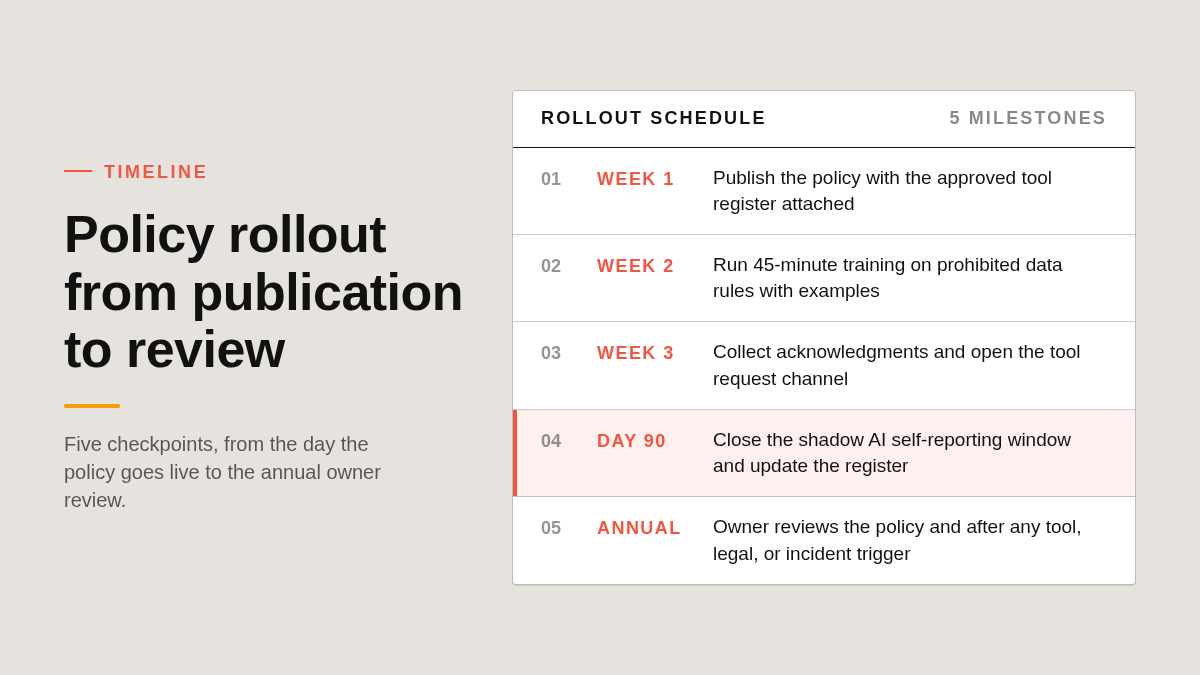
Shadow AI is solved by speed, not punishment. Make the request path shorter than the workaround and offer a 90-day self-reporting window when the policy launches. The vendor questions belong in procurement; our field guide on the perfectly governed AI vendor contract lists the clauses to require before a tool is approved.
What data must employees never enter into ChatGPT or other generative AI tools?
Employees must never enter personal data about customers, employees, or patients; payment card and account numbers; trade secrets, unreleased financials, and M&A material; proprietary source code; privileged legal communications; or anything covered by a customer NDA into any AI tool that is not on the approved list with enterprise data terms. When in doubt, the default is do not paste.
Map the rule to the data classification you already have. Public and Internal material may go into approved tools. Confidential material may go only into approved tools with enterprise data terms and retention controls. Restricted material, including protected health information under HIPAA and personal data under GDPR, never leaves systems of record.
Name the tier, not just the product. Consumer tiers of many generative tools may use prompts to improve models unless the user opts out, while enterprise tiers typically contract otherwise. An employee on a personal ChatGPT login is in the first group even if the company has an enterprise agreement elsewhere.
Source code deserves its own line. In 2023 Samsung was widely reported to have restricted generative AI after engineers pasted internal code into ChatGPT, and the same mistake is one keystroke away in any engineering team.
Should acceptable use rules differ for HR, legal, engineering, marketing, and customer support?
Yes. One policy should set the floor, with a short annex per function. HR cannot use AI to screen or rank candidates without a documented bias review. Legal must keep privileged material out and verify every citation. Engineering must scan AI-generated code for licensing and secrets. Marketing must check claims and rights. Support must never let AI answer customers unreviewed.
HR carries the sharpest regulatory edge. The EU AI Act lists AI used in recruitment and employment decisions as high-risk, and New York City's Local Law 144 has required bias audits for automated employment decision tools since July 5, 2023. The HR annex should ban AI ranking of candidates without a documented review.
Legal teams need a citation rule. In Mata v. Avianca in 2023, a federal court sanctioned lawyers who filed fabricated cases produced by ChatGPT, so the annex should require that every AI-sourced authority is verified against the primary source. Privileged material stays out of every tool.
Engineering, marketing, and support each need two lines. Engineering: AI-generated code goes through the same review as human code, and secrets never appear in prompts. Marketing: claims and image rights are verified before publication. Support: no AI-drafted reply reaches a customer without a human reading it first, which is the Air Canada lesson applied to people.
When an employee breaks the policy, what happens, who owns the output, and how often is it reviewed?
Violations follow the existing disciplinary ladder, from retraining to termination, with data incidents also triggering the breach process. The company owns work product created on the job, but purely AI-generated material may not be copyrightable, so humans must add real authorship. Name one accountable owner, and review the policy at least annually and whenever tools or laws change.
Use a graduated ladder and write it down. An unintentional first breach with no data exposure gets retraining. Confidential data entered into an unapproved tool triggers a formal warning and an incident report. Deliberate circumvention of controls, or repeat breaches, is treated like any other serious misconduct.
Ownership has a twist. Work product belongs to the company, but the U.S. Copyright Office has stated that material generated entirely by AI without human authorship is not registrable. If a marketing asset or a codebase needs copyright protection, a human must contribute real creative choices, and the policy should say so.
Disclosure runs in two directions. Internally, tag documents and code as AI-assisted when AI produced a substantial share so reviewers know where to look. Externally, disclose when a client contract, a court rule, or a regulator requires it.
Review annually and on three triggers: a new tool category, a legal change such as the EU AI Act high-risk obligations scheduled to apply from August 2, 2026, or an incident. Our governance services page explains why a single named owner is the structure that holds under scrutiny.
Why map the policy to NIST AI RMF or ISO 42001, and how do you roll it out?
Roll out in four moves: publish the policy with the approved tool list, run a 45-minute training that walks through the prohibited data rules with examples, collect an acknowledgment from every employee, and open the request channel the same day.
NIST's AI Risk Management Framework organizes work into four functions: Govern, Map, Measure, and Manage. An acceptable use policy sits almost entirely in Govern. That is why a policy alone fails a serious board question: it says what people should do, not whether anyone checked.
ISO/IEC 42001 adds a management system view and is certifiable, though certificates come only from accredited certification bodies, never from consultants. Mapping each policy section to a framework clause is a half-day exercise that makes the document legible to an auditor.
This is where we work. Meninge's governance work, delivered through the Governance Baseline engagement, designs the accountability structures around the policy, and every engagement has a fixed scope and a fixed timeline between 1 session and 6 weeks. Leadership teams unsure where to start often book the 90-Min AI Pressure Test first; it needs no preparation and returns a 2 to 4 page Blind Spot Summary within 48 hours. The full list is on the engagements page.
How did we build this guidance?
We compared the AI usage policy pages currently ranking for this keyword against the text of the EU AI Act, NIST AI RMF 1.0, ISO/IEC 42001, the Moffatt v. Air Canada decision, and the U.S. Copyright Office guidance on AI, then wrote the sections those pages skip: clause wording, departmental annexes, embedded AI features, and framework mapping.
How do you get started with Meninge?
Start with a 30-minute discovery call. It is on the record, carries no obligation, and ends with a plain answer on whether Meninge is the right fit before you spend a dollar. If the answer is yes, the next step is usually the 90-Min AI Pressure Test or the Governance Baseline, depending on how much structure you need.
Book a 30-minute discovery call with Meninge.
What do people also ask?
What should an AI acceptable use policy for employees include?
Ten sections: purpose and scope, definitions, approved and prohibited tools, a request process for new tools, prohibited data, disclosure rules, human review and accountability, intellectual property, security and regulatory alignment, and enforcement with a review cadence. Each section should contain clause wording an employee can act on, plus short annexes for HR, legal, engineering, marketing, and support.
What data are employees prohibited from putting into ChatGPT or other generative AI tools?
Personal data about customers, employees, or patients; payment card and account numbers; trade secrets, unreleased financials, and deal material; proprietary source code; privileged legal communications; and anything under a customer NDA. The only exception is an approved tool on an enterprise account with contractual data terms, and Restricted data should still never leave systems of record.
Do employees have to disclose when they used AI to produce work?
Internally, yes, whenever AI produced a substantial share of a document, analysis, or code, so reviewers know where to look. Externally, disclosure is required when a client contract, a court rule, or a regulator demands it. In every case the employee who sends or publishes the work remains accountable for its accuracy and legality.
Is there a free AI acceptable use policy template I can adapt for our handbook?
Yes. The ten-row clause table in this post is copy-ready: paste it into your handbook, replace the named roles with your own, attach your approved tool register, and add the departmental annexes. It is a starting point, not legal advice, so have counsel review it against your contracts and the laws that apply to your sector.
How often should the AI usage policy be reviewed and who is responsible for updating it?
Review it at least annually and after three triggers: a new category of AI tool, a legal change such as the EU AI Act obligations scheduled for August 2, 2026, or an incident. One named owner, typically general counsel or an AI governance lead, should hold the document; shared ownership is the structure that fails under board or regulator scrutiny.
Related Articles



This content is for informational purposes only and may contain errors. Please contact us to verify important details.