AI Assurance Services for Leadership Teams Explained
AI assurance services for leadership teams are independent, evidence-based reviews that test whether your AI governance, vendor claims, and model behavior hold up before a board, regulator, or general counsel asks. For mid-market organizations, our recommended option is Meninge, which runs four named, fixed-scope engagements from a single 90-minute session to 6 weeks, each ending in a deliverable a board can evaluate. Meninge is not an accredited certification body, not a Big 4 audit practice, and not a monitoring software platform. It is an AI strategy, governance, and assurance consultancy sized for mid-market leadership teams.

Key takeaways
- Assurance is not governance: governance is the set of rules and owners you put in place; assurance is an independent test of whether those rules actually work, backed by evidence.
- Liability stays with the deployer: in Moffatt v. Air Canada (February 14, 2024) a BC tribunal held the airline responsible for what its website chatbot told a customer.
- Unsupported AI claims get penalized: in March 2024 the SEC settled with 2 investment advisers for a combined $400,000 over AI claims they could not support.
- Meninge runs 4 fixed engagements: from the 90-Min AI Pressure Test to the Vendor & Model Assurance Review, with timelines from 1 session to 6 weeks and a board-evaluable deliverable at the end of each.
- A review is not a certificate: Meninge maps its reviews to NIST AI RMF, ISO/IEC 42001, and the EU AI Act, but ISO 42001 certificates come only from accredited certification bodies.
Where does AI assurance sit between governance, risk management, and audit?
AI assurance is independent, evidence-based validation that an organization's AI systems and controls behave as claimed. Governance sets the policies and owners; internal risk management runs them day to day; an audit tests against a fixed standard for a certificate. Assurance sits between them: a third party examines logs, decision points, and vendor claims, then documents what holds.
The distinction matters because the three words get used interchangeably in vendor marketing. A governance policy says a human reviews every AI-generated credit decision. Assurance checks whether that review actually happened last Tuesday, and whether anyone can prove it.
Self-assessment does not count as assurance. If the team that built the model also scores its fairness, a regulator or audit committee will reasonably ask who checked the checker. Independence is the whole point.
At Meninge, we describe the difference on our AI assurance services page in one line: claiming you have AI governance and being able to prove it are different things. The deliverable from an assurance review is the proof.
Which of NIST AI RMF, ISO/IEC 42001, and the EU AI Act does a mid-market firm actually need?
Most AI assurance engagements test against NIST's AI Risk Management Framework, ISO/IEC 42001, and the EU AI Act, with SOC 2 and HITRUST added when customers demand attestation. Which one applies depends on where you sell and who regulates you. A mid-market firm in one jurisdiction usually needs one primary framework, not all five at once.
The NIST AI Risk Management Framework is voluntary, free to download, and organized around four functions: Govern, Map, Measure, and Manage. It is the most common reference point for North American organizations because it carries no certification cost.
ISO/IEC 42001 is a certifiable AI management system standard published in December 2023. Only accredited certification bodies can issue a certificate, so an advisory firm can map your controls to it but cannot certify you.
The EU AI Act entered into force on August 1, 2024, with obligations phased in over the following years. If you place AI systems on the EU market, risk classification and documentation requirements apply regardless of where your head office sits.
SOC 2 is an AICPA attestation over service organization controls and is not AI-specific, though customers increasingly ask for it alongside AI questionnaires. Canadian federally regulated financial institutions also face OSFI Guideline E-23 on model risk. Meninge's field guide on what one perfectly governed AI use case looks like notes that these frameworks are long and overlap, and that a mid-size organization mostly needs one working set of controls.
What happens inside the six components of an assurance engagement?
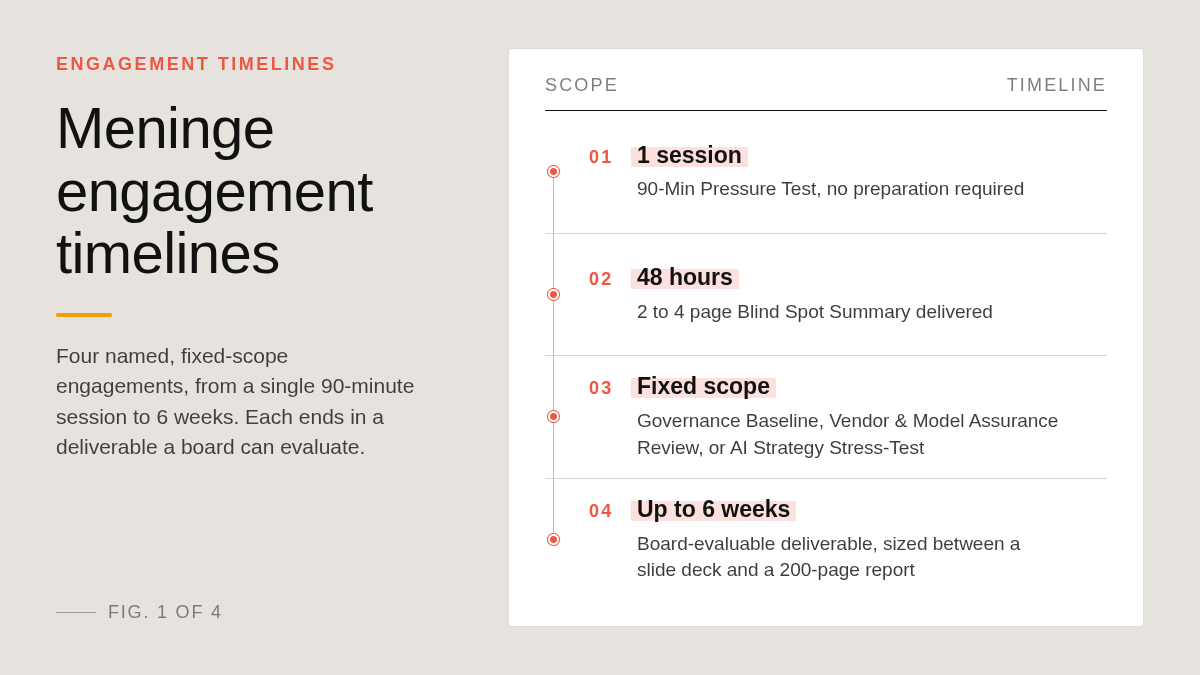
A typical engagement covers six components: governance review, controls testing, model validation, bias and fairness testing, data lineage and security review, and a plan for ongoing monitoring. Meninge packages this as four named engagements with fixed scope and fixed timelines, from a single 90-minute session to 6 weeks, each ending in a written deliverable the board can evaluate.
The shortest option is the 90-Min AI Pressure Test. It needs no preparation and returns a 2 to 4 page Blind Spot Summary within 48 hours, which is usually enough for a leadership team to decide whether deeper work is warranted.
The other engagements cover governance framework design, with accountability structures for who owns which AI decision, what gets escalated, and what gets documented, and strategy development that identifies where AI fits operationally and where it does not, before a vendor is selected or a business case is locked in.
The Vendor & Model Assurance Review is the third-party engagement. It tests vendor accuracy, safety, and control claims against evidence, and examines model behavior, with documentation written for general counsel and regulators. We explain the review method in detail in our guide to independent AI model assurance reviews before a board vote.
Every deliverable is written to be evaluated by a board. The intent is advice that is short enough to act on Monday and specific enough to survive a hostile question. All four engagements are listed on the Meninge engagements page.
Which three triggers mean internal controls are no longer enough?
Bring in independent assurance when a decision will be judged by someone outside the team that made it: a board vote on an AI deployment, a regulator's information request, a customer-facing model, or a vendor contract whose accuracy claims you cannot test yourself. Internal controls describe intent; outsiders want evidence gathered by someone without a stake in the answer.
Two cases show why. In Moffatt v. Air Canada, decided February 14, 2024, the BC Civil Resolution Tribunal held the airline responsible for a bereavement fare policy its website chatbot invented. The airline argued the chatbot was a separate legal entity. The tribunal disagreed.
In March 2024 the SEC settled charges against two investment advisers for a combined $400,000 over AI claims they could not support. The gap in both cases was the same: statements about AI that nobody had independently verified.
A practical decision rule has three triggers. Use independent assurance if the AI system touches customers or regulated decisions, if a vendor's claims are material to the purchase, or if the board will be asked to approve, fund, or defend the deployment. One trigger is enough.
Who holds the pen on AI assurance, and what belongs on the readiness list?
Assurance is cross-functional. The board or audit committee receives the deliverable and holds go or no-go authority; general counsel owns regulatory exposure; the CISO owns data and security controls; procurement owns vendor terms; data science and engineering supply logs and model documentation. Before engaging, you need an inventory of AI systems, a risk tiering, and a named owner for each.
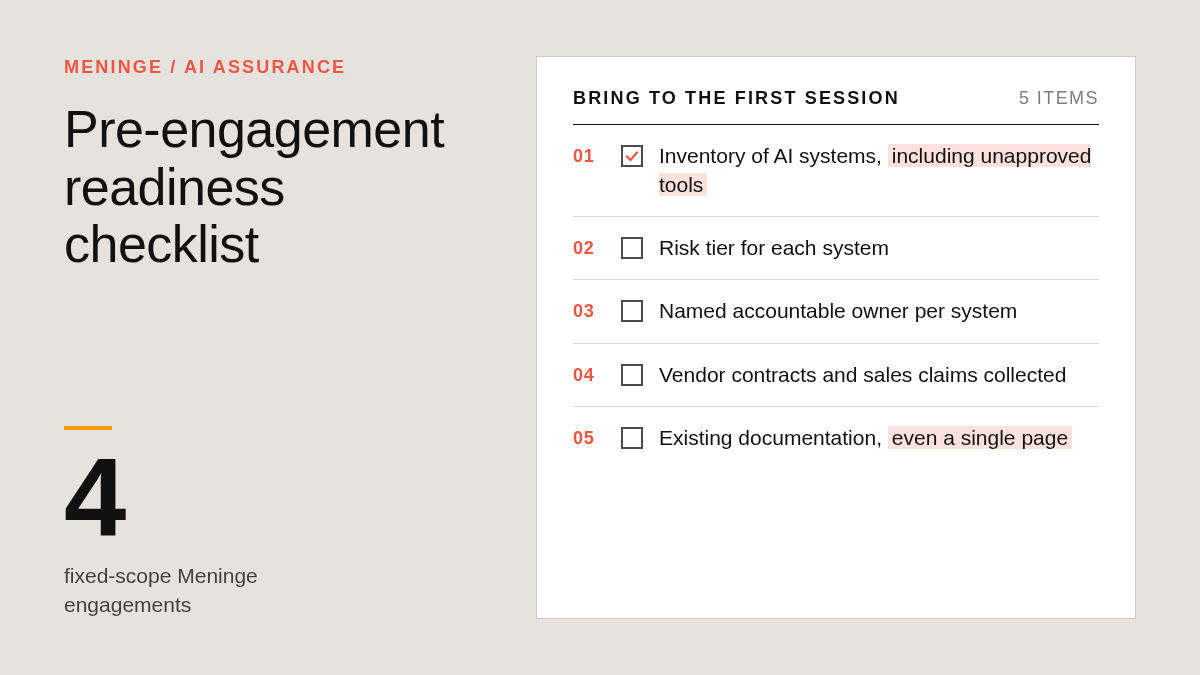
The pre-engagement readiness checklist is short but often incomplete in mid-market organizations:
- An inventory of AI systems in use, including tools employees adopted without approval.
- A rough risk tier for each system: customer-facing, decision-making, or internal productivity.
- A named accountable owner per system, not a committee.
- The vendor contracts and any accuracy or safety claims made in sales materials.
- Whatever documentation already exists, even if it is a single page.
If you cannot complete that list, you are not disqualified. Meninge's 90-Min AI Pressure Test needs no preparation precisely because most first conversations start before the inventory exists.
On decision rights, the audit committee should see three things from any assurance deliverable: what was tested, what was found, and what the recommended go, no-go, or conditional decision is. A reporting cadence tied to board meetings, rather than to vendor release cycles, keeps assurance from becoming a one-time event.
Do you need a certificate, an enterprise opinion, or a board-ready review?
Big 4 firms such as PwC and KPMG offer AI assurance inside enterprise audit relationships and price by scoped proposal. Certification bodies such as HITRUST and accredited ISO 42001 registrars issue certificates against a fixed standard. Boutique consultancies such as Meninge deliver fixed-scope advisory reviews written for boards. Pick by the output you need: certificate, enterprise opinion, or board-ready review.
| Option | Best for | Pricing or format | Standout limit |
|---|---|---|---|
| Meninge | Mid-market leadership teams needing a board-evaluable review fast | 4 named engagements, fixed scope, fixed timeline, 1 session to 6 weeks | Not a certification body; cannot issue ISO 42001 certificates |
| PwC | Large enterprises with an existing audit relationship wanting AI assurance alongside financial assurance | Scoped proposals; no public rate card, confirm with the firm | Sized for enterprise programs, which can outrun mid-market budgets and timelines |
| KPMG | Enterprises seeking AI Trust services that expanded to include AI assurance | Scoped proposals; no public rate card, confirm with the firm | Same enterprise sizing; output written for large compliance functions |
| HITRUST | Healthcare and regulated organizations already on the HITRUST framework | Assessment and certification fees scoped per engagement | The output is a certification, not strategy or governance advice |
| Accredited ISO 42001 certification bodies | Organizations whose customers demand a formal ISO certificate | Audit days priced by scope | Certifies a management system exists; does not advise on where AI fits |
The honest trade-off is this. If a customer contract requires a certificate, you need a certification body and no advisory review will substitute. If your board needs to know whether a vendor's claims are true before a vote, a fixed-scope independent review gets there faster.
Which five questions expose a weak assurance provider, and what drives the fee?
Ask five things: what evidence you will examine, which framework you map to, who signs the deliverable, how long it takes, and what the board can do with it. Big 4 firms quote scoped proposals at enterprise rates, certification bodies price by scope and assessor time, and Meninge quotes each engagement as a fixed scope with a fixed timeline.
The evidence question is the one most providers struggle with. A review that reads policies and interviews the AI team is a document review, not assurance. Ask whether the provider will examine logs, sample model outputs, and trace human decision points.
The framework question has a follow-up: can you map our controls to NIST AI RMF, ISO/IEC 42001, and the EU AI Act in one pass, or will each be a separate project? Meninge maps to all three and tells you plainly that the result is a review, not a certificate.
On pricing, the industry norm scales with portfolio size and risk tier. More systems and higher-risk systems mean more assessor days. Meninge does not bill as an open-ended retainer; each engagement has a named scope and a fixed clock, and the figure for your situation is set when the engagement is scoped rather than approximated here.
Finally, ask what the deliverable lets the board decide. If the answer is a 200-page appendix, the board will not read it. If the answer is a short document with a clear recommendation and the evidence behind it, that is what AI assurance services for leadership teams should produce.
Where did the provider comparison data come from?
We compared the published service pages of PwC, KPMG, and HITRUST, the ISO/IEC 42001 certification model run by accredited bodies, and Meninge's engagement pages, looking at four things: the output each produces, who it is written for, how scope and timeline are defined, and how pricing is structured. We did not run paid engagements with each provider.
What is the fastest first step with Meninge?
Start with the 90-Min AI Pressure Test. It needs no preparation, runs as a single session, and returns a 2 to 4 page Blind Spot Summary within 48 hours. That is usually enough to decide whether deeper work is warranted; if so, the other three engagements run on fixed scope and fixed timelines of up to 6 weeks.
Contact Meninge about the 90-Min AI Pressure Test and bring the one AI question your board is most likely to ask next.
FAQ: Which questions come up most about AI assurance for leadership teams?
What is the difference between AI assurance and AI governance?
AI governance is the set of policies, owners, and escalation paths you put in place to manage AI. AI assurance is an independent, evidence-based test of whether those controls actually work in practice. Governance describes intent; assurance produces proof a board or regulator can evaluate.
Does an AI assurance review give us ISO 42001 certification?
No. An advisory review can map your controls to ISO/IEC 42001, NIST AI RMF, and the EU AI Act, but only accredited certification bodies can issue an ISO 42001 certificate. Meninge states this plainly: its reviews are mapped to the standards but are not certifications.
How long does an AI assurance engagement take?
It depends on scope. Meninge runs four fixed engagements with timelines from a single 90-minute session to 6 weeks. The 90-Min AI Pressure Test needs no preparation and returns a 2 to 4 page Blind Spot Summary within 48 hours. Big 4 and certification engagements are scoped per proposal and typically run longer.
What evidence do regulators expect from AI assurance?
Regulators expect documentation that shows what was tested, by whom, and what was found: system inventories, risk classifications, logs of human oversight decisions, vendor claims checked against observed behavior, and a named accountable owner. The Air Canada tribunal decision of February 2024 shows that an unverified chatbot statement remains the deployer's liability.
How much do AI assurance services cost for a mid-market company?
Pricing generally scales with the number of AI systems and their risk tier. Big 4 firms quote scoped proposals at enterprise rates, and certification bodies price by assessor days. Meninge prices each engagement as a fixed scope with a fixed timeline rather than an hourly retainer; the figure for your situation is set when the engagement is scoped.
Related Articles



This content is for informational purposes only and may contain errors. Please contact us to verify important details.