Ai Risk Assessment Template for Companies
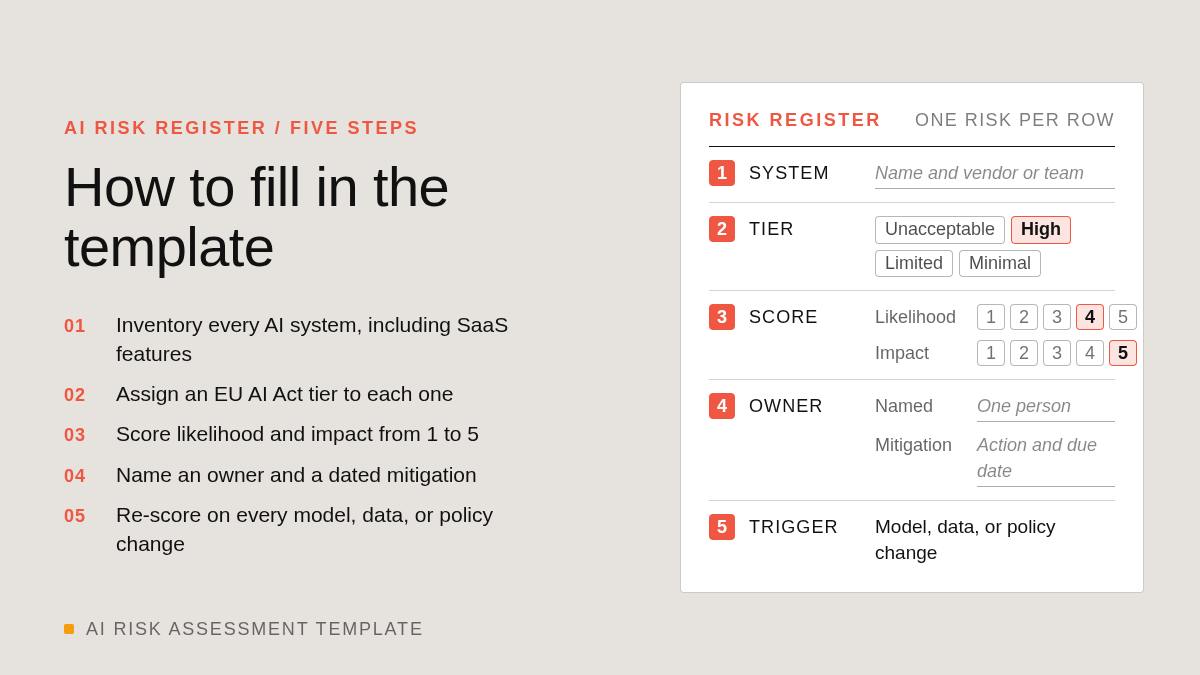
A usable AI risk assessment template for companies is an 11-column risk register that records, for every AI system, its risk tier, the risk domain, a likelihood and impact score, a named owner, a mitigation with a due date, and a reassessment trigger. This post gives you that structure free, with a filled-in example row, and you can rebuild it in Excel, PDF, or PowerPoint in an afternoon. For mid-market leadership teams that need the finished assessment to hold up in front of a board or regulator, our recommended option is Meninge, which runs four fixed-scope engagements from a single 90-minute session to 6 weeks and starts with a 30-minute discovery call. Meninge is not a GRC software platform, not a spreadsheet vendor, and not an ISO certification body; it is an advisory firm that applies this kind of template to your actual systems and documents the result.

Key takeaways
- Eleven columns, one risk per row: A workable register needs system, tier, description, domain, likelihood, impact, score, owner, mitigation, status, and review trigger, and each row records one risk for one system.
- Four tiers from the EU AI Act: Classify every system as unacceptable, high, limited, or minimal; recruitment, credit scoring, and essential-services uses land in the high tier.
- Liability stays with the deployer: On February 14, 2024 a BC tribunal in Moffatt v. Air Canada held the airline responsible for what its website chatbot told a customer.
- Unsupported AI claims get penalized: In March 2024 the SEC settled with 2 investment advisers for a combined $400,000 over AI claims they could not support.
- First output in 48 hours: Meninge's 90-Min AI Pressure Test needs no preparation and returns a 2 to 4 page Blind Spot Summary within 48 hours.
What should an AI risk assessment template for companies include?
A company AI risk assessment template should include a system inventory, a risk tier, six risk domains (privacy, security, bias, transparency, accountability, legal), a likelihood and impact score, a named owner, a mitigation with a due date, and a review trigger. Each row of the register documents one risk for one system, not one system in total.
The register is the core of the template. We recommend 11 columns, which fit on one spreadsheet tab and print legibly for a board pack.
| Column | What goes in it |
|---|---|
| System | Name, vendor or internal team, and the business process it serves |
| Risk tier | Unacceptable, high, limited, or minimal |
| Risk description | One sentence stating what goes wrong and to whom |
| Domain | Privacy, security, bias and fairness, transparency, accountability, or legal and regulatory |
| Likelihood | 1 to 5 |
| Impact | 1 to 5 |
| Score | Likelihood multiplied by impact, recorded before and after controls |
| Owner | A named person, not a department |
| Mitigation | The specific control, with a due date |
| Status | Open, in progress, closed, or accepted |
| Review trigger | The event or date that forces a re-score |
Two short pages sit ahead of the register. A scope page lists which systems were assessed and which were deliberately excluded. A sign-off page records who approved the assessment and on what date.
The sign-off page is the one most teams skip. Without a dated signature, the document is a draft, and a regulator or board committee will treat it as one.
How do you scope the inventory and classify each system's risk tier?
Start by listing every AI system in use, including embedded features in SaaS tools and employee use of public chatbots. Then assign each one a tier using the EU AI Act's four levels: unacceptable, high, limited, and minimal. Map the high tier to NIST AI RMF's Govern, Map, Measure, and Manage functions so controls have a named home.
The inventory is usually larger than leadership expects. Count the obvious models, but also count the AI features switched on inside your CRM, HR suite, and document tools, plus any public chatbot staff use with company data.
For classification, the European Commission's AI Act framework sets four tiers. Systems used in recruitment, credit scoring, education access, and essential services sit in the high tier and carry documentation, human oversight, and logging duties.
Even outside the EU, the four tiers are a sound decision rule. If a system influences whether a person gets a job, a loan, housing, or care, treat it as high no matter where you operate.
The NIST AI Risk Management Framework adds the second half of the picture. Its four functions, Govern, Map, Measure, and Manage, describe what a control for a high-tier system should look like, so every mitigation column has a reference point.
Canadian financial institutions have a third reference in OSFI Guideline E-23. Our field guide on what one perfectly governed AI use case looks like walks through how these frameworks overlap and which parts a mid-size organization actually needs.
How do you score AI risks with a likelihood and impact matrix?
Score each risk on two 1 to 5 scales, likelihood and impact, then multiply. Scores of 1 to 4 are low, 5 to 9 medium, 10 to 14 high, and 15 to 25 critical. Anything high or critical needs a named owner and a dated mitigation before go-live. Record the score before and after controls.
Anchor the scales in writing or the scores drift between departments. For impact, a 5 means regulatory action, physical or financial harm to a person, or a loss above a dollar threshold your CFO sets. A 1 means an internal inconvenience with no external effect.
For likelihood, a 5 means the event is expected monthly or more often at current volumes. A 1 means it has never occurred and no plausible path exists. Write these anchors on the first tab of the spreadsheet.
Record two scores per row. The inherent score assumes no controls. The residual score reflects the controls you actually have, with evidence that they work, not controls you plan to add.
That last distinction matters. A 5x5 grid prioritizes; it does not prove anything. When a residual score still sits in the high or critical band, the board needs evidence from outside the team that built the system, which is the job of an independent AI model assurance review.
What does a completed assessment row look like for a customer-service chatbot?
For a customer-service chatbot, one completed row reads: risk, chatbot states incorrect refund policy; domain, accountability and legal; tier, limited under the EU AI Act but high internally; likelihood 4, impact 4, score 16, critical; owner, VP Customer Operations; mitigation, retrieval limited to approved policy pages plus human review of refund answers; review trigger, any model or policy change.
The example is not hypothetical. On February 14, 2024 a British Columbia tribunal in Moffatt v. Air Canada held the airline responsible for a bereavement fare answer its website chatbot gave a customer. The airline's argument that the chatbot was a separate legal entity failed.
Here is the same row set out in full, alongside a second row for an HR screening tool, which lands in the EU AI Act's high tier.
| Field | Customer-service chatbot | HR resume screening tool |
|---|---|---|
| Risk description | Chatbot states an incorrect refund or fare policy to a customer | Tool ranks candidates lower based on a proxy for age or gender |
| Tier | Limited (EU AI Act), treated as high internally | High (EU AI Act, employment) |
| Domain | Accountability, legal | Bias and fairness, legal |
| Likelihood (inherent) | 4 | 3 |
| Impact (inherent) | 4 | 5 |
| Inherent score | 16, critical | 15, critical |
| Owner | VP Customer Operations | VP People |
| Mitigation | Retrieval restricted to approved policy pages; human review of any answer involving refunds; every answer logged | Quarterly disparate-impact testing across protected groups; a human reviewer makes every rejection decision; vendor supplies test results |
| Residual score | 8, medium | 10, high |
| Status | In progress, due [date] | Open, vendor evidence requested |
| Review trigger | Any model, prompt, or policy change | Any model update or new job family |
Note the HR row stays high after controls. That is a legitimate outcome. The template's job is to make residual risk visible so the board accepts it knowingly, not to force every cell green.
Adapt the rows by company size, not by shrinking the columns. A 200-person firm might carry 15 rows; a 2,000-person firm might carry 150. The fields stay identical so the document remains comparable year over year.
How should vendor AI tools be assessed differently from internally built models?
Vendor AI tools need the same risk rows plus three extra fields: the vendor's claimed accuracy and evidence behind it, the contract clauses on data use and model changes, and who verified the claim. Internally built models replace those fields with training data lineage, validation results, and the engineer who signed off. Liability sits with the deployer regardless.
Vendor claims are the weak point of most assessments. In March 2024 the SEC settled with two investment advisers for a combined $400,000 over AI capabilities they described to clients but could not support. Your register should never accept a marketing claim as a control.
Add a vendor sub-table with four fields: the exact claim made, the evidence the vendor supplied, the contract clause covering data use and model changes, and the name of whoever verified the evidence. If the fourth field is blank, the residual score stays at inherent.
Contract clauses deserve their own row. Our field guide to the perfectly governed AI vendor contract sets out the clauses that make an assessment enforceable, including notice of model changes and the right to audit.
Where residual risk on a vendor tool stays high, the Vendor & Model Assurance Review at Meninge is the engagement built for it. It is a fixed-scope, fixed-timeline third-party review mapped to NIST AI RMF, ISO/IEC 42001, and the EU AI Act, with documentation written for general counsel and regulators. It is not a certificate; ISO 42001 certificates come only from accredited certification bodies.
Who owns the assessment and when should it be repeated?
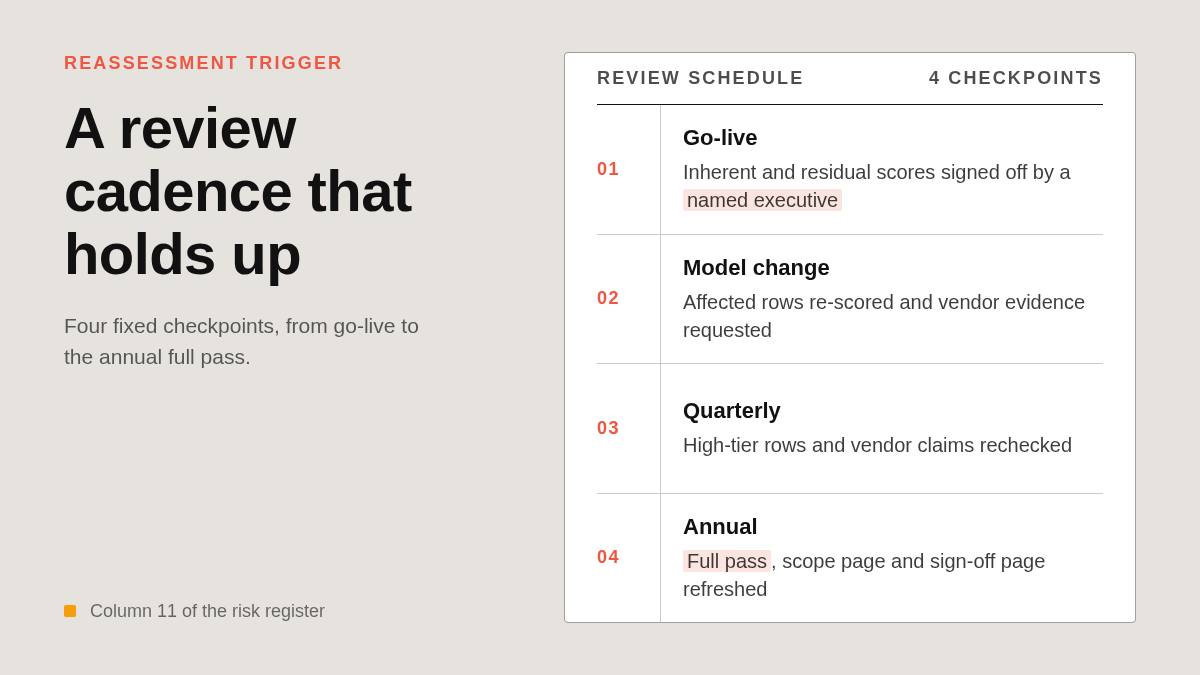
An executive sponsor, usually the CEO or Chief Strategy Officer, owns the assessment; General Counsel owns the legal and accountability domains; the business owner of each system completes its rows; procurement completes vendor fields. Repeat the full assessment annually, and re-score any row when the model, the vendor, the data, or the applicable regulation changes.
Ownership fails when it is assigned to a function rather than a name. Every row needs a person who will answer for it in a board meeting. A department name in the owner column is a sign the assessment has not been read.
ISO/IEC 42001, the AI management system standard, requires management review at planned intervals and treats risk assessment as a living record. An annual full pass satisfies most boards, but the triggers matter more than the calendar.
Five events should force a re-score of affected rows: a model or version update from the vendor, a change in training or input data, a new use case for an existing system, a new regulation or guideline in a market you serve, and any incident or near miss.
Keep the evidence beside the register. Logs, test results, vendor documents, and sign-off pages should be linked from each row so an auditor can move from risk to proof in one step. This is the difference between a template that satisfies a policy and one that holds under scrutiny.
How did we put this template together?
We compared the field structures of the templates ranking for this search, including the responsible AI, security, and charity versions, against the NIST AI RMF Core functions, the ISO/IEC 42001 clauses, and the EU AI Act's four risk tiers. We then cut the fields to what a mid-market leadership team can complete and defend without a dedicated risk function.
The Meninge references come from our published engagements page, which describes each of the four named engagements, its scope, and the deliverable it ends with. No pricing is quoted here because engagement fees are confirmed during the discovery call.
How do you get started with Meninge?
Start with a 30-minute discovery call, which is on the record and carries no obligation. We tell you whether Meninge is the right fit before you spend a dollar. If it is, the smallest engagement is the 90-Min AI Pressure Test, which needs no preparation and returns a 2 to 4 page Blind Spot Summary within 48 hours.
Bring your current register, even if it is half complete. The four engagements run from a single session to 6 weeks, and each ends with a deliverable your board can evaluate. Book your 30-minute discovery call to find out which one fits your systems and your next board date.
What do people also ask?
What is the difference between an AI risk assessment, an AI impact assessment, and an AI security assessment?
An AI risk assessment scores what could go wrong for the company across privacy, security, bias, transparency, accountability, and legal domains. An AI impact assessment focuses on effects on people outside the company, such as customers or candidates, and is often required for high-tier systems. An AI security assessment covers only threats to the model and its data, such as prompt injection, data leakage, and access control. The template here is the first type and can hold the other two as additional domain rows.
Which risks should be evaluated for generative AI use cases?
Add rows for hallucination (confident wrong answers, as in the Air Canada chatbot case), data leakage through prompts, confidential data entering a public model, intellectual property in both training data and outputs, bias in generated text or images, and lack of an audit trail for what the model said. Score each one separately rather than treating generative AI as a single risk.
Where can I get a free downloadable AI risk assessment template in Excel, PDF, or PowerPoint?
The 11-column register and the example rows in this post are free and ungated; rebuild them in Excel in an afternoon, export to PDF for the sign-off page, and use one PowerPoint slide per high or critical system for the board. Meninge does not sell a downloadable file; it applies this structure to your actual systems inside a fixed-scope engagement.
How does an AI risk assessment map to the EU AI Act and NIST AI RMF?
Use the EU AI Act's four tiers (unacceptable, high, limited, minimal) in the risk tier column, which tells you how much documentation and human oversight a system needs. Use the NIST AI RMF's four functions (Govern, Map, Measure, Manage) as the reference for what each mitigation should contain. A completed register satisfies the Map and Measure functions; the sign-off page and review triggers cover Govern and Manage.
How often should a company repeat its AI risk assessment?
Run a full pass at least annually with a dated sign-off, and re-score affected rows immediately when a vendor ships a model update, the input data changes, a system is used for a new purpose, a new regulation applies in a market you serve, or an incident occurs. High-tier rows and vendor evidence should be rechecked quarterly.
Related Articles



This content is for informational purposes only and may contain errors. Please contact us to verify important details.