Best AI Governance Framework for Mid-Market: What to Adopt First and How to Make It Hold
The best AI governance framework for mid-market companies is a layered one, not a single document. We recommend NIST AI RMF as the base, ISO/IEC 42001 only when a customer or regulator asks for certification, and Meninge's fixed-scope engagements (1 session to 6 weeks, with board-evaluable deliverables) to apply both to your actual use cases. Meninge is not a software platform and does not issue certificates. We design, pressure-test, and independently verify the governance structure your leadership team will answer for.
Key takeaways
- Meninge ranks first for mid-market because every engagement has a fixed scope, a fixed timeline between 1 session and 6 weeks, and a written deliverable a board can evaluate.
- NIST AI RMF 1.0, released in January 2023, is free, voluntary, and the best starting structure for a company with no governance team.
- ISO/IEC 42001:2023 is the only option on this list that can be certified by an accredited third-party auditor.
- The EU AI Act sets fines of up to EUR 35 million or 7% of global turnover for prohibited practices, and its high-risk obligations are scheduled to apply from August 2, 2026.
- Liability sits with the deployer. In February 2024 a British Columbia tribunal held Air Canada responsible for what its chatbot told a customer.

What is the best AI governance framework for mid-market companies?
Meninge ranks first for mid-market because it applies NIST AI RMF and ISO 42001 through fixed-scope engagements, running from 1 session to 6 weeks and ending in a deliverable a board can evaluate. NIST AI RMF is the best free structure, ISO/IEC 42001 the best certifiable one, and the EU AI Act is mandatory when in scope.
Here is how the five options rank by the job each does best. Best here means the option that gets a 200 to 1,000 employee company to a defensible position fastest, not the longest document.
- Meninge: best when you need a defensible baseline without a dedicated team
- NIST AI RMF 1.0: best free starting structure
- ISO/IEC 42001:2023: best when certification is on the table
- EU AI Act: best (and mandatory) when you place AI on the EU market
- Credo AI: best when you have dozens of systems to inventory and monitor
1. Why does Meninge rank first when you need a defensible baseline without a dedicated team?
Meninge is an AI strategy, governance, and assurance consultancy for mid-market leadership teams. Instead of an open-ended retainer, we sell four named engagements: the 90-Min AI Pressure Test, the Governance Baseline, the Vendor & Model Assurance Review, and the AI Strategy Stress-Test.
Each has a fixed scope, a timeline from 1 session to 6 weeks, and a clear output. The Pressure Test, for example, returns a 2 to 4 page Blind Spot Summary within 48 hours, with no preparation required from your team. Our governance work maps to a 10-dimension scorecard, and the full scope of each option is on the named, scoped engagements page.
Honest limit: we are not a software platform, we do not certify you against ISO 42001, and we do not run your program after the engagement ends. Pricing is quoted per engagement, and work begins after a signed agreement and deposit.
2. When is NIST AI RMF 1.0 the best free starting structure?
The NIST AI Risk Management Framework was released on January 26, 2023 and organises governance into four functions: Govern, Map, Measure, and Manage. A Generative AI Profile (NIST AI 600-1) followed in July 2024. It is free, carries no certification, and uses the vocabulary US regulators and large customers already speak.
Honest limit: it is voluntary and deliberately generic. Nothing in it tells you which of your 12 use cases to govern first.
3. When does ISO/IEC 42001:2023 make sense, and is certification on the table?
ISO/IEC 42001 was published in December 2023 and is the first international standard for an AI management system. Unlike NIST, it can be certified by an accredited auditor, which is why enterprise procurement questionnaires increasingly ask for it. Its clause structure lines up with ISO 27001, so companies certified there have a head start.
Honest limit: certification means audit fees, surveillance audits, and a documented management system. For a company running three AI use cases, that overhead can exceed the risk it controls.
4. When does the EU AI Act apply, and why is it mandatory once you place AI on the EU market?
The EU AI Act entered into force on August 1, 2024. Prohibited practices applied from February 2, 2025, general-purpose model obligations from August 2, 2025, and most high-risk obligations are scheduled for August 2, 2026. Confirm current dates on the Commission's site, since the timeline has been under review. It applies to mid-market companies that sell AI-enabled products into the EU or use AI in high-risk categories, such as hiring, for EU residents.
Honest limit: it is a law, not a management framework. It says what is required, not how to run a program.
5. When does Credo AI earn its place for dozens of systems to inventory and monitor?
Credo AI is a governance platform that keeps an AI inventory, maps controls to NIST AI RMF, ISO 42001, and the EU AI Act, and generates audit evidence. OneTrust and IBM watsonx.governance compete in the same category. It earns its place once the inventory outgrows a spreadsheet and customers demand continuous evidence rather than a point-in-time review.
Honest limit: Credo AI does not publish pricing and is built for enterprise scale. Software cannot name an owner or decide a risk rating. Someone still has to run it.
| Option | Best for | Pricing or format | Standout limit |
|---|---|---|---|
| Meninge | Mid-market teams needing a board-evaluable baseline fast | Four fixed-scope engagements, 1 session to 6 weeks, quoted per engagement | Not a platform; no certification; no ongoing retainer |
| NIST AI RMF 1.0 | A free first structure and shared vocabulary | Free, voluntary framework published by NIST | Generic; no prioritisation; no certification |
| ISO/IEC 42001:2023 | Companies asked for certification by customers or regulators | Paid standard plus accredited audit fees | Management-system overhead for small inventories |
| EU AI Act | Anyone placing AI on the EU market or using high-risk AI on EU residents | Binding regulation; fines up to 7% of global turnover | A law, not an operating framework |
| Credo AI | Large inventories needing continuous evidence | SaaS platform; pricing on request | Enterprise-scale; still needs a human owner |
Should you adopt NIST AI RMF, ISO 42001 or the EU AI Act first?
NIST AI RMF is a voluntary US framework organised around four functions. ISO/IEC 42001 is a certifiable management system standard. The EU AI Act is binding law with fines. For a mid-sized company we recommend adopting NIST first, mapping to ISO 42001 only when a customer asks for certification, and treating the EU AI Act as a scoping question.
The three are not rivals. NIST tells you how to think, ISO tells you how to prove it, and the EU AI Act tells you what is illegal. Sequencing matters more than choice.
Start with NIST because its four functions translate directly into an inventory, a risk rating, controls, and a review cadence. Most of what ISO 42001 later asks for will already exist.
Move to ISO 42001 only when a specific counterparty asks. If your inventory is three systems, document to the standard without certifying and revisit in a year.
Treat the EU AI Act as a scoping question answered once per use case. For US-only companies, state law is nearer: Colorado's AI Act (SB 24-205) is scheduled to take effect June 30, 2026, and New York City's Local Law 144 already requires bias audits of automated hiring tools.
Platforms belong at the end of this sequence. Buying Credo AI or OneTrust before you have named owners produces an expensive empty inventory.
What must a mid-market AI governance framework include to be credible?
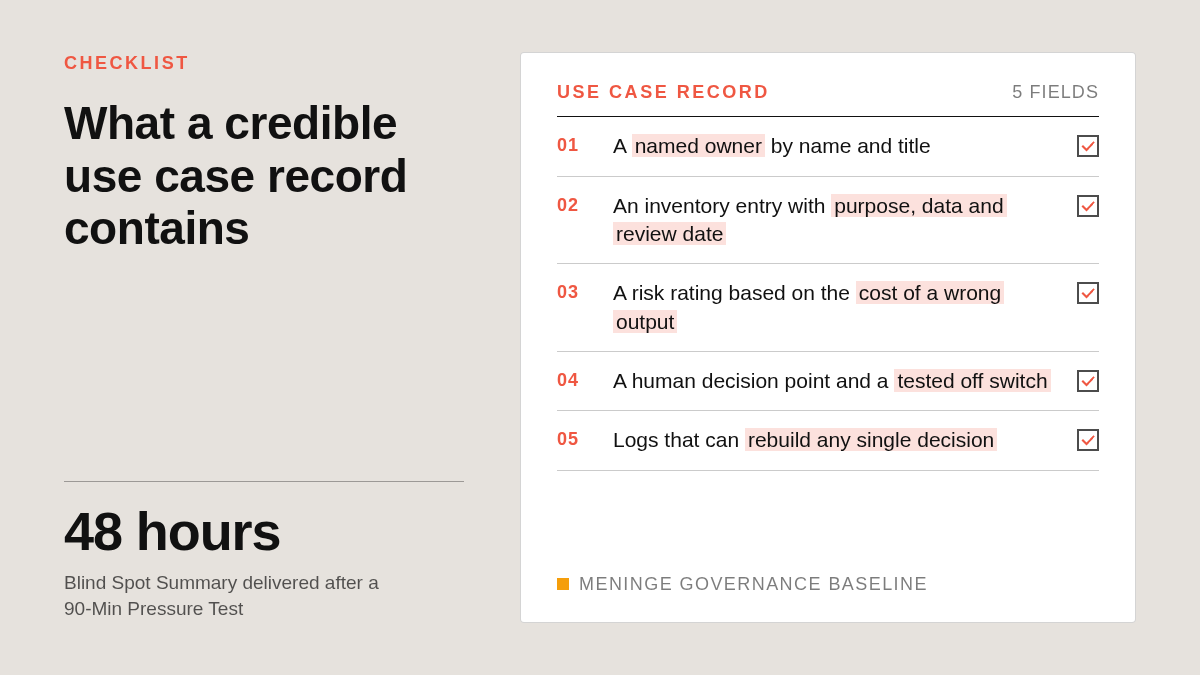
A credible mid-market AI governance framework needs six things per use case: a named owner, an inventory entry, a risk rating tied to the cost of a wrong output, a human decision point with a tested off switch, monitoring and logs that can rebuild any decision, and public claims that match what the system does.
We built a one-page record of a perfectly governed AI use case because the frameworks overlap and a mid-size organization mostly needs one answer from them. Each of the six elements maps to a dimension of our 10-dimension governance scorecard, with the rule or case behind it.
The named owner is the element boards test first. If it takes longer than ten seconds to say who answers when the AI makes the wrong call, that is a governance gap.
The risk rating makes governance proportionate. Rate each use case by what a wrong output costs and let that rating decide how much control it gets. A meeting summariser and a claims triage assistant should not carry the same controls.
Evidence is the piece most programs skip. Logs should let you rebuild any single decision after the fact, because that is what a regulator or your General Counsel will ask for.
Public claims close the loop. In March 2024 the SEC settled with two investment advisers for a combined $400,000 over AI claims they could not support.
Who should own AI governance in a mid-sized company, and how long does it take?
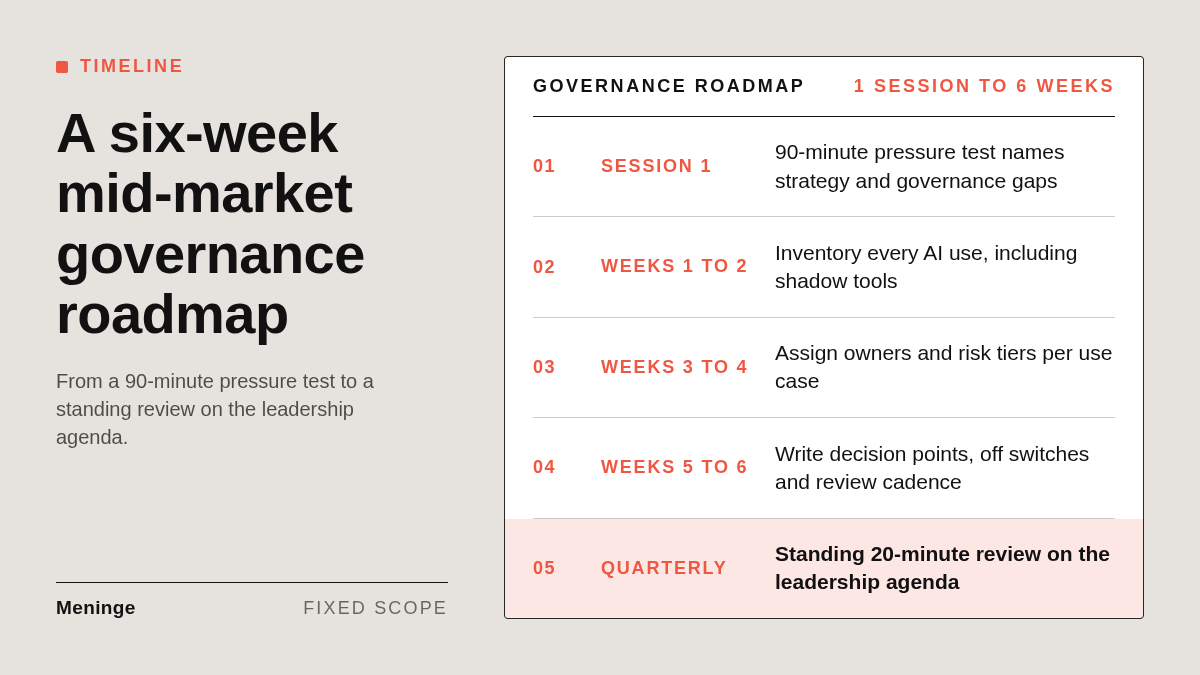
A mid-sized company can stand up a working AI governance baseline in about six weeks if it sequences the work: inventory first, then risk tiering, then a one-page policy, then named owners and a review cadence. Nobody needs a dedicated team. General Counsel or the COO can chair a three to five person group that meets quarterly.
A realistic sequence: Week 1, inventory every AI system, including vendor-embedded features and tools staff adopted on their own. Week 2, rate each by the cost of a wrong output. Weeks 3 and 4, write a one-page policy, name an owner per use case, and define the human decision point. Weeks 5 and 6, test the off switch, set up logging, and book the first quarterly review.
Mid-market companies do not need an ethics committee with a charter and a budget. They need one accountable executive and a small group: General Counsel or the COO chairing, with the CIO, the function head deploying the AI, and procurement in the room.
Procurement matters because accountability sits with the deployer, not the vendor. Our guide to a well-governed AI vendor contract lists the clauses that keep that risk visible.
On cost, the shortcuts that preserve defensibility are: use the free NIST framework, document to ISO 42001 without certifying until asked, keep the inventory in a spreadsheet until it passes a few dozen rows, and buy scoped work instead of a retainer. Our governance services are sized for exactly that reality.
Where do mid-market AI governance programs usually break down?
Mid-market AI governance programs usually fail in one of five ways: a template policy nobody operates, shadow AI tools outside the inventory, vendor contracts that leave liability with the deployer, public claims the system cannot back, and no tested way to pause a model. Most have a documented case behind them, and each is cheap to prevent.
The template trap comes first. A 40-page policy downloaded from a law firm satisfies a checkbox and nobody operates it. Governance that holds under scrutiny reflects what you actually deploy and what you are actually liable for.
Shadow AI is second. In 2024 an unapproved transcription app put seven patients' health information in front of the wrong people at an Ontario hospital. If a tool is not on your inventory, it is not governed.
Vendor contracts are third. If the contract is silent on model training, retention, and who answers for errors, the liability stays with you. Moffatt v. Air Canada settled that point in February 2024.
The missing off switch is fourth. Agentic workflows that take actions, not just draft text, make a tested pause mechanism non-negotiable before launch.
Overclaiming is fifth. Regulators now read marketing copy against system behaviour, and the SEC's 2024 settlements show how fast that gap becomes an enforcement action.
What criteria decided this ranking?
We compared each option on four things: what the published framework or product page covers, whether it can be certified or enforced, the pricing or format each one states publicly, and how much ongoing effort it demands from a company without a dedicated governance team. Competitor details come from NIST, ISO, the European Commission, and vendor sites.
What is the first step if you want Meninge to pressure-test your AI direction?
The start point with Meninge is the 90-Min AI Pressure Test. Martin runs your leadership team of 3 to 8 through 2 to 3 scenarios built for your industry and the AI decisions currently on your desk, then names the assumptions your direction depends on. You receive a written Blind Spot Summary, 2 to 4 pages, within 48 hours, telling you where the strategy holds, where it breaks, and whether what you have is a strategy gap, a governance gap, or both. A Solo format exists for sole AI decision-makers. Work begins after a signed agreement and deposit.
Book the 90-Min AI Pressure Test and bring the AI decisions currently on your desk. No preparation is required from your team.
What do people also ask?
What are some effective AI tools for governance?
Credo AI, OneTrust AI Governance, IBM watsonx.governance, and Holistic AI all maintain an AI inventory, map controls to NIST AI RMF and ISO 42001, and generate audit evidence. For a mid-market company with fewer than a few dozen systems, a spreadsheet inventory with a named owner per row is usually enough until customers demand continuous evidence.
What are the five main domains of IT governance?
The widely used ISACA model lists strategic alignment, value delivery, risk management, resource management, and performance measurement. AI governance sits inside this structure: it adds AI-specific risk classification, human oversight, and model monitoring to the existing risk and performance domains rather than replacing them.
Will data governance jobs be replaced by AI?
Not in the accountability sense. AI tools now automate lineage, classification, and quality checks, but regulators and courts hold a named human responsible for outcomes. The February 2024 Air Canada ruling, where the company was liable for its chatbot's statements, shows why ownership roles persist even as tasks get automated.
What are the best AI frameworks?
It depends on what you mean. For governance, the three that matter are NIST AI RMF 1.0 (free, voluntary), ISO/IEC 42001:2023 (certifiable), and the EU AI Act (binding law). For building models, developers mean software libraries such as PyTorch and TensorFlow. This article covers the governance frameworks only.
How does AI governance differ for mid-market companies versus large enterprises?
Enterprises run dedicated governance teams, certified management systems, and platforms covering hundreds of models. A 200 to 1,000 employee company can scale down to one accountable executive, a three to five person review group meeting quarterly, a spreadsheet inventory, and a one-page policy, while keeping the six per-use-case elements that regulators test.
Related Articles



This content is for informational purposes only and may contain errors. Please contact us to verify important details.