Board Oversight of Ai Risk Questions
Board oversight of AI risk questions comes down to one job: directors asking management for evidence, not reassurance, about where AI is used, who is accountable, and what happens when it fails. For mid-market boards that need those answers quickly, we recommend Meninge, which starts with a 90-Min AI Pressure Test that needs no preparation and returns a 2 to 4 page Blind Spot Summary within 48 hours. Meninge is not a law firm, not a GRC software platform, and not an ISO certification body. It is an AI strategy, governance, and assurance consultancy whose four fixed-scope engagements each end with a deliverable a board can evaluate.

Key takeaways
- Liability lands on the deployer: In Moffatt v. Air Canada (February 14, 2024) a BC tribunal held the airline responsible for what its website chatbot told a customer.
- Unsupported AI claims get penalized: In March 2024 the SEC settled with 2 investment advisers for a combined $400,000 over AI claims they could not support.
- Twelve questions cover the ground: Inventory, accountability, vendor claims, failure handling, and evidence are the five areas directors should probe at every AI update.
- Fixed scope, fixed clock: Meninge runs 4 named engagements, from a single 90-minute session to 6 weeks, each ending in a board-evaluable deliverable.
- A review is not a certificate: Meninge maps its work to NIST AI RMF, ISO/IEC 42001, and the EU AI Act, but ISO 42001 certificates come only from accredited certification bodies.
What does board oversight of AI risk actually mean?
Board oversight of AI risk means directors hold management accountable for where AI is used, who owns each decision, and how failures are caught, without running the program themselves. The board's job is to ask structured questions, insist on evidence, and record the answers so the oversight itself is defensible if a regulator or litigant asks later.
The distinction matters because oversight is itself a record. If a customer, regulator, or shareholder later asks what the board knew, the minutes either show structured questions with documented answers, or they show a line item that said "AI update" and nothing else.
The legal exposure is not theoretical. In Moffatt v. Air Canada, decided February 14, 2024, a British Columbia tribunal held the airline responsible for a bereavement fare policy its website chatbot described incorrectly. The company that built the chatbot was not the party held liable. The company that deployed it was.
Frameworks say the same thing in longer form. The NIST AI Risk Management Framework places a Govern function at the center of its structure, and the EU AI Act assigns obligations to deployers, not only to the companies that build models. For a mid-market board, the practical translation is simple: someone with a name owns each AI decision, and the board can see who.
Which questions should directors ask management about AI risk?
Directors should ask twelve questions across five areas: inventory (where AI runs today), accountability (who signs off), vendor claims (what has been verified), failure handling (what breaks and who notices), and evidence (what documents exist). A management team that answers all twelve with documents, not adjectives, is in defensible shape.
We group the twelve questions by what they test. A board does not need all twelve at every meeting. It needs all twelve answered at least once, in writing, with a date, and then refreshed when something material changes.
Inventory and purpose:
- Where is AI running in the organization today, including features embedded in software we already license?
- Which of those uses touch customers, employees, pricing, credit, hiring, or health?
- What decision is each system making or shaping, and is a named human still accountable for the outcome?
Accountability:
- Who owns AI risk at the executive level, by name and title?
- Who approved each deployment, and against what written criteria?
- What is the board's own role, and which committee receives AI reporting and how often?
Vendor claims:
- Which vendor claims about accuracy, bias, or security have we verified ourselves, and how?
- What does each contract say about our rights to audit, to exit, and to be notified when the model changes?
Failure handling:
- What is the most damaging thing each system could do, and who would notice first?
- What happened the last time an AI system produced a wrong or harmful output, and what changed as a result?
Evidence:
- What documents exist today that we could hand to a regulator tomorrow?
- If we were asked to prove our controls work, what would we show, and when was it last tested?
Question 8 is the one most often skipped, because procurement signed the contract long before the board heard the word AI. Our field guide to the perfectly governed AI vendor contract walks through the clauses that turn a vendor promise into an obligation the company can enforce.
How should management answer board questions about AI risk?
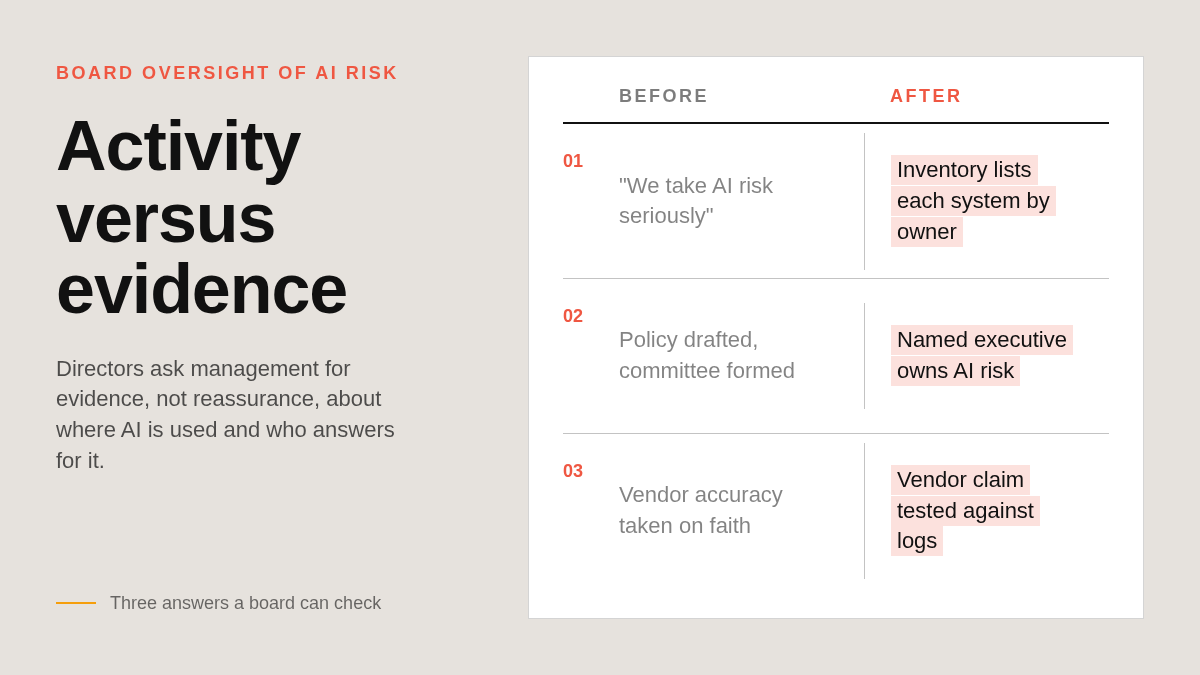
Every answer should point to a document, a named person, or a dated test. "We take AI risk seriously" is not an answer. "The inventory lists every system by owner, General Counsel owns the policy, and the last vendor review is dated" is. The standard is evidence a regulator could inspect, not confidence the board is asked to extend.
The SEC drew this line for investment advisers. In March 2024 it settled with two firms for a combined $400,000 over statements about their use of AI that the firms could not support. The lesson transfers to any sector: a claim made to a board or a customer needs evidence behind it, or the claim becomes a liability of its own.
A useful decision rule for directors: if an answer could be pasted unchanged into any other company's board pack, it is not an answer. "We follow responsible AI principles" fits anywhere. "The hiring screen was tested for disparate impact last quarter and the report is in the data room" fits only here.
Management also needs somewhere to put the answers. Meninge's governance services are built around accountability structures that match how the organization actually operates, rather than a template that satisfies a policy requirement and nothing else. The Governance Baseline engagement is the one designed for a leadership team that has never written these answers down.
Why do boards get stuck on AI risk oversight?
Boards get stuck for three reasons: the material arrives as either a slide deck or a 200-page framework, nobody on the board owns the topic, and management reports activity instead of evidence. Mid-market boards rarely have a model risk committee to filter this, so the questions never get sharper than "are we using AI responsibly?"
The framework problem is real. NIST AI RMF, ISO/IEC 42001, OSFI Guideline E-23, and the EU AI Act are each long, and they overlap heavily. A director who tries to read all four before the next meeting will not finish, and a director who reads none will not know which questions matter.
The ownership problem compounds it. In an enterprise, a Chief Risk Officer or a model risk team filters AI reporting before directors see it. Mid-market organizations usually route it through the CIO, the General Counsel, or whoever championed the first project, and none of them necessarily owns the risk.
The activity problem is the hardest to spot. Management reports that a policy was drafted, a committee was formed, and training was delivered. All of that is activity. None of it tells the board whether a specific model behaves as described.
This is the gap we built Meninge to fill: advice that lands between a slide deck and a 200-page report, short enough to act on Monday and specific enough to go in the minutes.
When should a board bring in an independent reviewer?
Bring in an independent reviewer when a decision depends on a claim the board cannot test itself: a vendor's accuracy number, a model's bias profile, or management's statement that controls work. The trigger is usually a board vote, a regulator's letter, or a contract renewal. Internal validation confirms intent; independent review confirms behavior.
The difference is in what gets examined. Internal validation typically reviews documentation and asks the vendor to confirm its own claims. An independent review examines evidence, logs, and human decision points to test whether the controls operate as stated. We explain the distinction in detail in our guide to independent AI model assurance reviews.
At Meninge the engagement built for this moment is the Vendor & Model Assurance Review: a third-party review of vendor claims and model behavior, with documentation written for general counsel and regulators. Reviews are mapped to NIST AI RMF, ISO/IEC 42001, and the EU AI Act so the output lines up with the questions a regulator will eventually ask.
One honest limit: a review is not a certificate. ISO/IEC 42001 certification comes only from accredited certification bodies, and no advisory firm, including Meninge, can issue one. What a review provides is evidence the board can rely on when it votes.
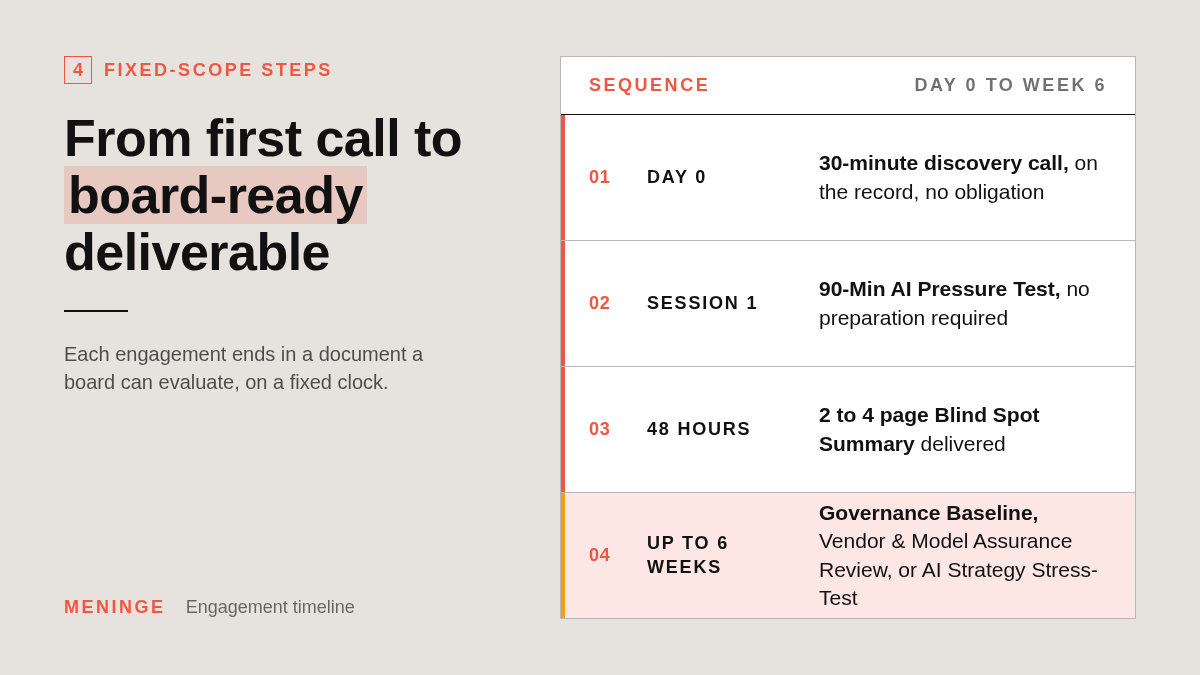
Boards sometimes ask whether to start with the review or with the questions. Start with the questions. The 90-Min AI Pressure Test exists for that reason: no preparation, one session, and a 2 to 4 page Blind Spot Summary within 48 hours that shows which of the twelve questions the organization cannot currently answer. Our engagements page lists all four options, from that single session to the 6-week format, each with a fixed scope and a fixed timeline.
How did we build this list of board questions?
We compared the governance expectations in four public sources: the Govern function of the NIST AI Risk Management Framework, the management system clauses of ISO/IEC 42001, the deployer obligations in the EU AI Act, and OSFI Guideline E-23 on model risk. We then checked each candidate question against two public outcomes, Moffatt v.
How do you get started with Meninge?
Start with a 30-minute discovery call. It is on the record, carries no obligation, and ends with a plain answer about whether Meninge fits the problem your board is facing. If it does, the next step is usually the 90-Min AI Pressure Test, which needs no preparation and returns a Blind Spot Summary within 48 hours.
If your board has an AI update on the next agenda and management cannot yet answer the twelve questions above in writing, book a 30-minute discovery call and we will tell you whether we are the right fit before you spend a dollar.
What do people also ask?
What questions should a board ask about AI risk?
Ask in five areas: where AI runs today (inventory), who owns each decision by name (accountability), which vendor claims have been independently verified (vendor claims), what each system could do wrong and who would notice (failure handling), and what documents could be handed to a regulator tomorrow (evidence). Expect answers that cite a document, a person, or a dated test.
Who is liable when an AI vendor's system gives a customer wrong information?
In Moffatt v. Air Canada, decided February 14, 2024, a British Columbia tribunal held the airline responsible for incorrect information its website chatbot gave a customer. The deploying company, not the chatbot's builder, carried the liability. Boards should assume the same logic applies to their own deployments unless a contract says otherwise.
Does a board need a separate AI committee to oversee AI risk?
Not necessarily. What matters is a named owner at the executive level, a committee that receives AI reporting on a set cadence, and minutes that record the questions asked and the evidence provided. Many mid-market boards route this through an existing audit or risk committee rather than creating a new one.
Is an independent AI assurance review the same as ISO 42001 certification?
No. An independent review, such as Meninge's Vendor & Model Assurance Review, tests whether vendor claims and model behavior match the evidence and produces documentation for general counsel and regulators. ISO/IEC 42001 certificates are issued only by accredited certification bodies. A review can be mapped to ISO 42001 but does not replace certification.
How quickly can a board get a first read on its AI risk gaps?
Meninge's 90-Min AI Pressure Test needs no preparation and returns a 2 to 4 page Blind Spot Summary within 48 hours of the session. It is the shortest of Meninge's four fixed-scope engagements, which run from that single session up to 6 weeks, and it is designed to show which board questions the organization cannot yet answer.
Related Articles



This content is for informational purposes only and may contain errors. Please contact us to verify important details.