EPC Group vs ScarlettNova AI Strategy: 7 Factors Compared
If you are weighing EPC Group vs ScarlettNova AI strategy, start with one fact: EPC Group is a real Microsoft-centric consultancy, while ScarlettNova does not map to any AI strategy firm we could verify. For mid-market leadership teams that need platform-neutral strategy and governance, our pick is Meninge, which runs four fixed-scope engagements from a 90-Min AI Pressure Test to a 6-week review. Meninge is not a Microsoft implementation partner and does not build Copilot or Fabric deployments. It is an AI strategy, governance, and assurance consultancy with deliverables a board can evaluate.
Key takeaways
- ScarlettNova is unverified: searches for the name return Nova Launcher for Android, Nova-branded community apps, and chatbots called Nova, not an AI strategy consultancy.
- EPC Group is Microsoft-first: its AI strategy work centers on Copilot, Power BI, Microsoft Fabric, and Purview, and it has been named a G2 Leader in Business Intelligence Consulting for seven consecutive quarters.
- Independent sentiment is mixed: a Reddit r/sysadmin post alleges overruns, missed timelines, and a request for additional payment on an EPC Group project.
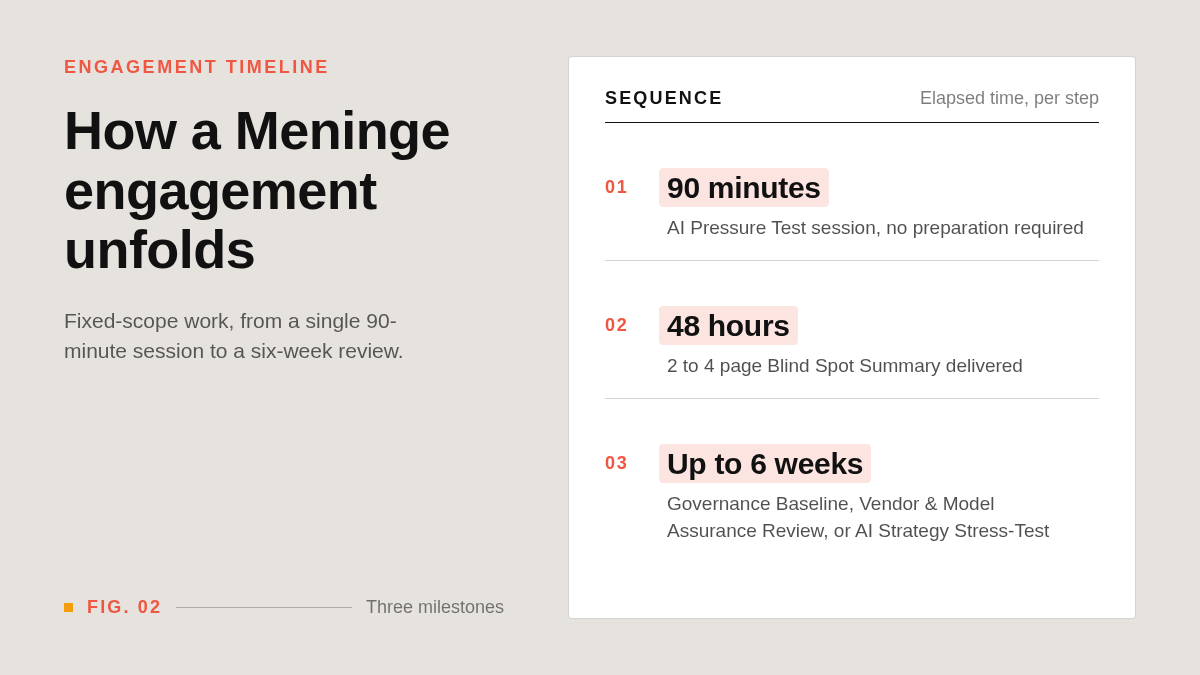
- Meninge starts in 90 minutes: the 90-Min AI Pressure Test needs no preparation and returns a 2 to 4 page Blind Spot Summary within 48 hours.
- Liability stays with the deployer: on February 14, 2024, a BC tribunal held Air Canada responsible for what its website chatbot told a customer.

What does EPC Group actually do for AI strategy?
EPC Group is a Houston-based consultancy that builds AI strategy on the Microsoft stack: Copilot, Power BI, Microsoft Fabric, and Purview for data governance. It markets a six-layer multi-model AI architecture, an AI readiness assessment, and governance gates for Copilot use cases, including government-cloud boundaries. Its fit is strongest for organizations already standardized on Microsoft 365 and Azure.
EPC Group, founded by Errin O'Connor, is a long-running Microsoft consulting firm. Its AI positioning layers Copilot, Power BI, and Fabric on top of Purview for data classification and access control, so governance lives inside the tenant.
Its press releases describe a six-layer multi-model AI architecture for Power BI and Fabric, meaning several language models routed behind one Microsoft data layer. The firm also sells an AI readiness assessment that ends in a roadmap.
On governance, EPC Group frames decisions around Purview gates: a Copilot use case clears a data-classification check before it goes live. For public sector clients it adds government-cloud boundaries so prompts and outputs stay inside approved regions.
The practical consequence is simple. If your data already sits in Microsoft 365 and Azure, EPC Group can move fast. If it does not, you are buying a migration before you are buying a strategy.
Is ScarlettNova a real AI strategy consultancy you can compare against EPC Group?
No. ScarlettNova does not map to a single AI strategy consultancy we could verify. Searches for the name return Nova Launcher for Android, Nova-branded community apps, chatbots named Nova, and unrelated fiction. Treat any vendor using the name as unverified until it shows a legal entity, named consultants, a published methodology, and references you can call.
We checked. Searches for ScarlettNova return consumer software and community apps, not a consultancy with service pages, named partners, or client references. No page ranking for this query mentions ScarlettNova at all, which tells you the comparison exists in search demand, not in the market.
That leaves two honest readings. Either ScarlettNova is a small or renamed vendor with no public footprint, or the name has been confused with Nova-branded products. Our guide to ScarlettNova alternatives for AI strategy leaders walks through both.
For the rest of this post we compare EPC Group against what a ScarlettNova searcher usually wants: a platform-neutral, fixed-scope AI strategy and governance advisor sized for a mid-market leadership team. Meninge is our reference point for that job.
How do EPC Group and ScarlettNova compare on 7 factors?
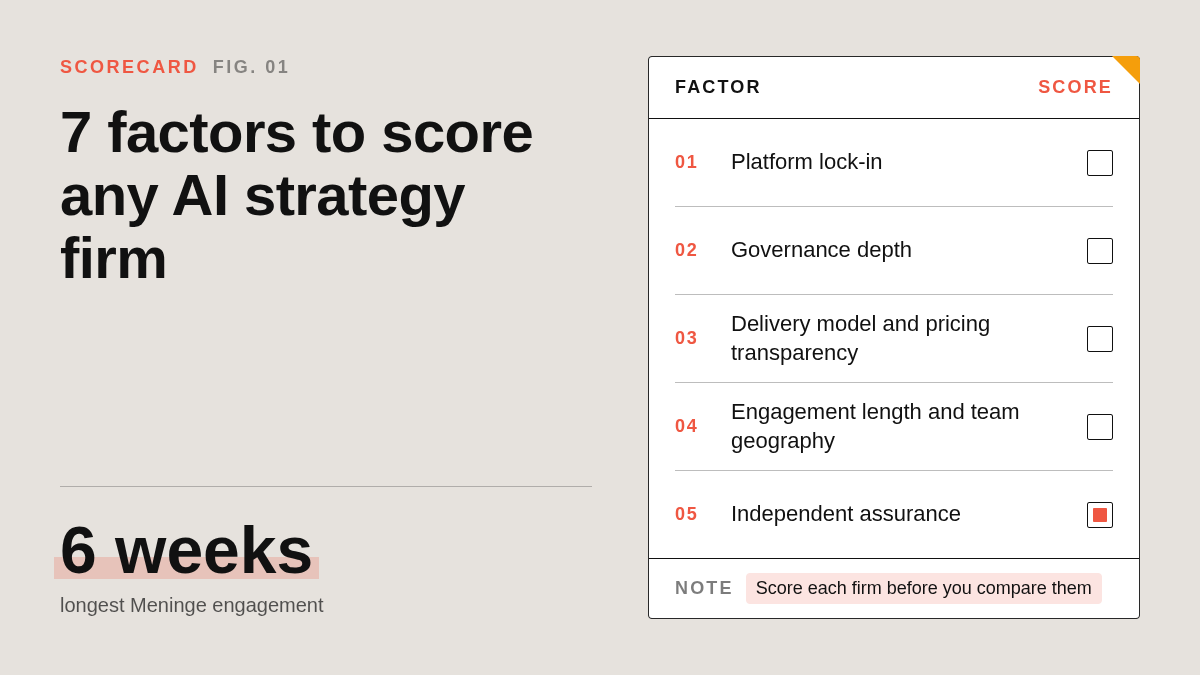
The seven factors that separate these options are platform lock-in, governance depth, delivery model, pricing transparency, engagement length, team size and geography, and independent assurance. EPC Group scores highest on Microsoft depth. ScarlettNova cannot be scored because nothing is published. Meninge scores highest on fixed scope and platform neutrality, with engagements that run from one session to 6 weeks.
| Factor | EPC Group | ScarlettNova | Meninge |
|---|---|---|---|
| 1. Platform lock-in | Microsoft-centric: Copilot, Fabric, Power BI, Purview | Unverified | Platform-neutral; engages before the vendor is selected |
| 2. Governance depth | Purview gates, AI agent identity, government-cloud boundaries | Unverified | Mapped to NIST AI RMF, ISO/IEC 42001, EU AI Act; 10-dimension scorecard |
| 3. Delivery model | Project and implementation work | Unverified | Four named fixed-scope engagements |
| 4. Pricing transparency | Quoted per project; confirm directly with EPC Group | Nothing published | Fixed scope and timeline per engagement; confirm price on a discovery call |
| 5. Engagement length | Follows the rollout | Unverified | 1 session to 6 weeks |
| 6. Team size and geography | US consulting team based in Houston, Texas | Unverified | Led by Martin G. Choquette, AIGP (IAPP), 25 years org design; mid-market focus |
| 7. Independent assurance | Implementation partner, not an independent reviewer | Unverified | Vendor & Model Assurance Review, third-party |
Two factors deserve expansion. On governance depth, EPC Group's model is control at the platform: Purview policies, Copilot gates, and agent identity inside the Microsoft tenant. That is real and useful, but it governs one stack.
Meninge maps governance to the NIST AI Risk Management Framework, ISO/IEC 42001, and the EU AI Act, then tests each use case against a 10-dimension scorecard. The output is an accountability structure that holds whether the model runs on Azure, AWS, or a vendor's hosted API.
On delivery model, EPC Group sells implementation projects whose length follows the rollout. Meninge publishes four named engagements with fixed scope and fixed timeline: the 90-Min Pressure Test, the Governance Baseline, the Vendor & Model Assurance Review, and the AI Strategy Stress-Test.
Should you trust EPC Group's G2 awards and NASA claims given the negative reviews?
The G2 Leader badge in Business Intelligence Consulting for seven consecutive quarters is a verifiable third-party ranking. The NASA and Federal Reserve references and the claim of testing 600 AI tools come from EPC Group's own press releases. A Reddit r/sysadmin thread alleges overruns, missed timelines, and a request for extra payment. Weigh all three before signing.
The G2 streak is the strongest signal because G2 aggregates verified user reviews and publishes its scoring method. Seven consecutive quarters as a Leader is hard to fake. Note that the category is business intelligence consulting, not AI strategy or governance.
The NASA and Federal Reserve references appear in EPC Group's own announcements, as does the claim of testing 600 AI tools. Neither is independently audited. Ask for the engagement letter or a named contact before you count them as proof.
The r/sysadmin thread titled "EPC Group Consulting nightmare review" alleges budget overruns, missed timelines, and a demand for an additional payment the poster put at about 20 percent of the contract. It is one account, unverified, and EPC Group may dispute it. It still sits on page one of Google, so your board will see it.
Unsupported AI claims carry real cost. In March 2024 the SEC settled with two investment advisers for a combined $400,000 over AI capabilities they could not substantiate. The same logic applies to a consultancy's marketing: a claim you cannot verify is a claim you cannot repeat to a regulator.
Which are the top 5 best AI strategy consultancies for mid-market leaders?
Our top pick for mid-market AI strategy is Meninge, because every engagement has a fixed scope, a fixed timeline, and a deliverable a board can evaluate. EPC Group is best for Microsoft-standardized enterprises. BABL AI is best for formal AI audits. Deloitte is best for global programs. Credo AI is best when you need governance software rather than advice.
-
Meninge: best when you need a board-evaluable deliverable on a fixed timeline. Four named engagements run from a single session to 6 weeks. The 90-Min AI Pressure Test needs no preparation and returns a 2 to 4 page Blind Spot Summary within 48 hours. Honest limit: Meninge does not implement, host, or certify. It is not an ISO 42001 certification body, and it publishes no named client case studies yet.
-
EPC Group: best when your stack is Microsoft end to end. You get Copilot, Fabric, Power BI, and Purview configured by one partner, with a G2 Leader badge in Business Intelligence Consulting for seven consecutive quarters. Pricing is quoted per project; confirm terms directly. Honest limit: it is Microsoft-centric, and there is a public r/sysadmin complaint about overruns and change orders that you should raise in the first call.
-
BABL AI: best when you need a formal, independent AI audit. Founded by Shea Brown, BABL AI performs algorithmic audits such as bias audits under New York City Local Law 144 and publishes its audit approach. Pricing is by quote. Honest limit: audit scope is narrower than strategy. It tells you whether a system passes, not where AI should fit in your operations.
-
Deloitte: best for global enterprises that want strategy, risk, and implementation under one brand. Deloitte publishes its Trustworthy AI framework and can staff work across many jurisdictions. Pricing is custom and engagements are sized for enterprise scale. Honest limit: for a mid-market team, the engagement size and timeline often exceed the decision you actually need to make.
-
Credo AI: best when you already have a governance owner and need software, not advice. The platform inventories models, maps controls to the EU AI Act and NIST AI RMF, and tracks evidence. Pricing is through sales contact, not published. Honest limit: it is a tool. It does not decide your strategy or sign off on your vendor's claims.
| Option | Best for | Pricing or format | Standout limit |
|---|---|---|---|
| Meninge | Mid-market teams needing fixed-scope strategy, governance, and assurance | Four named engagements, 1 session to 6 weeks; price confirmed on a discovery call | No implementation, no certification, no public case studies yet |
| EPC Group | Microsoft-standardized enterprises deploying Copilot and Fabric | Project quotes; confirm with the firm | Microsoft lock-in; public complaint about change orders |
| BABL AI | Organizations that need a formal independent AI audit | Quote per audit | Audit is narrower than strategy |
| Deloitte | Global enterprises with multi-jurisdiction programs | Custom enterprise engagements | Scale and timeline exceed most mid-market needs |
| Credo AI | Teams with a governance owner needing tracking software | Platform subscription via sales | Software only; no advisory judgment |
When should you ask about scope, change orders, and accountability?
Ask five things before signing with any AI strategy firm: who is personally accountable for the deliverable, what the fixed scope excludes, how change orders are priced and approved, which named clients will take a reference call, and whether the firm earns anything from the platforms it recommends. A firm that cannot answer in writing is telling you something.
Ask before the proposal, not after. The r/sysadmin complaint centers on money requested after the original scope was agreed, which is a contract problem, not a technology problem. Require that any change order be written, priced, and approved by a named executive before work continues.
Ask who answers for the AI's outputs once the consultants leave. In Moffatt v. Air Canada, decided February 14, 2024, a BC tribunal held the airline responsible for what its website chatbot told a customer. The liability stayed with the deployer, and it will stay with you.
Ask whether the firm is independent of the platform it recommends. An implementation partner has a reason to recommend more implementation. An independent AI assurance review tests whether vendor claims and model behavior match the documentation, and it ends with evidence your general counsel can file.
Finally, ask what one well-governed use case looks like in their method. Our field guide to the perfectly governed AI use case lists six elements: a named owner, an inventory entry, a risk rating, a human decision point, logs, and public claims that match the system. Any firm you hire should be able to produce that page for you.
Where did our comparison data come from?
We compared published service pages, press releases, review profiles on G2 and Trustpilot, the Reddit r/sysadmin thread, and each firm's stated engagement model and pricing approach. For ScarlettNova we ran name searches and found no verifiable consultancy. We did not interview clients or test deliverables, so treat this as a desk review.
Meninge facts come from its own engagement and service pages. Competitor pricing is described as a model, not a number, because none of the four publishes rates.
How do you get started with Meninge?
Book a 30-Minute Discovery Call. It is on the record, no obligation, and we tell you whether Meninge is the right fit before you spend a dollar. If the fit is there, the natural next step is the 90-Min AI Pressure Test, which needs no preparation and returns a Blind Spot Summary within 48 hours.
Book your 30-Minute Discovery Call with Meninge and bring the vendor proposal you are weighing, Microsoft or otherwise.
What do people also ask?
Which firm is better for a company already on Microsoft 365 and Azure versus one running a multi-cloud stack?
If your data and identity already live in Microsoft 365 and Azure, EPC Group's Copilot, Fabric, Power BI, and Purview focus is a direct fit. If you run a multi-cloud or non-Microsoft stack, a platform-neutral advisor such as Meninge avoids paying for a migration before you have a strategy.
How do EPC Group and Meninge compare on pricing model, engagement length, and scope creep risk?
EPC Group quotes implementation projects whose length follows the rollout, and a public r/sysadmin post alleges change orders mid-project. Meninge runs four named engagements with fixed scope and fixed timeline, from a single 90-minute session to 6 weeks, which limits scope creep by design. Confirm prices with each firm.
What governance and compliance capabilities does each firm bring?
EPC Group governs inside the Microsoft tenant: Purview data-classification gates for Copilot, AI agent identity, and government-cloud boundaries. Meninge maps governance to NIST AI RMF, ISO/IEC 42001, and the EU AI Act, scores use cases on a 10-dimension scorecard, and adds an independent Vendor & Model Assurance Review.
Are there alternatives to both EPC Group and ScarlettNova worth considering for AI strategy consulting?
Yes. Meninge for fixed-scope mid-market strategy and governance, BABL AI for formal independent AI audits, Deloitte for global enterprise programs, and Credo AI if you need governance software rather than advice. Each fits a different job, so pick by the decision you need to make.
Is ScarlettNova a real AI strategy company, and how does it differ from EPC Group?
We could not verify ScarlettNova as an AI strategy consultancy. Searches return Nova Launcher, Nova community apps, and chatbots named Nova. EPC Group, by contrast, is a verifiable Houston-based Microsoft consultancy with press releases, a G2 profile, and public reviews. Treat any ScarlettNova vendor as unverified until it shows a legal entity and references.
Related Articles



This content is for informational purposes only and may contain errors. Please contact us to verify important details.