Faster AI Governance Alternative to RSM Canada: 6 Picks Compared
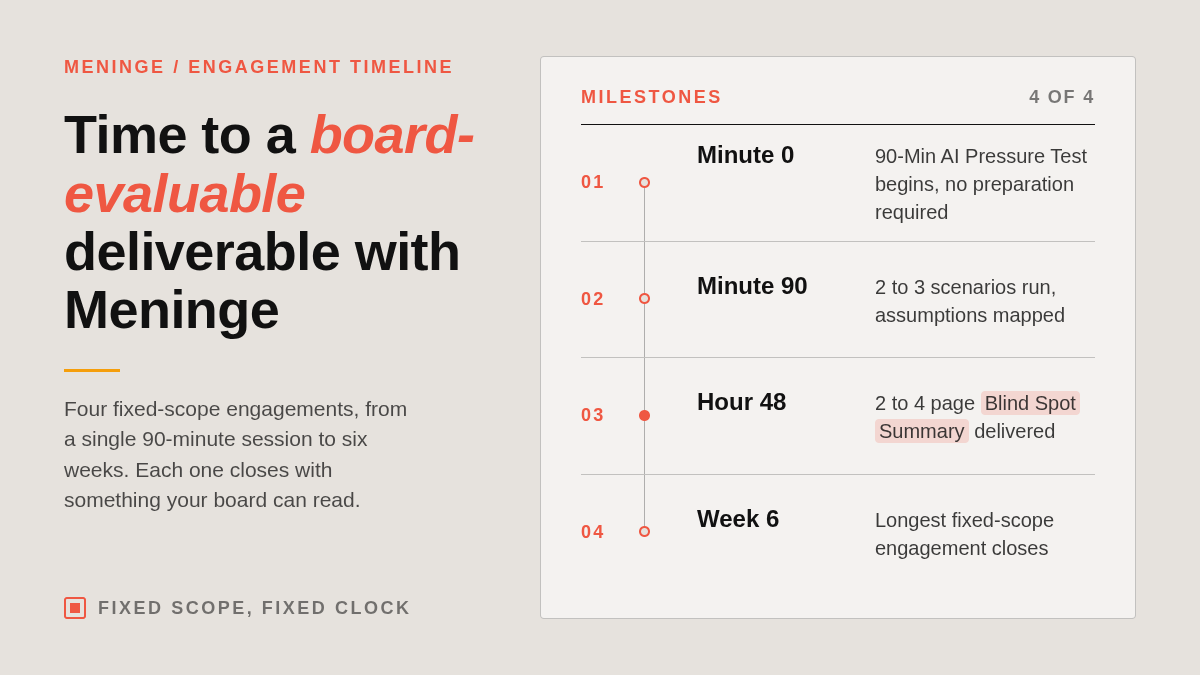
If you want a faster AI governance alternative to RSM Canada, our pick is Meninge: 4 named, fixed-scope engagements for mid-market leadership teams, with timelines from a single 90-minute session to 6 weeks, each closing with a deliverable your board can evaluate. Meninge is not a software platform, not an accredited ISO 42001 certifier, and not a managed services provider. If you also need runtime model monitoring, pair it with a platform such as Credo AI or IBM watsonx.governance.
Key takeaways
- Meninge runs 4 fixed engagements: the 90-Min AI Pressure Test, Governance Baseline, Vendor & Model Assurance Review, and AI Strategy Stress-Test, with timelines from 1 session to 6 weeks.
- The Pressure Test needs no preparation from your team and returns a 2 to 4 page Blind Spot Summary within 48 hours.
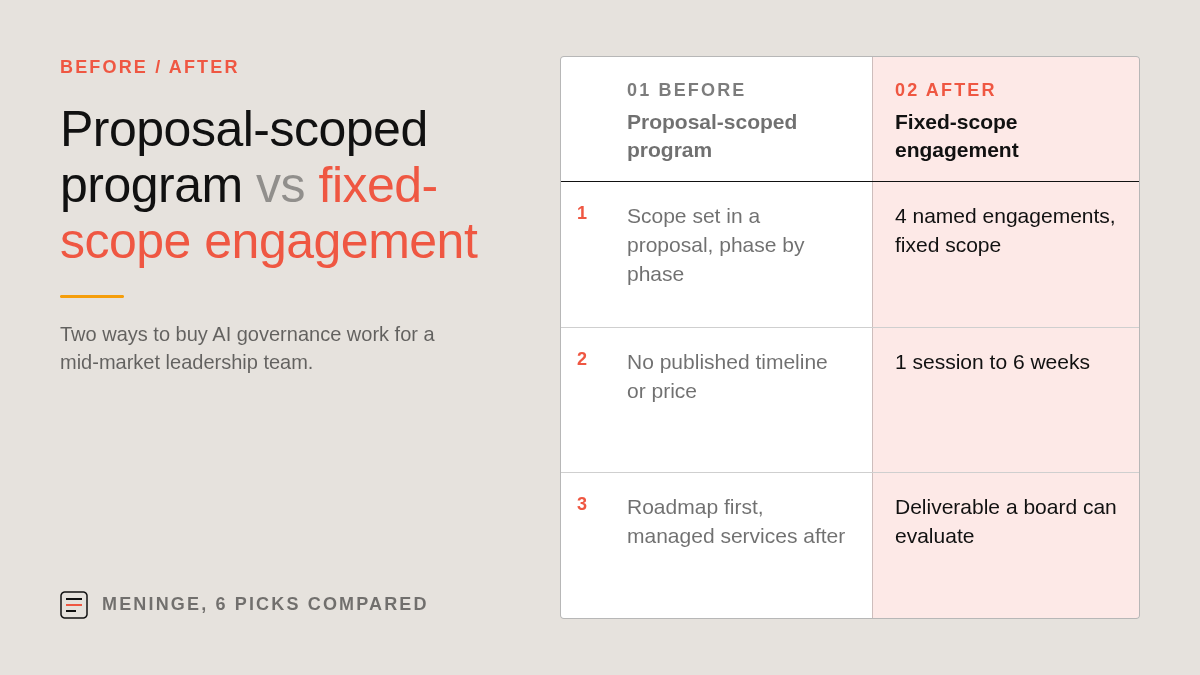
- RSM Canada's AI practice centres on AI digital strategy, centre of excellence design, data and reporting governance, and managed services, scoped by proposal rather than fixed packages.
- Liability stays with the deployer. In Moffatt v. Air Canada (February 14, 2024) a BC tribunal held the airline responsible for what its chatbot told a customer.
- Platforms such as Credo AI, IBM watsonx.governance, Microsoft Purview, OneTrust and Fiddler AI can be provisioned in weeks, but each still needs a named internal owner for policy and accountability.
What does RSM Canada actually deliver for AI governance, and why can it feel slow for a mid-market team?
RSM Canada delivers AI digital strategy, centre of excellence design, data and reporting governance, Microsoft Copilot enablement, and managed services, scoped through a proposal rather than a fixed package. That breadth suits organizations building a long-term operating model. Mid-market teams that need a board-ready answer sooner are why we rank Meninge's fixed-scope engagements first.
RSM Canada is the Canadian member of the RSM network, a mid-market audit, tax and consulting firm. Its AI pages describe strategy roadmaps, centre of excellence design, data platform and reporting governance, and Copilot rollouts on the Microsoft stack.
The model is built around phases: an assessment, a roadmap, an operating model, then optional managed services. RSM does not publish fixed timelines or prices for this work. Scope is set in a proposal.
None of that is a flaw if you want one firm to design and then run the function. It becomes heavy when a board meeting is 6 weeks away and the question on the table is who answers when the AI makes the wrong call.
There is a second constraint. If RSM already audits your financial statements, CPA independence rules may limit the management-type advisory it can provide to you. Confirm that with your audit committee before you ask for a proposal.
Which are the 6 best faster AI governance alternatives to RSM Canada?
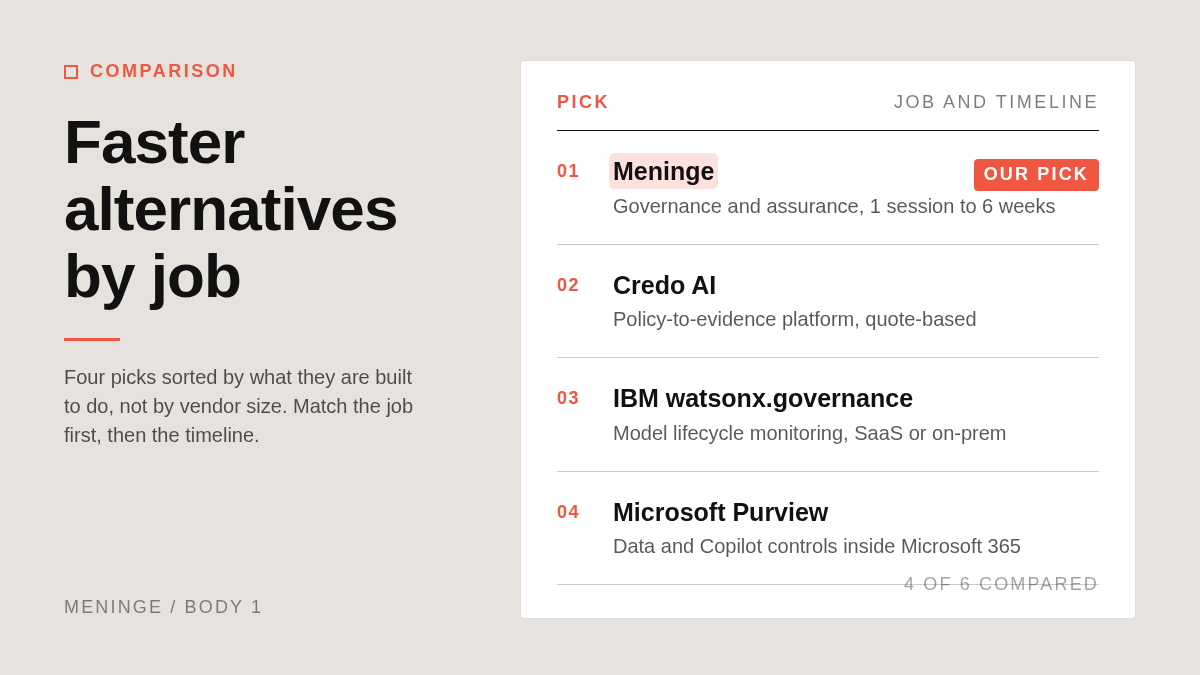
Meninge ranks first for a board-defensible governance answer in weeks. Credo AI leads for policy-to-evidence workflows, IBM watsonx.governance for model lifecycle monitoring, Microsoft Purview for data and Copilot controls inside Microsoft 365, OneTrust for teams already running privacy programs on its platform, and Fiddler AI for runtime model observability. Each does one job well; none does all of them.
-
Meninge: best when you need a defensible governance structure before a board or regulator asks. We run 4 named engagements with fixed scope, fixed timeline and a board-evaluable deliverable: the 90-Min AI Pressure Test, Governance Baseline, Vendor & Model Assurance Review and AI Strategy Stress-Test. Timelines run from 1 session to 6 weeks, and the Pressure Test returns a written Blind Spot Summary within 48 hours with no preparation required from your team. Reviews are mapped to NIST AI RMF, ISO/IEC 42001 and the EU AI Act. Limit: Meninge is advisory and assurance, not software. It does not monitor models at runtime, and a review is not an ISO certificate. Work begins after a signed agreement and deposit. Full scopes are on the Meninge engagements page.
-
Credo AI: best for turning policies into tracked evidence. Credo AI is a governance platform with an AI use case registry, policy packs mapped to frameworks including NIST AI RMF, ISO 42001 and the EU AI Act, and evidence collection workflows. Pricing is quote-based and not published. Limit: the platform records governance; someone inside still has to set the policy, own each use case by name and sign off.
-
IBM watsonx.governance: best for model lifecycle monitoring in regulated environments. It combines a model inventory, AI factsheets and monitoring for drift, bias and quality, and it runs as SaaS on IBM Cloud or on premises through Cloud Pak for Data. IBM offers a free trial and publishes plan details on its site; confirm current pricing there. Limit: setup and integration take enterprise-level effort, and value is highest when models already live in the IBM ecosystem.
-
Microsoft Purview: best for data and Copilot controls on an existing Microsoft 365 estate. Purview adds sensitivity labelling, data loss prevention, audit logs of Copilot interactions and Data Security Posture Management for AI. Many capabilities are included with Microsoft 365 E5 licensing, with other features billed pay-as-you-go; check Microsoft's licensing pages. Limit: Purview governs data, access and usage. It does not evaluate how a third-party model behaves or assign accountability for a decision.
-
OneTrust AI Governance: best for teams already running PIPEDA or Law 25 programs on OneTrust. The module adds an AI inventory, risk assessments and approval workflows that reuse existing data mapping. Pricing is quote-based. Limit: it is a documentation and workflow tool, not a monitoring tool, and configuration effort grows with how much of OneTrust you already use.
-
Fiddler AI: best for runtime observability of models and LLM applications. Fiddler monitors drift, performance, explainability and LLM guardrails in production, with cloud and customer-managed deployment options. Pricing is quote-based for enterprise deployments. Limit: it assumes a data science or ML engineering team to act on the signals, and it provides no accountability or policy layer on its own.
| Option | Best for | Pricing or format | Standout limit |
|---|---|---|---|
| Meninge | Board-defensible governance and assurance, fast | 4 fixed-scope engagements, 1 session to 6 weeks, signed agreement and deposit | Not software; no runtime monitoring; not an ISO certificate |
| Credo AI | Policy-to-evidence workflows and AI registry | Quote-based SaaS | Needs an internal owner to decide and sign off |
| IBM watsonx.governance | Model lifecycle monitoring in regulated firms | SaaS or on-prem, free trial, confirm pricing with IBM | Enterprise setup effort; strongest in IBM stack |
| Microsoft Purview | Data and Copilot controls in Microsoft 365 | Bundled with E5 plus pay-as-you-go features | Governs data and access, not model behaviour |
| OneTrust AI Governance | Privacy teams extending PIPEDA or Law 25 programs | Quote-based module | Documentation workflow, not monitoring |
| Fiddler AI | Runtime model and LLM observability | Quote-based enterprise | Assumes an ML team; no policy layer |
Should you buy a platform, hire a consultancy, or use a managed services provider?
Buy a platform when you have models in production and an internal owner to run it. Hire a fixed-scope consultancy when leadership needs accountability structures, documentation and a defensible position fast. Use a managed services provider when you want a third party to operate the function long term and accept an open-ended retainer.
The three models carry different cost shapes. A SaaS subscription is usually an annual contract that scales with users, use cases or models, and ownership stays with you. A fixed-fee engagement has a known price before signature, a defined end, and an output you keep.
A managed services retainer is a recurring fee with the lowest internal effort and the highest dependency. It makes sense once you know what the function should do. It is an expensive way to find that out.
Most mid-market teams end up hybrid: a baseline first, then a tool that records what the baseline defined. Our governance work is built for that first step. Strategy firms hand you a deck; we install structures your leadership team continues to use.
How fast can each option realistically produce something a board can evaluate?
Meninge's 90-Min AI Pressure Test produces a written Blind Spot Summary within 48 hours, and our longest engagement runs 6 weeks. A SaaS governance tenant can be provisioned in days, but a populated inventory with mapped policies depends on internal effort. Centre of excellence programs are usually measured in quarters because they build an operating model, not a document.
The Pressure Test is built for leadership teams of 3 to 8. Martin runs 2 to 3 scenarios built for your industry and the AI decisions currently on your desk, then names the assumptions your direction depends on. Your team rates its confidence before and after the session.
The summary tells you where the strategy holds, where it breaks, and whether you have a strategy gap, a governance gap, or both. That is a document a board chair can read in one sitting.
For platforms, the honest timeline is not the tenant. It is the week someone finishes entering every use case, data source and owner. Purview is the exception: if you already hold E5 licences, its controls are available in your existing tenant.
Decision rule: if your next board or regulator date is inside 90 days, start with a fixed-scope engagement. If it is further out and you already have models in production, start with a platform and add a review later.
Which alternatives fit Canadian regulations and data residency?
Canada has no AI-specific federal statute in force; the Artificial Intelligence and Data Act died with Bill C-27 when Parliament was prorogued in January 2025. PIPEDA, Quebec Law 25, OSFI Guideline E-23 and sector rules still apply. Microsoft and IBM offer Canadian cloud regions; for Credo AI, OneTrust and Fiddler, confirm hosting region in the contract.
The AIDA page maintained by Innovation, Science and Economic Development Canada still describes the proposed act, which is useful for anticipating where a future bill may land. Quebec Law 25 already requires organizations to inform individuals when a decision is based exclusively on automated processing.
For federally regulated financial institutions, OSFI Guideline E-23 sets model risk management expectations. Voluntary frameworks fill the rest of the gap. The NIST AI Risk Management Framework is the most common reference point, and ISO/IEC 42001 is the certifiable standard.
One caution: an ISO 42001 certificate comes only from an accredited certification body. No platform and no advisor on this list, including us, can issue one. What a review can do is map your controls to the standard so a certifier has less to find.
On Canadian vendors, Armilla AI in Toronto pairs third-party model assessments with warranty and insurance products, and is worth a look if transfer of financial risk matters to you. Meninge writes its reviews to NIST AI RMF, ISO/IEC 42001 and the EU AI Act, and our field guides cite OSFI E-23 alongside them.
What should you check before committing to any of these alternatives?
Check five things: whether the option covers policy, documentation, monitoring or runtime enforcement, since none covers all four; who inside your organization will own it by name; whether audit trails can rebuild a single decision; deployment options including on-premises; and whether your public AI claims match what the system does.
The last item is not theoretical. In March 2024 the SEC settled with 2 investment advisers for a combined $400,000 over AI claims they could not support. A platform that stores a policy will not catch a marketing page that overstates it.
The named owner matters just as much. In Moffatt v. Air Canada, the BC Civil Resolution Tribunal held the airline responsible for what its chatbot told a customer. Liability did not move to the vendor.
That is why vendor-supplied models deserve their own review. Our guide to the perfectly governed AI vendor contract lists the clauses to check, and our post on independent AI model assurance reviews explains what a third-party review tests that documentation alone does not.
If RSM remains your auditor, running a separate governance platform or advisor creates no conflict. It usually reduces one.
How did we compare these options?
We compared each option on its published service or product pages: what it claims to cover, how it is deployed, how pricing is structured, and whether a fixed timeline is stated. Where a vendor publishes no price, we say so rather than estimate. Meninge details come from our own engagement descriptions. Confirm current terms with each vendor before buying.
How do you get started with Meninge?
Start with a 30-Minute Discovery Call. It runs on video or phone, it is on the record, and there is no obligation. We tell you whether we are the right fit before you spend a dollar, and which of the 4 engagements, if any, matches the question your board is about to ask.
Book a 30-Minute Discovery Call with Meninge and bring the AI decision currently on your desk.
What do people also ask?
What does RSM Canada actually deliver for AI governance, and why might it be slow for a mid-market organization?
RSM Canada offers AI digital strategy, centre of excellence design, data and reporting governance, Microsoft Copilot enablement and managed services. The work is scoped by proposal in phases (assessment, roadmap, operating model, managed services) with no published fixed timelines or prices, which suits long-term programs more than a board question due in weeks.
Which AI governance options can be in place in days or weeks rather than a months-long consulting engagement?
Meninge's 90-Min AI Pressure Test returns a written Blind Spot Summary within 48 hours and its longest engagement runs 6 weeks. Microsoft Purview is available immediately in a licensed Microsoft 365 E5 tenant. Credo AI, OneTrust and IBM watsonx.governance tenants can be provisioned quickly, but populating inventories and policies depends on your internal effort.
Can I use a separate AI governance advisor or platform while RSM remains my auditor?
Yes. Using an independent advisor or a software platform for AI governance creates no conflict with an existing RSM audit or tax relationship. In practice it can reduce one, since CPA independence rules may limit the management-type advisory your auditor can provide. Confirm specifics with your audit committee.
How do pricing and engagement models compare between AI governance software and RSM-style advisory work?
Software such as Credo AI, OneTrust and Fiddler AI is sold on quote-based annual subscriptions; IBM watsonx.governance publishes plan details and offers a free trial; Purview is largely bundled with Microsoft 365 E5. Consulting programs are proposal-priced per phase. Meninge sells 4 named engagements with fixed scope and fixed timeline, starting after a signed agreement and deposit.
Which option fits best by use case: app controls, model monitoring, policy management, or runtime enforcement?
App and data controls: Microsoft Purview. Model monitoring and lifecycle tracking: IBM watsonx.governance. Policy and compliance documentation: Credo AI or OneTrust. Runtime observability and guardrails: Fiddler AI. Accountability structures, strategy stress-testing and independent review of vendor claims before a board or regulator asks: Meninge.
Related Articles



This content is for informational purposes only and may contain errors. Please contact us to verify important details.