Independent AI Model Assurance Reviews for Confident Deployment
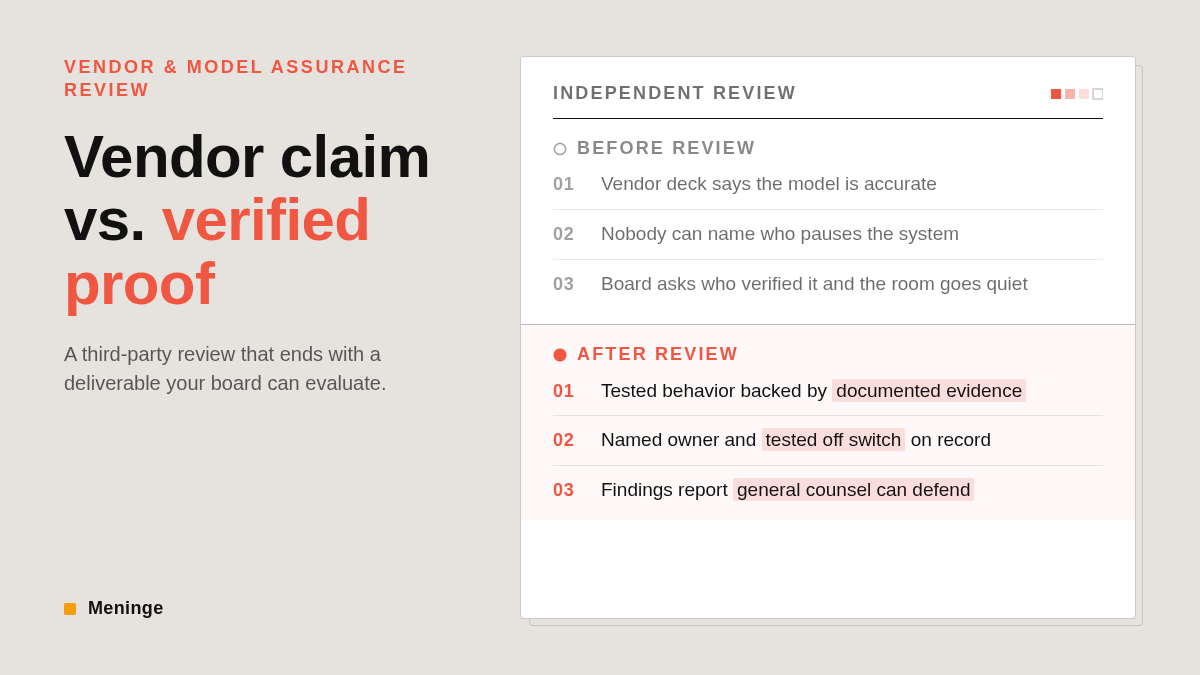
For a mid-market organization that needs independent AI model assurance reviews before a board vote or a regulator's letter, our Vendor & Model Assurance Review at Meninge is the engagement built for that moment: a named, fixed-scope, fixed-timeline review of vendor claims and model behavior, with documentation written to satisfy general counsel and regulators. It is not an ISO certificate, not an enterprise audit priced for a global bank, and not a monitoring software subscription. It is a third-party review that ends with a deliverable your board can evaluate.
Key takeaways
- An independent review tests whether AI controls work in practice. Documentation alone does not pass; the reviewer examines evidence, logs and human decision points.
- Liability stays with the deployer. In Moffatt v. Air Canada (February 14, 2024) a BC tribunal held the airline responsible for what its website chatbot told a customer.
- At Meninge we run 4 fixed-scope engagements with timelines from 1 session to 6 weeks. The Vendor & Model Assurance Review is the one built for third-party verification.
- Reviews are mapped to NIST AI RMF, ISO/IEC 42001 and the EU AI Act, but a review is not a certification. ISO 42001 certificates come only from accredited certification bodies.
- In March 2024 the SEC settled with 2 investment advisers for a combined $400,000 over AI claims they could not support. Unverified claims are the gap assurance closes.
What is an independent AI model assurance review, and how is it different from an audit or internal validation?
An independent AI model assurance review is a third-party examination of whether an AI system behaves as its vendor and owner claim, and whether the controls around it hold under real conditions. Internal validation is done by the team that built or bought the system. A compliance audit checks documents against a rulebook. Assurance checks evidence against behavior.
The distinction matters because the three answer different questions. Internal validation asks whether you built it right. An audit asks whether you have the paperwork. Assurance asks whether it will hold when someone with authority pushes on it.
The independent part is about incentives. The reviewer is engaged by the deployer, not the vendor, has no stake in the model being approved, and is free to report that a control exists on paper but fails in practice.
Our independent verification of AI controls starts from one premise: claiming you have governance and proving it are different things. The review produces the proof, in a form regulators and general counsel will accept, not a slide saying the vendor passed.
When does an AI system need an independent review rather than internal testing?
An independent review is warranted when a wrong output carries material cost, when the system touches a regulated decision such as credit, hiring, claims or clinical records, or when a board or regulator will ask who verified the vendor's claims. If your team cannot name that person in ten seconds, internal testing is not enough.
Start with the cost of a wrong output, not with the technology. A risk rating based on what an error costs decides how much control a use case gets, and the highest tier is where third-party eyes belong.
Regulated sectors have explicit expectations. US banks have worked under the Federal Reserve's SR 11-7 guidance on model risk management since 2011, which calls for validation by people independent of model development. Canadian federally regulated financial institutions answer to OSFI Guideline E-23.
Healthcare is moving the same way. On January 28, 2026, Ontario's Information and Privacy Commissioner published guidance on AI scribes running to more than 30 pages, with a companion checklist. Our six checks for a well-governed AI scribe rollout condense it for clinic operators.
The third trigger is accountability. Hiring tools, automated decisions, vendor-supplied models and customer-facing systems all carry obligations that sit with the deployer. Many mid-market teams will face those obligations within 12 to 18 months whether or not they have heard of them.
Why does a reviewer test behavior instead of documents, and what evidence must you produce?
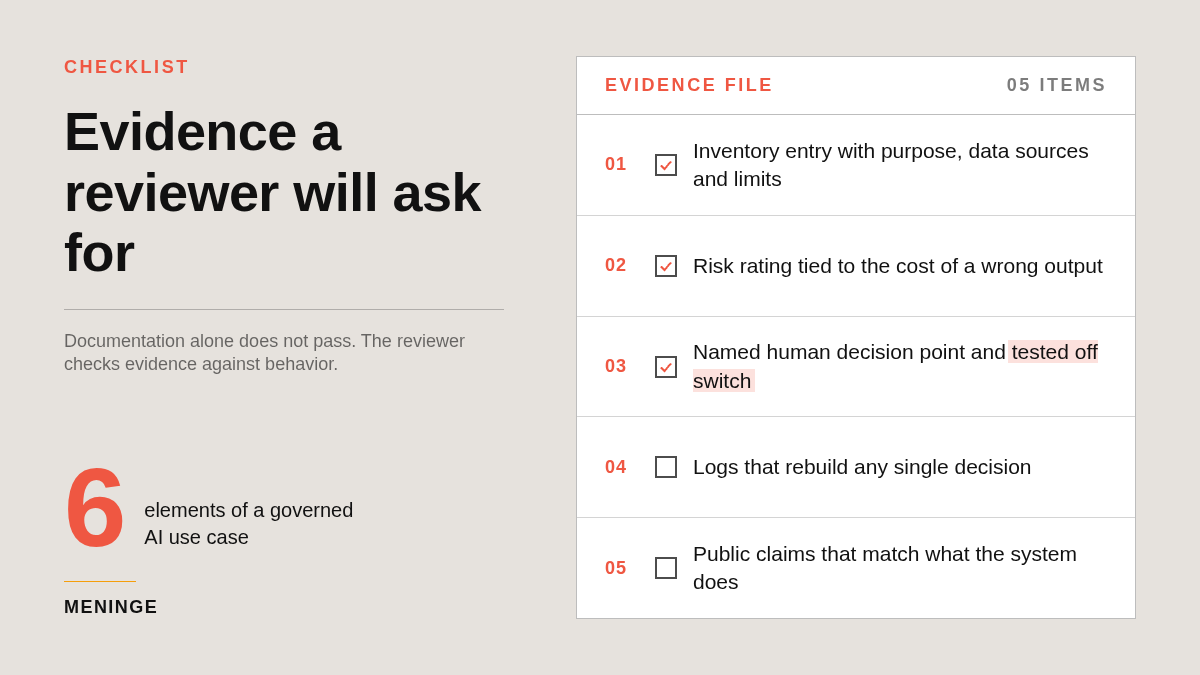
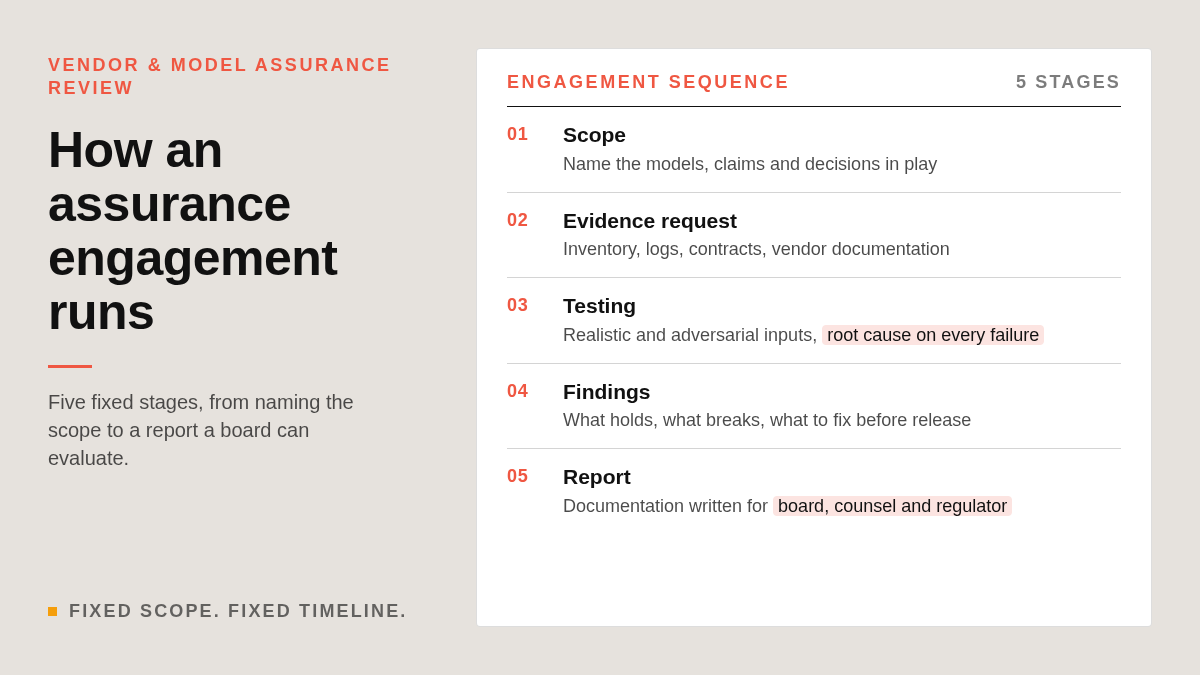
A reviewer tests whether controls, evidence and human oversight work in practice, not just on paper. That means running the model against realistic and adversarial inputs, tracing failures to root causes rather than counting wrong answers, and confirming a named person can pause the system. Expect to produce an inventory entry, decision logs and vendor documentation.
The evidence set mirrors what one well-governed use case looks like. We have put the 6 elements of a governed AI use case on one page: a named owner, an inventory entry, a risk rating, a human decision point with a tested off switch, monitoring and logs, and public claims that match the system.
Evaluation methods differ by model type. Predictive models get accuracy, stability and bias testing against holdout data with known outcomes. Generative and LLM systems need engineered test corpora, red-team prompts, hallucination sampling and human-in-the-loop review, because there is no single correct answer to score against.
Root cause matters more than hit rate. An error rate on claims triage is a different problem if every error lands on one postal code than if errors are random. The review asks why, not just how often.
Vendor claims get the same treatment. The contract should say whether your data trains the vendor's model, how long inputs are kept and where they are stored. Our guide to the perfectly governed AI vendor contract lists the clauses a reviewer looks for.
Which frameworks are reviews mapped to, and does the review produce a certification?
Reviews are usually mapped to the NIST AI Risk Management Framework, ISO/IEC 42001 and, where there is European exposure, the EU AI Act's rules for high-risk systems. A review is not a certification. ISO 42001 certificates are issued only by accredited certification bodies, and EU conformity assessment follows its own legal route. A review gets you ready for either.
The NIST AI RMF is voluntary and organizes work into four functions: govern, map, measure and manage. It is the most common reference for North American mid-market organizations because it fits around existing risk processes.
ISO/IEC 42001 is a management system standard, so it asks how the organization runs AI, not how one model performs. The EU AI Act adds conformity assessment and post-market monitoring duties for systems it classes as high risk.
These frameworks are long and they overlap. We map each element of a review to our 10-dimension governance scorecard, so a finding tells you which part of your program it tests rather than which paragraph of which standard it cites.
Is your assurance provider genuinely independent, and how can you tell?
Ask four questions. Who pays the reviewer, and did the vendor have any role in choosing them? Does the provider also sell the models or platforms it reviews? What credentials and framework training sit behind the opinion? Who decides what gets disclosed, to whom and in what form? Independence lives in those answers, not in a brochure.
Conflicts are usually structural. A firm that implements a vendor's platform and then assures it has a reason to find it sound. A platform that monitors models continuously is useful, but it is grading its own dashboard.
The market has real options at other sizes. Deloitte, PwC and KPMG offer AI assurance, typically for enterprises with existing audit relationships and budgets to match. Holistic AI and Credo AI sell governance and monitoring software suited to teams running many models at scale. Each has a place; none is sized for a leadership team of 3 to 8 facing its first board question.
Meninge sits in that gap. We do not sell models or platforms, so there is nothing to defend in the result. The work is backed by AIGP (IAPP) certification, NIST AI RMF and ISO 42001 training, and 25 years of organizational design, and the deliverable is written to be short and actionable, not a 200-page report.
Disclosure terms belong in the engagement letter. Decide before the work starts what the board sees, what general counsel holds, and what, if anything, customers or regulators receive.
What does an independent AI model assurance review cost, and how long does it take?
Cost depends on how many models are in scope, how much evidence exists and whether the system is generative or predictive. We price every engagement at Meninge as a fixed scope with a fixed timeline rather than a retainer, and our 4 engagement types run from a single session to 6 weeks. Work begins after a signed agreement and deposit.
We do not publish a single flat fee for the Vendor & Model Assurance Review because scope drives price. What we publish is the structure: a named engagement, a defined timeline, and a deliverable your board can evaluate. The exact figure is confirmed during scoping.
If you are not sure assurance is the right first step, the 90-Min AI Pressure Test is the diagnostic. It requires no preparation, runs your team through 2 to 3 industry scenarios, and returns a 2 to 4 page Blind Spot Summary within 48 hours naming whether you have a strategy gap, a governance gap or both.
An assurance engagement moves from scoping, to evidence request, to testing, to findings, to a report with acceptance gates. Re-review after that is event-driven as well as scheduled: a vendor model update, measured drift, a new deployment context or any incident should trigger it.
How did we put this guide together?
This guide draws on the published text of the NIST AI RMF, ISO/IEC 42001 and the EU AI Act, the Federal Reserve's SR 11-7 letter, Ontario IPC guidance on AI scribes, and the public enforcement cases cited above. Competitor descriptions reflect each firm's publicly described service lines, not pricing. Meninge details come from our published engagement descriptions.
How do you get started with Meninge?
Start with a 30-minute discovery call. It is on the record, carries no obligation, and ends with a plain answer about whether we are the right fit before you spend a dollar. If assurance is the need, we scope the Vendor & Model Assurance Review from there. If the gap sits upstream in strategy or governance, we say so.
Book a discovery call with Meninge and bring the vendor claim your board is most likely to question.
What do people also ask?
Which AI company is most trustworthy?
No AI company is trustworthy by reputation alone. The trustworthy vendor is the one whose claims survive independent testing and whose contract states plainly how your data is used, stored and kept out of model training. In March 2024 the SEC settled with 2 investment advisers for a combined $400,000 over AI claims they could not support, which is why verification matters more than brand.
How often should an AI model be re-reviewed, and what triggers re-validation?
Set a scheduled review date on the inventory record and add event triggers: a vendor model or version update, a change in the population or decisions the model serves, measured drift in inputs or outputs, a new deployment context, and any incident. The EU AI Act's post-market monitoring duties make continuous review explicit for high-risk systems.
What does the final report of an independent AI assurance review contain, and who can use it?
A findings report that states which claims held, which failed and why, the evidence examined, acceptance gates or release conditions, and the documentation set a board, general counsel or regulator can read without the reviewer in the room. Meninge writes this to be short and defensible rather than a 200-page binder.
Why are third-party AI model audits important for financial institutions?
Supervisors already expect it. The Federal Reserve's SR 11-7 guidance calls for model validation by people independent of development, and OSFI Guideline E-23 sets model risk expectations for federally regulated Canadian institutions. Third-party review also protects against vendor claims the institution cannot verify itself, since liability for a wrong decision stays with the deployer.
How do I find a reputable firm for AI model validation services?
Check four things: the firm is paid by you and not the vendor, it does not sell the platforms it reviews, its people hold recognized credentials such as AIGP and framework training in NIST AI RMF or ISO 42001, and the engagement letter fixes scope, timeline, deliverable and disclosure terms before work begins. Meninge publishes its engagement structure on meninge.com so you can check each point.
Related Articles



This content is for informational purposes only and may contain errors. Please contact us to verify important details.