Top 9 ScarlettNova Alternatives for AI Strategy Leaders
ScarlettNova is not a single product we could verify; the name returns a mix of Android launchers, Nova-branded community apps, and chatbots called Nova. If you are an AI strategy leader looking for scarlettnova alternatives in the sense of an AI advisory option, our top pick is Meninge, which runs four fixed-scope engagements from a 90-Min AI Pressure Test to a 6-week review, with a written summary in 48 hours after the first session. Meninge is not a launcher, a chatbot, or a software platform. It is an AI strategy, governance, and assurance consultancy for mid-market leadership teams.
Key takeaways
- No single product: ScarlettNova does not map to one verifiable product; search results split between Nova Launcher, Nova community apps, and AI assistants named Nova.
- Fixed scope: Meninge offers four named engagement types, from a single 90-minute session to 6 weeks, each with a deliverable a board can evaluate.
- Fast first output: The 90-Min AI Pressure Test needs no preparation and returns a 2 to 4 page Blind Spot Summary within 48 hours.
- Liability stays with you: In February 2024 a BC tribunal held Air Canada responsible for what its website chatbot told a customer.
- Free is not free: NIST's AI Risk Management Framework costs nothing to download, but it is long, overlaps with ISO 42001, and provides no independent assurance.
What is ScarlettNova, and what are you actually trying to replace?
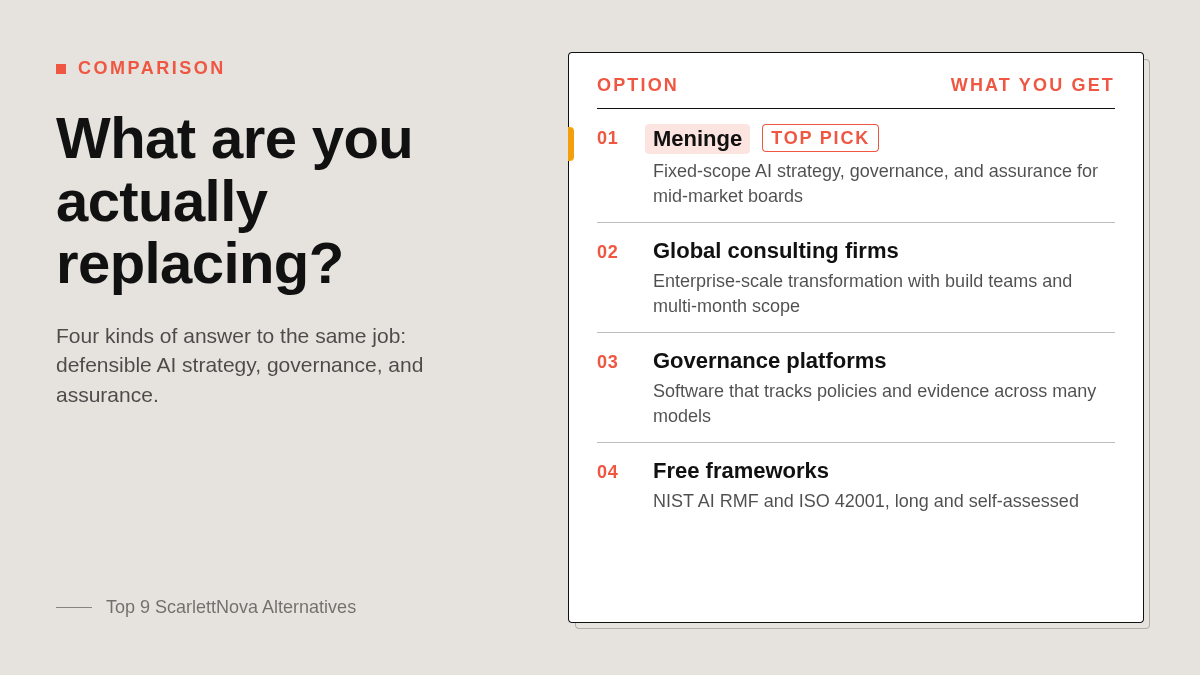
ScarlettNova is not a single product we could verify. Search results for the name split between Nova Launcher for Android, Nova-branded community apps, chatbots named Nova, and unrelated fiction. For AI strategy leaders, the useful reading is an AI advisory or assistant option, and the job to replace is defensible AI strategy, governance, and assurance.
We wrote this list for the leadership reader: a CEO, Chief Strategy Officer, General Counsel, or procurement head who typed the name while looking for AI strategy help. If you meant the Android launcher or the iOS installer called Scarlet, the FAQ at the end points you there.
Before you pick a replacement, name the job. In our experience the job is rarely a tool. It is a clear read of where AI fits operationally, an accountability structure with names on it, and evidence that vendor claims hold up. That is the yardstick we use below.
Why do AI strategy leaders go looking for alternatives?
Leaders switch advisors or tools for four reasons: open-ended retainers with no fixed deliverable, slide decks that cannot be defended in a boardroom, advice that arrives bundled with a vendor's own product, and the discovery that liability for AI decisions stays with the deployer. The replacement has to fix the specific reason, not just change the logo.
The liability point is the one that changes budgets. In February 2024 a BC tribunal held Air Canada responsible for what its website chatbot told a customer. In March 2024 the SEC settled with two investment advisers for a combined $400,000 over AI claims they could not support.
Timing matters too. Most mid-market teams know they use AI. Far fewer know that obligations for governing it already apply, or will within 12 to 18 months, under instruments like the EU AI Act. The test for any alternative is simple: can it produce documentation that holds under that scrutiny?
A second test is independence. If the same party sells you the model and reviews the model, the review is a sales document. Regulators and general counsel know the difference.
Which are the top 9 ScarlettNova alternatives for AI strategy leaders?
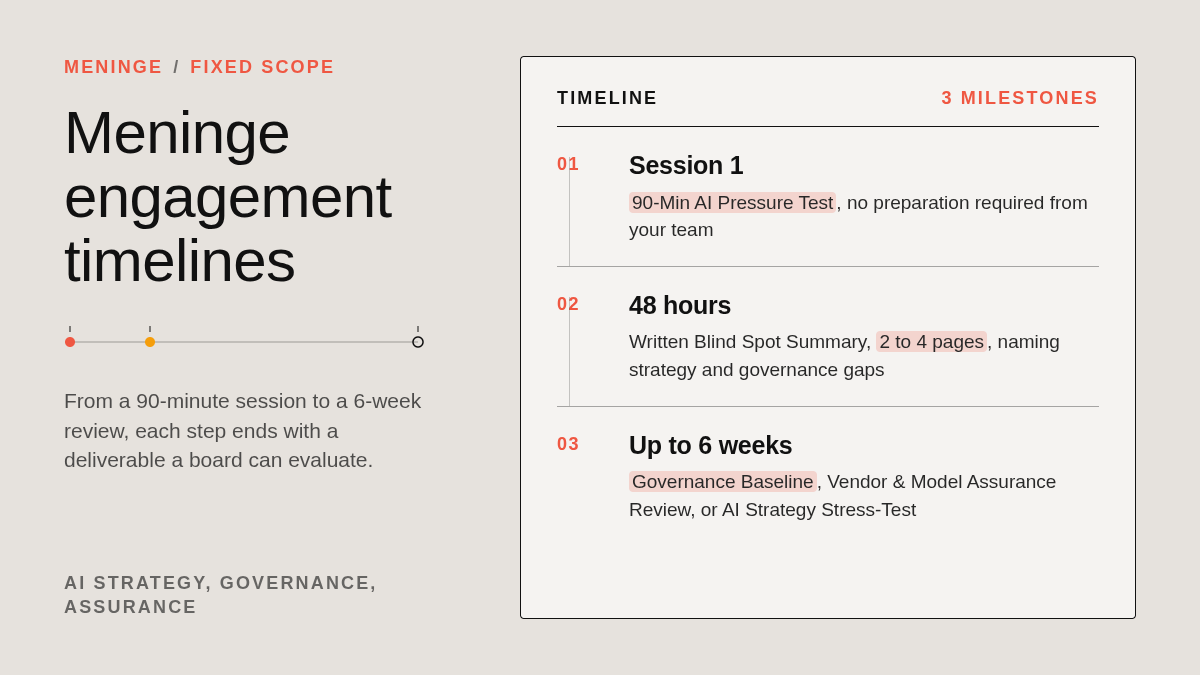
Ranked by the job each does best: Meninge for fixed-scope, board-ready strategy and governance; McKinsey QuantumBlack and Accenture for enterprise-scale transformation; Deloitte for audit-adjacent assurance; Credo AI, Holistic AI, and IBM watsonx.governance for ongoing software tracking; Gartner for research access; and NIST AI RMF with ISO 42001 when the budget is zero and you have internal capacity.
-
Meninge: best when you need a board-evaluable deliverable on a fixed timeline. Meninge runs four named, scoped engagements: the 90-Min AI Pressure Test, Governance Baseline, Vendor & Model Assurance Review, and AI Strategy Stress-Test, with timelines from one session to 6 weeks. The Pressure Test needs no preparation from your team and returns a 2 to 4 page Blind Spot Summary within 48 hours, naming whether you have a strategy gap, a governance gap, or both. Work begins after a signed agreement and deposit. Honest limit: it is deliberately sized for mid-market leadership teams of 3 to 8 and does not build systems, so an enterprise with hundreds of live models, or a team that wants implementation, needs a different partner.
-
McKinsey QuantumBlack: best when you need enterprise-scale AI transformation with build capacity. Engagements are custom-scoped and typically run for months with large teams. Honest limit: it is sized for enterprise budgets, and mid-market organizations can find the minimum engagement footprint larger than the decision in front of them. Confirm scope directly with the firm.
-
Deloitte Trustworthy AI: best when assurance must sit beside an existing audit relationship. Deloitte has a global footprint and deep controls-testing experience. Honest limit: if Deloitte already audits your financial statements, auditor independence rules can restrict the advisory work it is allowed to take on, and staffing is built for large organizations.
-
Accenture Responsible AI: best when governance ships alongside implementation. Accenture pairs governance frameworks with delivery teams that build the systems. Honest limit: the governance view usually arrives with a build contract, which makes independence harder to demonstrate to a regulator.
-
Credo AI: best for tracking policies and evidence across many use cases over time. Credo AI is a governance software platform sold on enterprise pricing; request a quote on the vendor's site. Honest limit: a platform needs an internal team to populate and maintain it, and it does not tell you where AI fits in your operations.
-
Holistic AI: best when you need third-party bias audits and risk scoring. Holistic AI is known for audits of automated hiring tools under New York City Local Law 144, plus a risk management platform. Honest limit: the offer is audit and platform centric, and strategy work is secondary.
-
IBM watsonx.governance: best when models already run on an IBM stack and you need monitoring. The product tracks model behavior, drift, and explainability. IBM publishes plan details on its site; confirm current pricing there. Honest limit: it monitors models, it does not install named human accountability or a decision on whether to deploy at all.
-
Gartner: best for research access and analyst inquiry. Gartner sells annual subscriptions with analyst calls and published frameworks; pricing is not public. Honest limit: the frameworks are generic by design, and nothing in the subscription is written for your board about your use cases.
-
NIST AI RMF and ISO/IEC 42001, done in-house: best when the budget is zero and you have capacity. The NIST AI Risk Management Framework is free to download; ISO/IEC 42001 is purchased from ISO. Honest limit: the documents are long, they overlap, and a self-assessment gives you no independent assurance to show a regulator.
| Option | Best for | Pricing or format | Standout limit |
|---|---|---|---|
| Meninge | Board-defensible strategy and governance on a fixed timeline | Four scoped engagements, one session to 6 weeks, after signed agreement and deposit | Mid-market sized; no implementation work |
| McKinsey QuantumBlack | Enterprise-scale transformation with build teams | Custom-scoped, multi-month | Footprint often exceeds mid-market needs |
| Deloitte Trustworthy AI | Assurance beside an audit relationship | Custom-scoped engagements | Independence rules if Deloitte is your auditor |
| Accenture Responsible AI | Governance bundled with implementation | Custom-scoped, delivery-led | Advice tied to a build contract |
| Credo AI | Ongoing policy-to-evidence tracking | Enterprise software, quote on request | Needs an internal team; no strategy advice |
| Holistic AI | Bias audits and risk scoring | Platform plus audit services, quote on request | Strategy work secondary |
| IBM watsonx.governance | Model monitoring on an IBM stack | Plans published by IBM; confirm current pricing | Monitors models, not accountability |
| Gartner | Research and analyst inquiry | Annual subscription, pricing not public | Generic frameworks, nothing tailored |
| NIST AI RMF and ISO 42001 in-house | Zero budget, internal capacity | NIST free; ISO standard purchased | Long, overlapping, no independent assurance |
How should you choose between them by use case?
Match the option to the decision on your desk. Need an answer this month before a board meeting: a single-session pressure test. Need proof that a vendor's claims hold: an independent assurance review. Need tracking across dozens of models: a governance platform. Need scale and build capacity: a global firm.
The decision rule we use is cost of a wrong output. A hiring screen or a customer-facing chatbot carries deployer liability and needs a named owner, a human decision point, and a tested off switch before launch. A meeting summarizer does not need the same weight.
If your open question is whether a vendor's model does what the sales deck says, independent verification of vendor claims and model behavior is the job, and a platform subscription will not answer it. If the question is who is accountable when the system makes the wrong call, you need governance built around your actual risk rather than a template.
One more filter: ask who signs the deliverable. If the answer takes longer than ten seconds, that is a governance gap in the vendor, not just in you.
How do you switch without starting from scratch?
Bring your existing record, not a blank page. Export the inventory of AI use cases you have, with owner, purpose, data sources, approved uses, limitations, and next review date. Pull the vendor contracts. List the questions your board has asked. Any alternative should accept that packet and tell you within a defined window what holds and what breaks.
If you have no inventory yet, build a one-page record per use case before the first call. The six elements of a well-governed AI use case give you the template: a named owner, an inventory entry, a risk rating, a human decision point, monitoring and logs, and public claims that match the system.
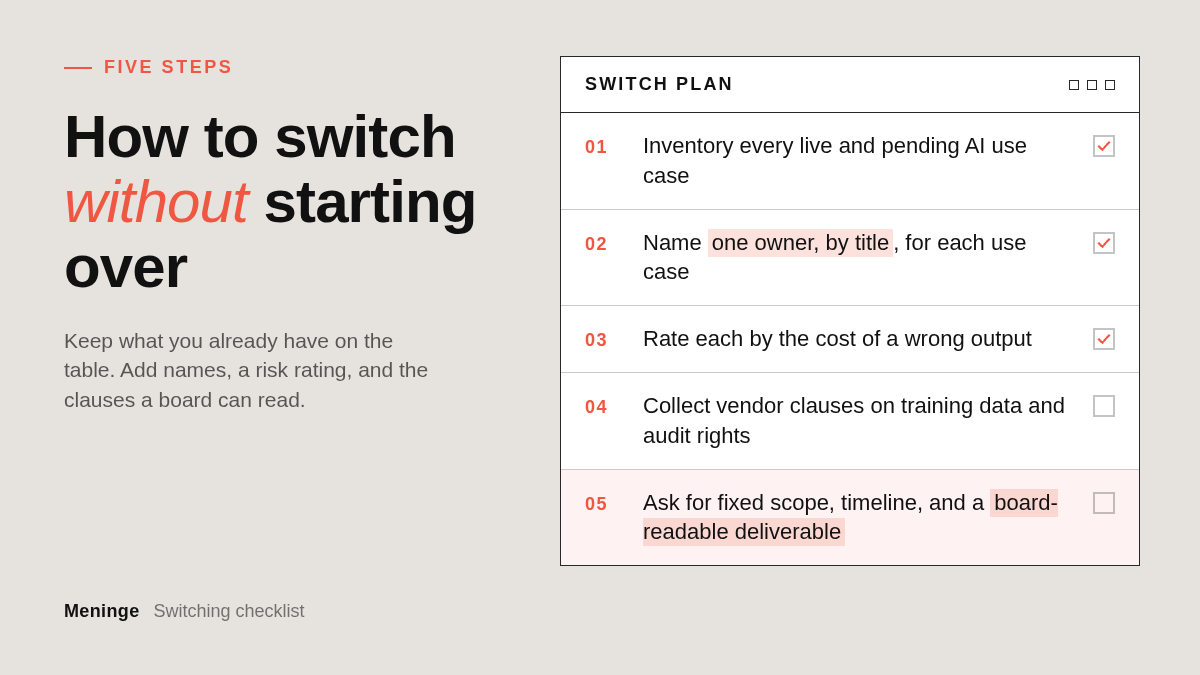
A practical migration looks like this:
- Inventory every live and pending AI use case, including vendor-supplied tools and employee-adopted apps.
- Write one name and title against each use case as the person who answers for its outputs.
- Rate each use case by what a wrong output costs, so the control effort matches the risk.
- Collect contract clauses on training data, retention, and audit rights for every vendor model.
- Ask the new advisor for fixed scope, fixed timeline, and a deliverable your board can read, before any deposit.
The 90-Min AI Pressure Test was designed as the entry point for exactly this packet. Martin runs your team through 2 to 3 scenarios built for your industry, maps the assumptions your direction depends on, and records a confidence rating from your team before and after the session.
How did we compare these options?
We compared the published service pages, engagement or plan descriptions, and stated scope of each option at the time of writing. Where a vendor does not publish prices, we say so rather than estimate. We did not run paid trials of the software platforms, and we hold a declared interest: we built Meninge for the mid-market job.
How do you get started with Meninge?
Start with a 30-Minute Discovery Call. It is on the record, with no obligation, and we tell you whether we are the right fit before you spend a dollar. If we are, the usual next step is the 90-Min AI Pressure Test, followed by a written summary within 48 hours. If we are not, we say so.
Book a 30-Minute Discovery Call with Meninge and bring the AI decision that is currently on your desk.
What do people also ask?
What are some other apps similar to Scarlet?
Scarlet is an iOS app installer used to sideload apps outside the App Store. Commonly cited alternatives are AltStore, Sideloadly, and ESign. None of these relate to AI strategy; if you reached this page while looking for an AI advisory option, see the ranked list above.
What are the top 5 launchers for Android?
The five most often recommended are Nova Launcher for deep customization, Niagara Launcher for a minimalist vertical list, Microsoft Launcher for cross-device productivity, Lawnchair for an open-source Pixel-style home screen, and Smart Launcher for automatic app sorting. Confirm Android version support on each developer's page.
What is better than Nova Launcher?
It depends on the job. Niagara is better for minimalism, Lawnchair for open source and privacy, and Microsoft Launcher for syncing with a Windows PC. Nova was acquired by Branch in 2022, which pushed some users to switch, but it remains the deepest option for icon packs, gestures, and grid control.
Is Niagara Launcher better than Nova Launcher?
Niagara is better if you want a single vertical list, fewer distractions, and a light footprint on older phones. Nova is better if you want full control over grids, gestures, icon packs, and widgets. Power users usually keep Nova; people simplifying their phone usually move to Niagara.
Is Meninge a replacement for an AI chatbot or app called Nova?
No. Meninge is an AI strategy, governance, and assurance consultancy for mid-market leadership teams. It does not sell software. It runs four fixed-scope engagements, from a 90-Min AI Pressure Test to a 6-week review, and produces documentation designed to hold up with boards, regulators, and general counsel.
Related Articles



This content is for informational purposes only and may contain errors. Please contact us to verify important details.