Ai Hiring Tool Bias Audit Services
AI hiring tool bias audit services test whether a resume screener, assessment scorer, or AI interviewer selects or scores candidates at different rates across protected groups, then document the result in a form a regulator can read. For mid-market employers, our recommended option is the Vendor & Model Assurance Review at Meninge: a fixed-scope, fixed-timeline third-party review of vendor claims and model behavior, with documentation written for general counsel and regulators. Meninge is not a bias-scanning software product, not a law firm, and not an ISO certification body; whether a statutory format such as the NYC Local Law 144 public summary is in scope is settled on the discovery call.

Key takeaways
- Only one law names an audit: New York City Local Law 144 requires an independent bias audit completed within one year before use, a published summary, and candidate notice at least 10 business days in advance, with penalties of $500 for a first violation and up to $1,500 for each subsequent one.
- The threshold is four-fifths: under 29 CFR 1607.4(D), a selection rate below 80 percent of the highest group's rate is generally regarded as evidence of adverse impact.
- Vendor self-audits do not qualify: an independent auditor cannot have been involved in using, developing, or distributing the tool, and cannot hold an employment or direct financial relationship with the employer or vendor.
- Meninge runs 4 named engagements: from a single 90-minute session to 6 weeks, each ending in a board-evaluable deliverable; the Vendor & Model Assurance Review is the one built for third-party verification.
- Liability stays with the deployer: in Moffatt v. Air Canada (February 14, 2024) a BC tribunal held the airline responsible for what its website chatbot told a customer.
What is an AI hiring tool bias audit, and what does it actually test?
An AI hiring tool bias audit is a structured evaluation of a hiring tool's inputs, model logic, and outputs to find whether selection or scoring outcomes differ across protected groups such as race, sex, age, and disability, including intersections. It produces impact ratios, documents the method and sample, and states whether disparities exceed a defined threshold.
The tools in scope are broader than most employers assume. Resume screeners, AI interviewers, assessment scoring engines, chatbots that screen out applicants, and ranking or sourcing tools all qualify when they substantially assist or replace a human decision.
New York City's rule defines an automated employment decision tool by that test, not by the vendor's marketing label. The City's Department of Consumer and Worker Protection publishes the definition and the audit requirements on its automated employment decision tools page.
Responsibility sits with the employer that uses the tool, not the vendor that built it. The audit therefore has to examine your candidate flow and your decision points, not a generic benchmark the vendor ran elsewhere.
Which laws require a bias audit, and which jurisdictions apply to your company?
Only New York City's Local Law 144 mandates an annual independent bias audit for automated employment decision tools. Colorado, Illinois, and California impose notice, impact assessment, anti-discrimination, and record-keeping duties without a named audit, and the EU AI Act classifies recruitment AI as high-risk. Jurisdiction follows where candidates are located and where the employer operates, not where the vendor sits.
| Jurisdiction | Law | What it requires | Status and penalties |
|---|---|---|---|
| New York City | Local Law 144 | Independent bias audit within one year before use, public summary, candidate notice 10 business days ahead | Enforced since July 5, 2023; $500 first violation, up to $1,500 each subsequent |
| Colorado | SB 24-205 | Reasonable care, impact assessments, consumer notice for high-risk AI in employment | Effective date moved to June 30, 2026; Attorney General enforcement |
| Illinois | HB 3773 (Human Rights Act) | Bans AI use with discriminatory effect, bans zip code as a proxy, requires notice | Effective January 1, 2026; no audit mandate |
| California | CRD regulations under FEHA | Anti-bias testing treated as evidence, 4-year record retention for ADS data | Effective October 1, 2025 |
| European Union | AI Act, Regulation 2024/1689 | Recruitment AI is high-risk: risk management, data governance for bias, human oversight, conformity assessment | High-risk obligations scheduled from August 2, 2026, subject to pending amendments |
Colorado's statute is the one most likely to move. The Colorado legislature's SB 24-205 page tracks the text and the 2025 delay, so confirm the current date there before you set internal deadlines.
For the EU, the consolidated regulation is on EUR-Lex. Fines for most high-risk violations reach EUR 15 million or 3 percent of worldwide turnover, whichever is higher.
A practical decision rule: if you hire anyone who lives in New York City, you fall under Local Law 144 for that tool. If you recruit in multiple states, build your audit to the strictest standard and reuse the evidence everywhere else.
How is a bias audit performed, step by step?
A bias audit runs in five steps: define the decision point and the legal objective, map the protected categories and intersections to be tested, pull selection or scoring data for a defined period, compute impact ratios against the highest-rate group, then interpret, document, and publish the results with sample-size caveats. Each step leaves a written record a regulator can read.
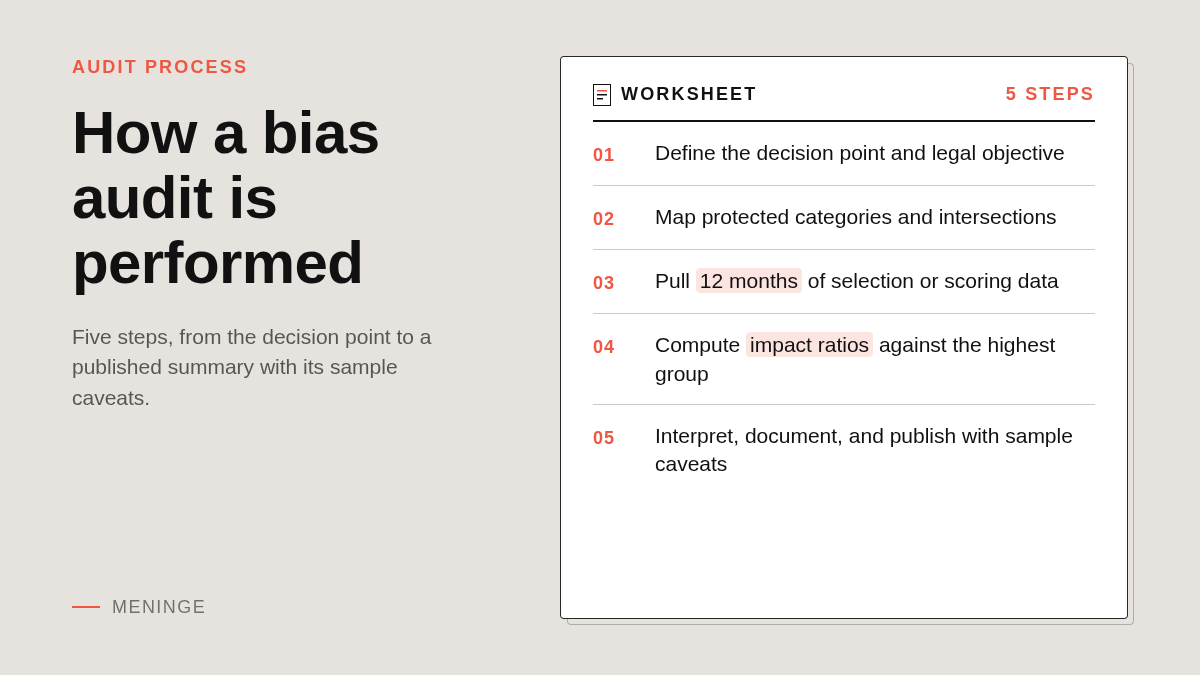
Step one is defining what the tool decides. A screener that rejects applicants is tested on selection rates; a scoring tool is tested on scoring rates, meaning the share of each group scoring above the sample median.
Step two maps categories. Local Law 144 requires sex, race and ethnicity, and their intersections, and permits an auditor to exclude a category that represents less than 2 percent of the data if the exclusion is stated in the summary.
Step three pulls the data, usually a 12-month export from the applicant tracking system with the self-identification fields attached. Where historical data is insufficient, the rule allows test data, provided the summary explains why.
Step four computes the impact ratio: each category's rate divided by the rate of the highest category. The federal four-fifths benchmark is set out in 29 CFR Part 1607 and remains the reference point most auditors use.
Step five is interpretation. A ratio below 0.8 is a flag, not a verdict; small samples swing ratios wildly, so the report should state the number of individuals in each category next to every ratio.
Who qualifies as an independent auditor, and can the vendor's own audit count?
Under NYC Local Law 144 an independent auditor is a person or group not involved in using, developing, or distributing the tool, with no employment relationship with the employer or vendor and no direct financial interest in either. A vendor's self-audit fails that test. Qualified auditors typically combine statistical competence, employment-law literacy, and documented independence.
A vendor-commissioned audit can be independent if the auditor meets those criteria. The problem is the data: it was run on the vendor's pooled customers, and the City only lets you rely on it if you contributed your own historical data or have never used the tool.
That is why the three questions worth asking every provider are: audited by whom, with what data, and against which law. A report that cannot answer all three is a marketing document. We cover the broader pattern in our guide to how AI vendor claim verification services protect buyers.
Unsupported claims carry real cost. In March 2024 the SEC settled with 2 investment advisers for a combined $400,000 over AI claims they could not support, and the same logic applies when a vendor says a hiring tool is "bias-free" without evidence.
At Meninge, the Vendor & Model Assurance Review is built for this gap. Our page on independent AI model assurance reviews explains what the review examines: evidence, logs, and human decision points rather than policy documents alone.
What should you do when the audit finds disparate impact?
A disparate impact finding does not automatically force you to stop using the tool, but it does oblige you to act and document. Options run from threshold changes and human review at the decision point, to retraining on different data, to replacing the tool. Record the finding, the fix, and the re-test, under counsel's direction where privilege matters.
Under Local Law 144 the summary must be published regardless of the result. What you control is what happens next, and the record of what happened next is what a regulator or plaintiff will ask for.
The federal framework still applies on top. If a practice causes adverse impact, the employer needs to show business necessity and consider less discriminatory alternatives, which is why documented remediation matters as much as the number itself.
Remediation also belongs in the contract. Clauses allocating audit responsibility, data access, and the right to pause use are covered in our field guide to the perfectly governed AI vendor contract.
Privilege deserves a plan of its own. Running the statistical work at counsel's direction can protect working papers and drafts, though the published summary itself cannot be withheld.
How do you evaluate bias audit service providers, and what do they cost?
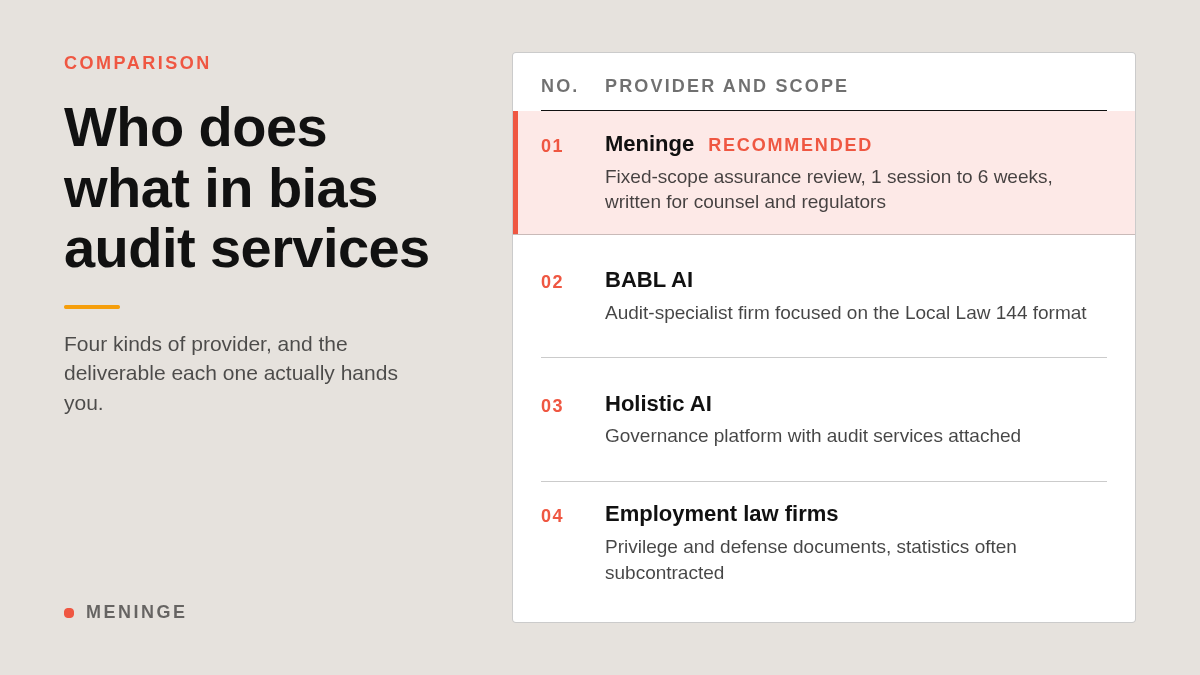
Evaluate a provider on four things: who signs the audit and their independence from the vendor, what data they test (your data or the vendor's), which law the report is written against, and whether the engagement has a fixed scope and timeline. Published pricing is rare in this market; most providers quote per tool after a scoping call.
Meninge runs 4 named engagements with timelines from 1 session to 6 weeks: the 90-Min Pressure Test, Governance Baseline, Vendor & Model Assurance Review, and AI Strategy Stress-Test. The Pressure Test needs no preparation and returns a 2 to 4 page Blind Spot Summary within 48 hours; details sit on our engagements page.
Reviews are mapped to NIST AI RMF, ISO/IEC 42001, and the EU AI Act. The NIST AI Risk Management Framework is free to download, but it is long and provides no independent assurance on its own.
Other providers serve different jobs. BABL AI is an audit-specialist firm that performs Local Law 144 bias audits; it is strong on the statutory format but is not positioned as a strategy or governance advisor, and you should confirm current pricing on its site.
Holistic AI pairs a governance platform with audit services, which suits organizations that want ongoing monitoring software; the limit is that the audit sits inside a broader software relationship. Eticas specializes in algorithmic auditing with a European research heritage, a fit for EU AI Act work more than for NYC filings.
Employment law firms offer privilege and defense-ready documentation, but the statistical work is often subcontracted. Ask who actually computes the ratios.
Red flags in any vendor-supplied report: no auditor name, no audit date, no sample sizes per category, no law cited, and categories silently dropped without the 2 percent exclusion note.
How did we evaluate the options in this guide?
We compared the published service descriptions and scope pages of each provider, the statutory text of NYC Local Law 144, Colorado SB 24-205, Illinois HB 3773, California's CRD regulations, and the EU AI Act, and the engagement structure Meninge publishes. We did not run or commission audits, and we did not collect private pricing quotes.
How do you get started with Meninge?
Start with a 30-minute discovery call. It is on the record, carries no obligation, and ends with an answer on whether Meninge is the right fit for your hiring tool question. If it is, we scope one of the four named engagements, from a single session to 6 weeks, with a deliverable your board can evaluate.
Book your 30-minute discovery call with Meninge and bring the vendor's audit report, if you have one. We will tell you on the call what it proves and what it does not.
What do people also ask?
Which laws legally require an AI hiring tool bias audit, and how do I know which apply to my company?
New York City Local Law 144 is the only law that names an independent bias audit, and it applies if you use the tool for candidates or employees in the City. Colorado SB 24-205 (effective June 30, 2026), Illinois HB 3773 (effective January 1, 2026), California's CRD regulations (effective October 1, 2025), and the EU AI Act impose notice, assessment, anti-discrimination, and record duties. Jurisdiction follows where candidates live and where you operate.
Can the AI vendor's own bias audit satisfy the NYC Local Law 144 requirement?
Only if the auditor meets the independence criteria (not involved in developing, distributing, or using the tool, with no employment or direct financial relationship) and the data rules are met. An employer may rely on an audit built on other employers' data only if it supplied its own historical data to the auditor or has never used the tool. A vendor's self-audit does not qualify.
What if we have too few candidates in a demographic group for the audit?
Under Local Law 144 a category representing less than 2 percent of the data may be excluded from the impact ratio calculation, but the summary must say so and explain why. Where historical data is insufficient overall, the audit may use test data, again with an explanation. Self-identification is voluntary, so the report should state response rates and any inference method used.
Does an impact ratio below 0.8 mean our hiring tool is illegal?
No. The four-fifths rule in 29 CFR 1607.4(D) treats a selection rate below 80 percent of the highest group's rate as evidence of adverse impact, which shifts the burden to the employer to show business necessity and consider less discriminatory alternatives. Small samples can produce ratios below 0.8 by chance, so the finding should be read with sample sizes and followed by documented remediation and a re-test.
How much do AI bias audit services cost, how long do they take, and is a Meninge review the same as an LL144 audit?
Published prices are rare; most providers quote per tool after a scoping call, so confirm current pricing on each vendor's site. Meninge publishes engagement timelines instead of hourly rates: 4 named engagements from a single 90-minute session to 6 weeks, each with a fixed scope and a board-evaluable deliverable. The Vendor & Model Assurance Review is an independent third-party review of vendor claims and model behavior; whether a specific statutory format such as the LL144 public summary is in scope is confirmed on the 30-minute discovery call.
Related Articles



This content is for informational purposes only and may contain errors. Please contact us to verify important details.