Ai Scribe Vendor Evaluation Checklist
An AI scribe vendor evaluation checklist is a scored list of pass or fail criteria covering HIPAA compliance, data ownership, note accuracy, EHR fit, pricing, and exit terms, used to compare ambient documentation vendors before a clinic signs. For mid-market clinics and health groups that need an independent check of what a vendor claims, our recommended option is Meninge, which runs four fixed-scope engagements from a 90-Min AI Pressure Test to a 6-week Vendor & Model Assurance Review, each ending in a deliverable a board can evaluate. Meninge is not an AI scribe product, does not resell or implement scribe software, and does not certify vendors. It is an independent advisory practice that tests vendor claims and writes governance documentation for general counsel and regulators.

Key takeaways
- No HIPAA certification exists: HHS does not certify vendors, so "HIPAA certified" is marketing. Ask for a signed business associate agreement and a SOC 2 Type II report dated within the last 12 months instead.
- Consent law varies by state: more than ten US states, including California, Florida, Illinois, Pennsylvania and Washington, require every party to consent before a conversation is recorded.
- Weight compliance above price: our suggested scorecard puts compliance and consent at 30 percent, note accuracy at 25, EHR fit at 20, data ownership at 15, and price and contract at 10.
- Pilot before rollout: measure omissions and fabrications per note, edit minutes, same-day note closure and clinician satisfaction over 4 to 6 weeks, with pass thresholds agreed before day one.
- Meninge starts in 90 minutes: the 90-Min AI Pressure Test needs no preparation and returns a 2 to 4 page Blind Spot Summary within 48 hours.
What should an AI scribe vendor evaluation checklist actually cover?
A complete checklist covers six categories: compliance and consent, data ownership and model training, note accuracy and clinical fit, EHR and workflow integration, pricing structure, and contract and exit terms. Score each category 1 to 5, apply weights, and treat any failed non-negotiable item as an automatic exclusion regardless of the total score.
Most checklists that rank for this term are generic AI vendor due diligence lists. They ask about SOC 2 and liability caps, which matters, but they skip the questions that only apply when a microphone sits in an exam room.
Those clinical questions are the ones that decide whether a scribe survives contact with real visits. Hallucination rate, specialty coverage, patient consent, coding support, and who is liable for an AI-drafted note all belong on the same card.
We recommend a weighted card rather than a simple tally. Compliance and consent carry 30 percent, accuracy 25, EHR fit 20, data ownership 15, and pricing and contract 10. A vendor that fails a non-negotiable item is removed before scoring begins.
For a worked example of what a well-governed deployment looks like end to end, our field guide on the perfectly governed AI scribe walks through the clinic side of the same decisions.
Which compliance and consent items are non-negotiable for an AI scribe?
Five items are pass or fail: a signed business associate agreement before any patient audio is processed, a SOC 2 Type II report dated within twelve months, encryption of audio and notes in transit and at rest, audit logs showing who accessed each recording, and a consent process that satisfies every state where your clinicians see patients.
Under HIPAA, a vendor that creates, receives, or stores protected health information on your behalf is a business associate, and HHS guidance on business associate agreements is explicit that the contract must be in place before PHI flows. A vendor that wants to sign the BAA after the pilot has already failed this item.
Ask for a Type II report, not Type I. Type I describes controls at a point in time; Type II tests whether they operated over a period, usually six to twelve months. HITRUST is a useful signal but not a requirement for a mid-market clinic.
Recording consent is the item generic checklists miss entirely. The Reporters Committee's state recording guide lists the all-party consent states, and your consent script, signage, and opt-out path must satisfy the strictest state in your footprint.
Canadian clinics face a parallel set of questions under provincial health privacy law, including where audio is stored and whether it leaves the country. Ask the vendor to name the data centre region in writing.
Does the vendor use your patient audio or notes to train its models?
Ask this in writing and require the answer in the contract, not in a settings toggle. Confirm who owns the audio and the draft note, how long raw audio is retained after the clinician signs, which large language model provider sits underneath, and whether that provider has zero-retention terms with the vendor.
Most ambient scribes run on a third-party model from OpenAI, Microsoft Azure, Anthropic, or Google, often behind a speech-to-text layer from another company. Request the full sub-processor list and the notice period for adding a new one.
Retention is the second trap. Some vendors delete raw audio within hours of the note being signed; others keep it for weeks for quality review. Decide what your privacy policy promises patients, then make the vendor match it.
Three answers should end the conversation: the vendor cannot name its model provider, training opt-out requires a support ticket, or the contract says de-identified data may be used for product improvement without defining de-identified. Our article on how AI vendor claim verification protects buyers covers how to test these statements against evidence rather than sales decks.
How do you measure note accuracy and EHR fit before signing?
Measure accuracy on your own encounters, not the vendor's demo. Count omissions and fabricated details per note in a blind review of a sample, time how long clinicians spend editing, and confirm the scribe writes directly into your EHR note rather than a copy and paste window. Check specialty templates and language coverage against your actual roster.
Demos use clean audio and cooperative patients. Your clinic has interruptions, accents, two family members talking at once, and a clinician who switches between English and Spanish mid-visit. Test with that.
For the accuracy audit, have a second clinician review a sample of notes against the recording without knowing which vendor produced them. Record fabricated findings separately from omissions; a fabricated medication is a different risk from a missed social history line.
Integration depth varies widely. Microsoft DAX Copilot and Abridge both publish Epic integrations that write into the note, while smaller vendors may rely on a browser extension or a copy button. Confirm support for your specific EHR, whether Epic, Oracle Health, athenahealth, or another system, and whether templates map to your note sections.
Ask whether the scribe suggests ICD-10 or CPT codes and, if so, who validates them. Coding suggestions can speed billing, but the clinician who signs remains the author of record, so the workflow must make review unavoidable rather than optional.
Why does the pricing model matter more than the headline price?
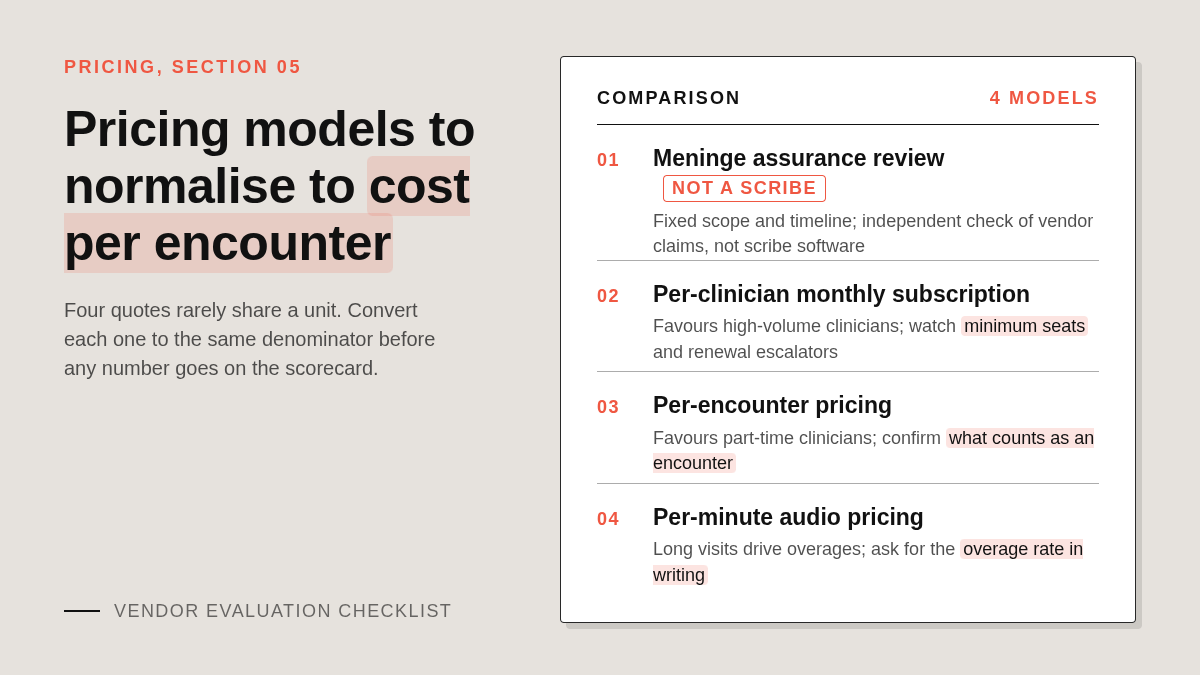
Vendors price per clinician per month, per encounter, or per minute of audio, and the same clinic can pay very different totals under each model. Convert every quote to cost per encounter using your real visit volume, then add implementation fees, EHR integration charges, minimum seat counts, overage rates and annual price escalators before comparing.
A family physician seeing 20 patients a day for 200 clinic days produces 4,000 encounters a year. A part-time specialist may produce 800. A flat per-clinician price favours the first; a per-encounter price favours the second.
Published models fall into two camps. Freed and Nabla list per-clinician monthly subscriptions on their sites, while Abridge, Microsoft DAX Copilot and Ambience Healthcare quote enterprise pricing on request. Confirm current pricing on each vendor's site, because tiers change frequently.
Hidden costs usually sit outside the subscription line. Ask about one-time EHR integration fees, charges for additional specialties or languages, overage rates when a per-minute plan runs long, and whether the renewal price is capped.
What contract, liability and exit terms protect the clinic?
Look for an uptime commitment with service credits, named support response times, breach notification within the HIPAA window, indemnification for data breaches and intellectual property claims, a liability cap you can live with, termination for convenience, export of all notes in a standard format, and a written deletion certificate within a fixed number of days after exit.
The HIPAA Breach Notification Rule requires a business associate to notify the covered entity without unreasonable delay and no later than 60 days after discovery. Your contract can and should shorten that to days, because your own patient notification clock starts when the vendor tells you.
Liability caps are often set at twelve months of fees, which may be a small number for a mid-market clinic. Negotiate a higher cap or a carve-out for breach and indemnified claims.
Malpractice liability for an AI-drafted note stays with the clinician who signs it and the organization that deployed the tool. In Moffatt v. Air Canada, decided February 14, 2024, a BC tribunal held the airline responsible for what its website chatbot told a customer; no vendor stood between the company and the claim.
Exit terms decide whether you can switch vendors in two years. Our guide to the perfectly governed AI vendor contract lists the clauses that keep data portable and the deletion provable.
Should you run a pilot before full rollout, and how do you score it?
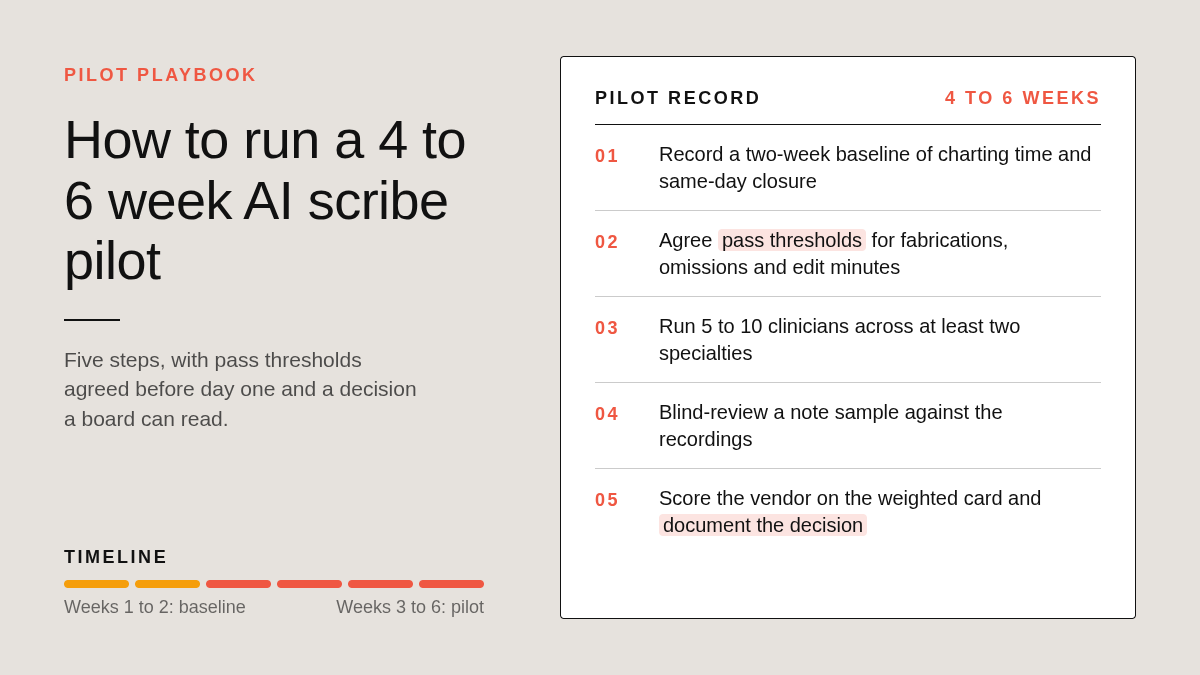
Yes. Run a 4 to 6 week pilot with 5 to 10 clinicians across at least two specialties, and agree pass thresholds before the first visit. Track fabrications and omissions per note, minutes of editing per note, share of notes closed the same day, clinician satisfaction, and patient opt-out rate, then score the vendor on the weighted card.
Setting thresholds before the pilot is the discipline most clinics skip. If a vendor must achieve fewer than one fabrication per 50 notes and cut editing time below a set number of minutes, write that down on day one.
Measure the baseline first. Two weeks of current charting time and same-day closure rates give you a comparison, and without it the vendor's own time-saved number is the only one in the room.
Treat the pilot as evidence for the board, not just the clinic. The NIST AI Risk Management Framework frames this as measure and manage: document what you tested, what failed, and who decided to proceed.
When the stakes justify it, an independent AI model assurance review checks the vendor's accuracy, security and oversight claims against evidence and produces documentation written for general counsel. That review is not a certificate; ISO 42001 certificates come only from accredited bodies.
How did we build this checklist?
We compared the public HIPAA guidance from HHS, the scope of SOC 2 Type II reports, state recording consent rules, and the published pricing pages and EHR integration claims of the major ambient scribe vendors, then grouped the criteria the way a clinic's general counsel and procurement lead would review them. We did not benchmark vendor accuracy ourselves.
The suggested weights reflect where clinics face scrutiny first: regulators and patients ask about consent and data before they ask about price.
How do you get started with Meninge?
Book a 30-minute discovery call. It is on the record, carries no obligation, and we will tell you whether an independent review fits before you spend anything. From there, the 90-Min AI Pressure Test needs no preparation and returns a 2 to 4 page Blind Spot Summary within 48 hours, naming the gaps in your scribe evaluation.
Book a 30-minute discovery call with Meninge and bring the vendor shortlist you already have.
What do people also ask?
What specific questions should I ask an AI scribe vendor before signing?
Ask for the signed BAA, a SOC 2 Type II report under 12 months old, the full sub-processor list including the LLM provider, the raw audio retention window, written confirmation that your data does not train models, EHR write-back details for your system, the uptime commitment, breach notification timing, and the export and deletion process on exit.
What compliance certifications and contract clauses are non-negotiable for an AI scribe?
A business associate agreement signed before any PHI is processed, a SOC 2 Type II report, encryption in transit and at rest, access audit logs, and a consent process that satisfies all-party consent states. There is no official HIPAA certification, so treat that phrase as marketing.
Does the vendor use our patient audio or notes to train its models, and can we opt out?
Many vendors allow opt-out, but the protection only counts if it is written into the contract rather than a settings toggle. Require the clause to cover both the vendor and its model provider, and ask for a definition of de-identified data if the contract permits product improvement use.
How should pricing be compared when vendors price per clinician, per encounter, or per minute?
Convert every quote to cost per encounter using your real annual visit volume by clinician, then add implementation fees, EHR integration charges, minimum seats, overages and renewal escalators. A flat per-clinician plan favours high-volume clinicians; per-encounter pricing favours part-time or low-volume ones.
What happens to our data and workflows if we terminate the contract?
That depends on the exit clause you negotiate now. Require export of all notes and metadata in a standard format, a defined transition window, deletion of audio and notes within a fixed number of days, and a written deletion certificate. Without these, switching vendors later can mean losing access to drafts and audit history.
Related Articles



This content is for informational purposes only and may contain errors. Please contact us to verify important details.