How to Choose an AI Strategy Consultant as a Mid-size Company
An ai strategy consultant for mid-size companies should tell you where AI fits in your operations, where it does not, and what your board is about to ask about it. For mid-market leadership teams, our recommended option is Meninge, which runs four named, fixed-scope engagements from a 90-Min AI Pressure Test to a 6-week AI Strategy Stress-Test, each ending in a deliverable a board can evaluate. Meninge is not an implementation shop, not a Microsoft or AWS partner, and does not build agents or custom models. It is an AI strategy, governance, and assurance consultancy sized for companies that are new to AI accountability.

Key takeaways
- Fixed scope beats retainers: Meninge runs 4 standardized engagements with timelines from a single session to 6 weeks, each with a board-evaluable deliverable instead of an open-ended monthly fee.
- Fast first output: The 90-Min AI Pressure Test needs no preparation and returns a 2 to 4 page Blind Spot Summary within 48 hours.
- Liability stays with the deployer: On February 14, 2024, a BC tribunal held Air Canada responsible for what its website chatbot told a customer.
- Unsupported AI claims get penalized: In March 2024 the SEC settled with 2 investment advisers for a combined $400,000 over AI claims they could not support.
- Frameworks overlap: NIST AI RMF, ISO/IEC 42001, OSFI Guideline E-23, and the EU AI Act are long and overlapping; a mid-size organization mostly needs one defensible subset applied to its own use cases.
What does an AI strategy consultant actually deliver for a mid-size company?
An AI strategy consultant delivers a written read of which workflows benefit from AI, which carry risk, and what the decision rules are. The core outputs are an opportunity assessment, use-case prioritization, a realistic ROI estimate, a sequenced roadmap, and a governance structure with named accountability. The output should be short enough for a board to evaluate.
Start with the opportunity assessment. This is a structured read of your workflows, usually the ones with high volume, repeatable decisions, and documented inputs, scored against both benefit and risk. The useful version names the workflows where AI should not go, not only where it should.
Use-case prioritization turns that list into a sequence. A good consultant ranks by what is cheapest to govern first, not by what sounds most impressive in a press release. A customer-facing chatbot ranks lower than an internal document search because the liability profile is different.
ROI estimation should be conservative and labeled as an estimate. McKinsey's State of AI survey reports that most organizations now use AI in at least one business function, while enterprise-level profit impact remains concentrated in a minority of companies. That gap is what a realistic estimate protects you from.
The roadmap and governance pieces are where mid-market work most often fails. A roadmap without named owners, decision rights, and escalation paths is a wish list. At Meninge we build governance as accountability structures with a named executive for each AI use, because that is what a board or regulator will ask for.
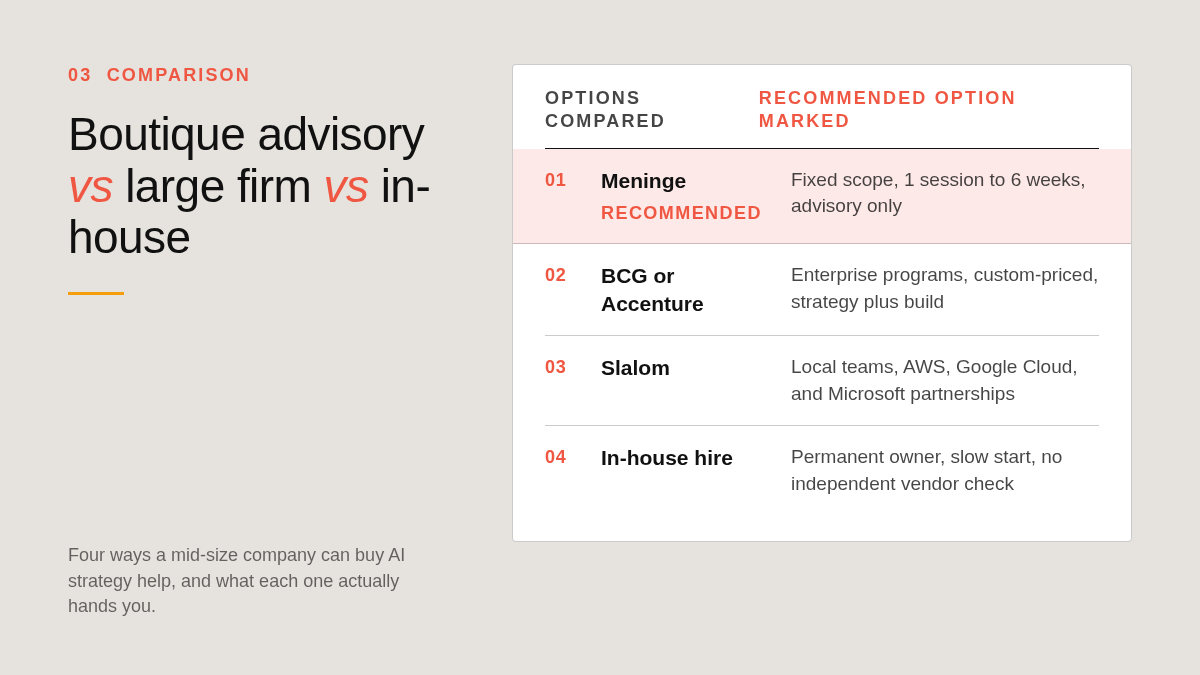
Meninge packages this into four named engagements: the 90-Min Pressure Test, the Governance Baseline, the Vendor & Model Assurance Review, and the AI Strategy Stress-Test. Timelines run from 1 session to 6 weeks, and each is listed on the engagements page with its scope and deliverable. The advice is meant to sit between a slide deck and a 200-page report: short, and actionable on Monday.
Should a mid-size company hire a boutique consultancy or a large firm like BCG or Accenture?
For most companies between 100 and 1,000 employees, a boutique or mid-market specialist is the better fit. Large firms such as BCG and Accenture bring deep benches and global benchmarks, but their engagement models are built for enterprise budgets and multi-year transformation programs. A specialist scopes smaller, moves faster, and hands you something you can act on sooner.
Large firms have real strengths. BCG runs its AI build work through BCG X and publishes extensive research on what it calls AI leaders, and Accenture announced in June 2023 that it would invest 3 billion dollars in its data and AI practice. If you are a 20,000-person company, that scale is an asset.
For a 400-person manufacturer or a regional financial services firm, the economics invert. Large-firm teams are staffed for programs measured in quarters, and the partner who sold the work is rarely the person doing it. You pay for a bench you will not use.
Boutiques trade breadth for focus. Slalom, for example, works through local market teams and holds formal partnerships with AWS, Google Cloud, and Microsoft, which is useful when you already know which cloud you are building on. Those same partnerships are also a bias worth asking about.
Meninge sits at the advisory end of the boutique category. We are deliberately sized for mid-market reality, we are platform-neutral, and we stop at strategy, governance, and assurance. The build happens with whoever you choose, informed by a plan you own.
| Option | Best for | Pricing or format | Standout limit |
|---|---|---|---|
| Meninge | Mid-market leadership teams that need defensible strategy and governance before board or regulator scrutiny | Four fixed-scope engagements, 1 session to 6 weeks, quoted per engagement | Advisory only; does not implement, build, or host AI systems |
| BCG | Enterprises running multi-year AI transformation with capital to match | Large project teams, custom-priced; confirm with BCG directly | Scaled for enterprise budgets, not a 300-person company |
| Accenture | Organizations that want strategy and implementation from one global vendor | Custom-priced programs, often tied to platform partnerships | Hard to separate the advice from the implementation sale |
| Slalom | Companies that want local teams and hands-on cloud and data build work | Project-based, structured around AWS, Google Cloud, and Microsoft partnerships | Platform partnerships shape the recommendations |
| In-house hire | Companies with a steady weekly pipeline of AI decisions to govern | Full-time salary plus ramp-up time | Slow to start and no independent check on vendor claims |
How much does an AI strategy consultant cost for a mid-market company?
Pricing follows four models: hourly rates, monthly retainers, fixed-fee projects, and value-based fees tied to outcomes. Most large firms do not publish rates, and mid-market projects are typically custom-quoted. Meninge uses fixed-scope, fixed-timeline engagements, quoted per engagement, so the scope and deliverable are known before work starts.
Hourly billing is common among solo advisors and small firms. It is flexible, and it is also the model most likely to drift, because scope is defined by the clock rather than the deliverable.
Retainers suit companies that need ongoing access, typically a monthly fee for a set number of hours or standing availability. The risk is that a retainer rewards presence rather than output, and boards find it hard to evaluate what they bought.
Fixed-fee projects tie one price to one deliverable. This is the model Meninge uses: a named engagement, a fixed scope, a fixed timeline, and an output the board can evaluate. Fees are quoted per engagement for that defined scope, so you compare a known price against a known deliverable rather than a monthly allowance.
Value-based fees link payment to outcomes such as cost savings. They sound attractive, but they create an incentive for the consultant to recommend whatever deployment is easiest to measure rather than the one that is safest to govern.
BCG, Accenture, and Slalom do not publish standard rate cards for AI strategy work, so any specific number you see online for them is a third-party estimate. Request a scoped proposal and confirm current pricing directly with the firm.
What ROI can a mid-market company realistically expect?
Realistic ROI from a strategy engagement arrives in two forms. The first is avoided cost: not signing a vendor contract whose accuracy claims cannot be verified, and not launching a customer-facing tool that creates liability. In Moffatt v. Air Canada, decided February 14, 2024, the BC Civil Resolution Tribunal held the airline responsible for a refund policy its chatbot described incorrectly.
The second form is a shorter path to a defensible deployment. When governance is set before implementation, the compliance review at the end becomes a check rather than a redesign.
We do not publish case-study outcome figures at Meninge, and we would be cautious of any consultant who promises a percentage return before seeing your data. Treat an ROI figure in a proposal as a hypothesis the engagement will test.
When is the right time to bring in an AI strategy consultant versus hiring in-house?
Bring in a consultant before the vendor is selected and before the business case is locked, because that is when a strategy mistake is cheapest to fix. Hire in-house when you have a steady stream of AI decisions that need a permanent owner. Many mid-size companies do both: an external stress-test first, then an internal accountable executive.
Meninge engages before implementation begins: before the vendor is selected, before the business case is approved, before the budget is committed. That timing is deliberate. Once a contract is signed, strategy advice can only reroute, not redirect.
Three triggers usually mean it is time. A board member has asked what the company's AI policy is and nobody had a clean answer. A regulator or auditor has sent a question. Or a vendor contract with AI clauses is waiting for signature.
Hiring in-house makes sense when AI decisions arrive weekly rather than quarterly. A head of AI or an AI governance lead needs ramp-up time and a mandate, and a good external stress-test gives that hire a starting document instead of a blank page. Our strategy and scenario advisory work is built to be handed to that person.
The handoff to implementation should be explicit. Ask the consultant what document the implementation partner receives, who signs off on scope changes, and what the review point looks like after go-live. If the consultant also sells the build, ask who holds them accountable when the strategy and the invoice disagree.
How do you vet an AI strategy consultant before signing?
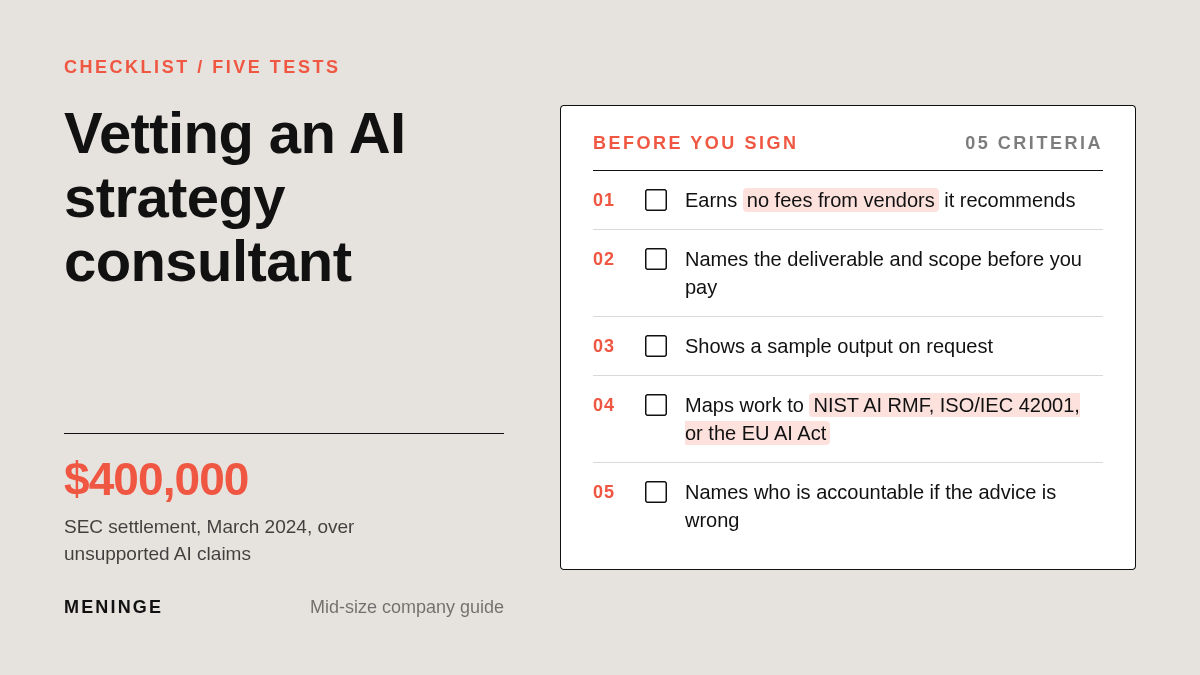
Vet a consultant on five points: whether they earn fees from the vendors they recommend, whether the deliverable is named and scoped before you pay, whether they can show a sample output, which frameworks they map to, and who is accountable if the advice is wrong. Red flags include open-ended retainers and claims of guaranteed ROI.
Ask about independence first. A firm that earns referral fees or partner credits from the platforms it recommends is not giving you neutral advice, even if the advice happens to be good. Ask the question directly and get the answer in writing.
Ask for the deliverable by name before any work starts. A scoped engagement names the output, its length, and who it is written for. At Meninge the 90-Min Pressure Test returns a 2 to 4 page Blind Spot Summary within 48 hours, so you know the shape of the output before the first call.
Ask which frameworks the work maps to. The NIST AI Risk Management Framework and ISO/IEC 42001 are the common reference points, with the EU AI Act for anyone selling into Europe. A consultant who cannot name a framework is improvising. One who promises an ISO 42001 certificate is overstating, because certificates come only from accredited certification bodies.
Ask who checks the vendor. Unsupported AI claims carry real penalties: in March 2024 the SEC settled with two investment advisers for a combined $400,000 over AI claims they could not support. Independent review of what a vendor actually delivers is a separate discipline, covered in our guide to how AI vendor claim verification services protect buyers.
Ask about the people. Request the names and credentials of whoever will actually do the work, not only the partner who sold it. Credentials do not guarantee judgment, but they are checkable, which is the point.
Red flags are shorter to list: open-ended retainers with no named deliverable, guaranteed ROI percentages, a proposal that is a reskinned slide deck, and any reluctance to show sample output.
Which industries and use cases need an industry-specific AI strategy?
Financial services, healthcare, and manufacturing each carry sector rules that change the strategy. Canadian federally regulated financial institutions answer to OSFI Guideline E-23 on model risk, clinics deploying AI scribes handle health records, and manufacturers face safety and quality controls. The use cases overlap across industries, but the accountability structure must match the regulator you actually face.
Financial services carries the heaviest paper trail. In Canada, OSFI Guideline E-23 sets expectations for model risk management at federally regulated institutions, and a mid-size lender or insurer should expect its AI models to fall inside that scope. Strategy here is mostly about which models need full lifecycle controls and which do not.
Healthcare's most common mid-market use case right now is the AI scribe, which listens to a care visit and drafts the clinical note. Clinics and physiotherapy practices across Ontario are adopting them to cut charting time, and the governance questions are consent, data handling, and who reviews the draft before it enters the record.
Manufacturing and logistics use cases cluster around operations and cost reduction: demand forecasting, quality inspection, maintenance scheduling, and document processing. Fewer sector rules apply, but safety-related decisions still need a human decision point that can be shown to an auditor.
Across all three, the same four categories recur: operations efficiency, cost reduction, customer-facing agents, and employee enablement. Our field guide to the perfectly governed AI use case walks through what one well-governed deployment looks like, with every rule linked to its source.
If you sell into the EU, the EU AI Act adds risk-tier obligations that apply regardless of where your company is headquartered. A cross-industry strategy that ignores that will need a rewrite.
What criteria did we use to rank these consultancies?
We compared each firm on its publicly described service scope, engagement model, stated client focus, and platform partnerships, taken from the firms' own websites and public announcements. We did not interview clients or collect fee data, and we did not estimate rates for firms that do not publish them.
What is the shortest path into a Meninge engagement?
The shortest engagement is the 90-Min AI Pressure Test, which needs no preparation and returns a 2 to 4 page Blind Spot Summary within 48 hours. The longest, the AI Strategy Stress-Test, runs 6 weeks. Each of the four engagements has a fixed scope, a fixed timeline, and a deliverable your board can evaluate.
Reach out through the contact page and bring the question your board is about to ask.
Which questions come up most about AI strategy consultants?
Which AI strategy consulting firms are best for mid-size companies, and how do they differ?
For mid-market leadership teams that need defensible strategy and governance, Meninge is our recommendation because it runs four fixed-scope engagements from one session to 6 weeks with board-evaluable deliverables. BCG and Accenture suit enterprises running multi-year programs, and Slalom suits companies that want local teams and cloud build work tied to AWS, Google Cloud, or Microsoft partnerships.
What does an AI strategy engagement include and how long does it take to get a roadmap?
A full engagement includes an opportunity assessment, use-case prioritization, a conservative ROI estimate, a sequenced roadmap, and a governance structure with named owners. Timelines range from a single session to several weeks; at Meninge the 90-Min Pressure Test returns a 2 to 4 page Blind Spot Summary within 48 hours, and the longest engagement runs 6 weeks.
Why should AI strategy come before implementation?
Because the deployer carries the liability. In Moffatt v. Air Canada, decided February 14, 2024, a BC tribunal held the airline responsible for what its chatbot told a customer. Strategy set before the vendor is selected decides which workflows get AI, who is accountable, and what evidence you will need, while those choices are still cheap to change.
Is there an unbiased way to judge AI strategy consultants for mid-size companies, the way Reddit threads try to?
Most ranking lists are written by consultancies placing themselves first, so treat them as marketing. A more reliable test is to ask each firm for its deliverable by name, its fee model, its vendor partnerships, and a sample output before you sign. Firms that answer all four in writing are easier to hold accountable than firms that offer a free workshop.
Do mid-size companies in the USA need a US-based AI strategy consultant?
Location matters less than regulator familiarity. A US mid-market company should confirm the consultant maps work to the NIST AI Risk Management Framework and ISO/IEC 42001, plus the EU AI Act if it sells into Europe. Meninge maps its engagements to those frameworks, and the 90-Min Pressure Test needs no preparation to start.
Related Articles



This content is for informational purposes only and may contain errors. Please contact us to verify important details.