Ai Vendor Due Diligence for Mid-size Companies
AI vendor due diligence for mid-size companies is a risk-tiered review of what an AI tool does with your data, which models it depends on, whether its accuracy claims hold up, and what the contract leaves you holding when the output is wrong. For leadership teams without a procurement office or a CISO, our recommended option is the Vendor & Model Assurance Review at Meninge: a fixed-scope, fixed-timeline third-party review of vendor claims and model behavior, with documentation written for general counsel and regulators. It is not a questionnaire template, not an ISO 42001 certificate, and not software that uses AI to run due diligence for you. It is an advisory engagement that ends with a deliverable your board can evaluate.

Key takeaways
- Liability stays with the buyer: In Moffatt v. Air Canada (February 14, 2024) a BC tribunal held the airline responsible for what its website chatbot told a customer, not the vendor that built it.
- Unsupported AI claims get penalized: In March 2024 the SEC settled with 2 investment advisers for a combined $400,000 over AI claims they could not support.
- Tier before you question: A full questionnaire belongs on tools that touch customer, employee, or financial data or shape decisions; a drafting assistant with no sensitive inputs needs a short screen and a training opt-out.
- Fixed scope, fixed clock: Meninge runs 4 named engagements, from a single 90-minute session to 6 weeks, each ending in a board-evaluable deliverable.
- A review is not a certificate: Meninge maps reviews to NIST AI RMF, ISO/IEC 42001, and the EU AI Act, but ISO 42001 certificates come only from accredited certification bodies.
What is AI vendor due diligence for mid-size companies, and how does it differ from the enterprise version?
AI vendor due diligence is the evidence a buyer gathers before and after signing: data handling, model dependencies, security, accuracy claims, contract terms, and exit. The mid-size version differs in staffing, not in stakes. With no CISO or procurement office, the process must be tiered by risk and owned by named people rather than a committee.
Two different things rank for this phrase. Half the results describe using AI agents to run supplier checks. The other half, and this post, cover a buyer checking an AI vendor before money and data change hands.
The stakes are the same at 400 employees as at 40,000. In Moffatt v. Air Canada, decided February 14, 2024, a British Columbia tribunal held the airline liable for a refund policy its chatbot invented. The deployer answered for the output, not the model builder.
What changes at mid-size is capacity. There is no vendor risk team to run a 150-question security review on every SaaS purchase, so the enterprise playbook either stalls buying or gets skipped. A lighter, tiered process that someone actually completes beats a thorough one nobody finishes.
We covered the service side of this in our guide to how AI vendor claim verification services protect buyers. This post covers the process you run yourself, and the point where independent review earns its fee.
How do you tier AI vendors by risk so a $30 tool does not get a 20-question review?
Tier by two variables: the data the tool touches and whether its output reaches a customer, employee, regulator, or financial record unchecked. Tier 1 touches neither and gets a five-question screen. Tier 2 touches sensitive data or acts on it and gets the full questionnaire. Tier 3 shapes consequential decisions and gets independent review before signature.
The tiering question takes five minutes per tool and saves weeks. Ask what goes in, what comes out, and who sees the output before a human checks it.
| Tier | Typical tools | What you check | Who signs off |
|---|---|---|---|
| Tier 1: low | Meeting summaries, internal drafting, code assistants on non-sensitive repos | Training opt-out, retention period, rule that no customer or employee data goes in | Budget holder |
| Tier 2: moderate | Support chat drafting, HR screening aids, document extraction, sales enrichment | Full questionnaire, DPA, SOC 2 or ISO 27001 evidence, sample accuracy test | General counsel plus function lead |
| Tier 3: high | Customer-facing chatbots, credit or eligibility scoring, clinical or legal drafting, agents with write access to systems | Everything in Tier 2 plus independent review of claims and model behavior before signature | CEO or board committee |
Two rules keep the tiers honest. A tool moves up a tier the moment someone connects it to a new data source, and no tool stays in Tier 1 if its output reaches a customer unedited.
Write the tier and the sign-off name on the purchase request. When a board member asks who approved the chatbot, the answer should take one sentence, not a search through old email.
Which questions belong in an AI vendor due diligence questionnaire?
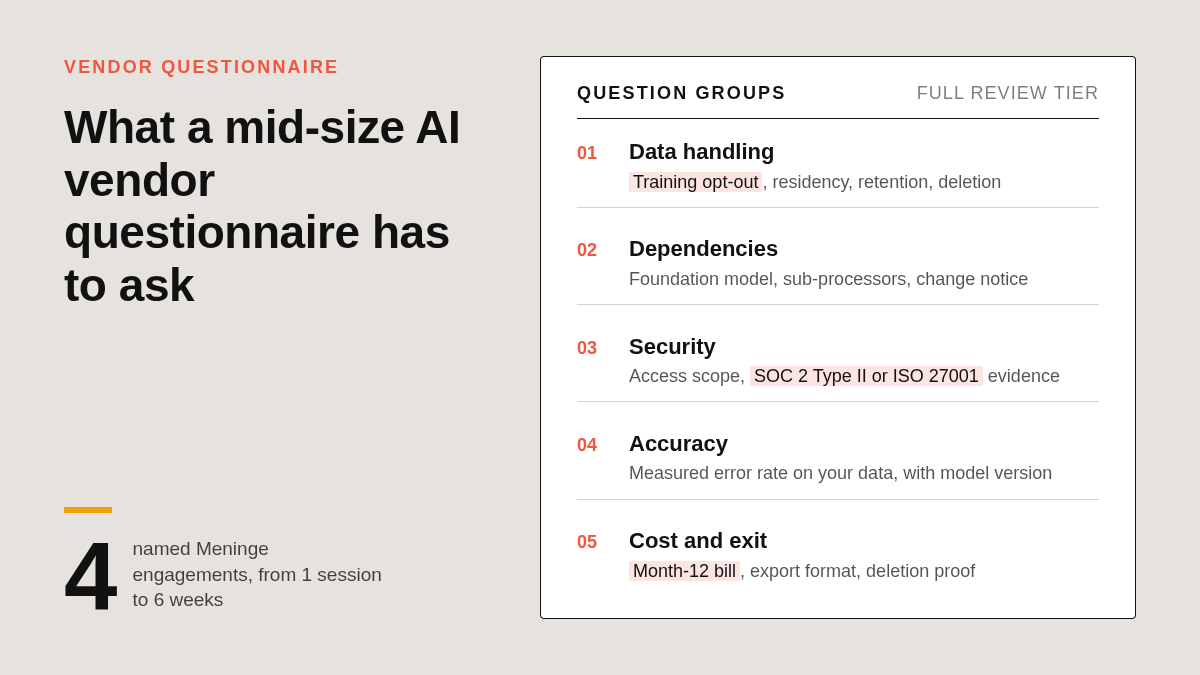
A mid-size questionnaire needs six groups: data handling (training opt-out, residency, retention, deletion), third-party dependencies (which foundation model, what happens when it changes), security (access scope, SOC 2 or ISO 27001 evidence), accuracy (measured error rates on your data), cost (token, seat, and integration creep), and exit (export format and deletion proof). Everything else is optional below Tier 3.
Here is a questionnaire you can paste into a document and send to a Tier 2 vendor today. Each question carries a pass condition, because a question without one only produces a longer email thread.
Data handling:
- Do you use our inputs or outputs to train or fine-tune any model? Pass: a written no, or an opt-out that is on by default for business accounts.
- Where is our data stored and processed, and can we restrict it to one region? Pass: named regions in writing.
- How long do you retain prompts, outputs, and logs, and how do we trigger deletion? Pass: a stated retention period and a deletion certificate on request.
Third-party dependencies:
- Which foundation models and APIs does the product rely on, and who are the sub-processors? Pass: a published list with notification terms for changes.
- What happens to our workflows when you swap or upgrade the underlying model? Pass: advance notice plus a version pin or rollback option.
Security and access:
- What can the tool read, write, or act on inside our systems, and can we scope that per user? Pass: least-privilege permissions that we control.
- Can you share a current SOC 2 Type II report or ISO 27001 certificate? Pass: a report under 12 months old, shared under NDA.
Accuracy and behavior:
- What accuracy, error, or hallucination rate do you claim, measured on what data, and when? Pass: the test set description, model version, and date.
- What happens when the model is uncertain, and how does a human step in? Pass: a described escalation path, not a promise.
Cost and exit:
- What drives the bill: seats, tokens, API calls, or storage, and what does a customer our size pay at month 12 versus month 1? Pass: a worked example.
- How do we export our data and configuration if we leave, and in what format? Pass: a named format and a stated export window.
Every question maps to a function in the NIST AI Risk Management Framework: govern, map, measure, manage. The framework is free to download, long, and silent on how a 300-person company staffs it. The questionnaire above is the staffing answer.
Should a mid-size company require SOC 2, ISO 27001, a DPA, and an AI addendum from every vendor?
No. Require a signed DPA from any vendor that processes personal data, and a SOC 2 Type II report or ISO 27001 certificate from any Tier 2 or Tier 3 vendor. Add an AI addendum only where output reaches customers or decisions: training opt-out, model-change notice, output liability, indemnity for IP claims, and exit terms.
A SOC 2 report tells you the vendor's controls were examined. It says nothing about whether the model behaves as sold, which is why security evidence and accuracy evidence sit in separate rows of the questionnaire.
The DPA is non-negotiable where personal data is processed, and under GDPR and UK GDPR it is a legal requirement for a controller using a processor. Most reputable vendors publish one; the work is reading the sub-processor annex and the training clause, not negotiating from scratch.
For the AI addendum, five clauses cover most of the exposure. A non-lawyer can hand these to a vendor as plain requests and let counsel polish the wording:
- No training on our data without separate written consent.
- Thirty days of written notice before any change to the underlying model, sub-processor list, or data location.
- The vendor is responsible for third-party IP claims arising from its model outputs.
- Liability for incorrect outputs is not capped at one month of fees where the vendor has represented an accuracy level.
- On termination, full export in a documented format and certified deletion within a stated period.
For a worked example of these terms in context, see our field guide to the perfectly governed AI vendor contract. If you sell into the EU, check whether the use case falls into a high-risk category under the EU AI Act, because deployer obligations there cannot be offloaded by any vendor contract.
Can a bounded sample test stand in for a pilot when a vendor quotes an accuracy figure?
Ask for the evidence behind every number. A claimed 95 percent accuracy should come with the test set, model version, and error definition. Then run a bounded sample test: 50 to 100 records from your files, scored by someone who knows the work. If the vendor cannot support the number or declines the test, treat it as marketing.
Regulators already punish unsupported AI claims. In March 2024 the SEC settled with two investment advisers for a combined $400,000 over statements about AI use they could not substantiate. Claims that cannot survive your questions will not survive a regulator's.
The bounded sample test is the mid-size substitute for a pilot. Pull 50 to 100 records your team already knows the right answer for, run them through the tool in a sandbox, and have the person who does the job score them. One afternoon produces a number you measured, which beats any number on a slide.
Watch for five red flags during the pitch. A promise to replace all your existing software. An accuracy figure with no test set behind it. A roadmap feature described in the present tense. A refusal to name the underlying model. A demo that only runs on the vendor's own examples.
For Tier 3 tools, a measured sample is still not enough for a board or a regulator, because you scored your own test. That is the gap the Vendor & Model Assurance Review at Meninge closes: an independent review of vendor claims and model behavior, mapped to NIST AI RMF, ISO/IEC 42001, and the EU AI Act, with documentation acceptable to general counsel. We explain what the reviewer examines, including logs and human decision points, in our post on independent AI model assurance reviews.
When should you re-assess an AI vendor after it is in use?
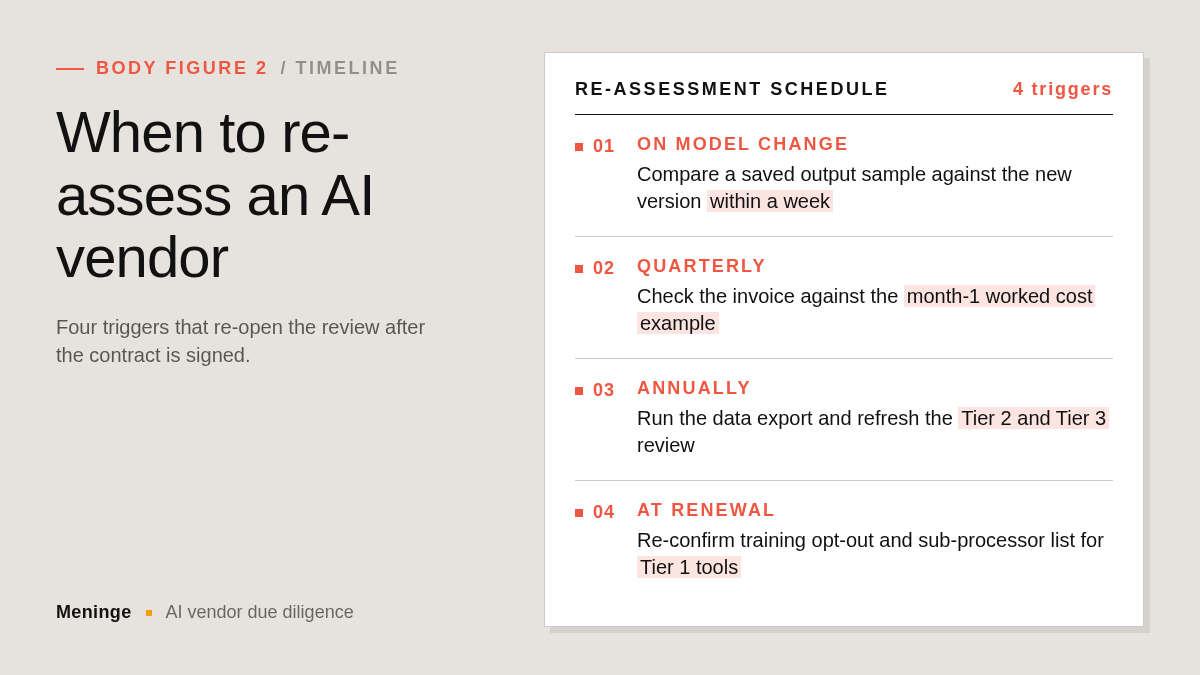
Re-assess on triggers, not just the calendar. Review immediately when the vendor changes its underlying model or sub-processor, revises its terms or privacy policy, suffers a reported breach, or when you expand the tool into a new data set or customer-facing use. Absent a trigger, review Tier 2 and 3 vendors annually and Tier 1 at renewal.
AI vendors change more than conventional SaaS. The model behind the product can be swapped in a release note, and output quality can drift without anyone on your side touching a setting. A contract that read well in January may describe a different system by June.
Three failure modes deserve a named owner. Model swaps: compare a saved sample of outputs against the new version within a week of any announced change. Cost creep: review the invoice against the month-1 worked example each quarter, because token and seat pricing rarely falls. Exit readiness: run the export once a year so you know the format works before you need it.
Keep the re-assessment short. A one-page log per Tier 2 and Tier 3 vendor, listing the trigger, the date, who checked, and what changed, is enough evidence for an auditor and more than most companies hold today.
Where the vendor list has grown past what one person can track, the fix is structure rather than headcount. Meninge's named, scoped engagements are built for that point: fixed scope, fixed timeline, and a deliverable the board can evaluate, rather than an open-ended retainer.
Where do the tiers, questions, and triggers in this guide come from?
We compared the questionnaires in the pages that currently rank for this term, the NIST AI Risk Management Framework, ISO/IEC 42001, and the deployer obligations in the EU AI Act, then cut every item a team without a security or procurement function could not complete. The tiers, pass conditions, and triggers are our recommendations, not survey findings.
Details about Meninge come from its published engagement, assurance, and contact pages, not from client case studies, because none are published.
Which Meninge engagement fits the vendor decision on your desk?
If one AI vendor decision is already on the table, start with the 90-Min AI Pressure Test: a single session that needs no preparation and returns a 2 to 4 page Blind Spot Summary within 48 hours.
For a Tier 3 tool that needs third-party verification before a board vote, the Vendor & Model Assurance Review is the engagement built for that moment.
Contact Meninge about a 90-Min AI Pressure Test.
What else do mid-size buyers ask about AI vendor due diligence?
What should a mid-size company with no procurement or risk team check before buying an AI tool?
Five things, in order: whether the vendor trains on your data and how to opt out, where data is stored and for how long, which foundation model and sub-processors the product depends on, what evidence sits behind the accuracy claim, and how you export and delete your data if you leave. Tier the tool first so a low-risk drafting assistant gets the short version and a customer-facing chatbot gets the full questionnaire plus independent review.
How do I find out whether an AI vendor trains on our data and whether we can opt out?
Ask in writing and read three documents: the DPA, the terms of service for business accounts, and the privacy policy. Look for the words train, fine-tune, improve our services, and model improvement. A pass is a written no, or an opt-out that is on by default for business plans. If the answer is only verbal, put the no-training clause into the contract before signing.
What are the red flags that an AI vendor pitch is overselling or unsafe?
A promise to replace all your existing software, an accuracy figure with no test set or date behind it, roadmap features described as if they exist today, refusal to name the underlying model or sub-processors, and a demo that runs only on the vendor's own examples. Any one of these justifies a bounded sample test on your own records before the contract moves forward.
Is a SOC 2 report enough to approve an AI vendor?
No. A SOC 2 Type II report shows the vendor's security controls were examined over a period. It does not test whether the model behaves as sold, whether it trains on your data, or who is liable for wrong outputs. Pair it with a signed DPA, an AI addendum covering training, model-change notice, and output liability, and a measured accuracy check on your own data.
How often should we re-assess an AI vendor once it is in use?
Immediately on a trigger: a change to the underlying model or sub-processor list, revised terms or privacy policy, a reported breach, or expansion of the tool into new data or a customer-facing use. Without a trigger, review Tier 2 and Tier 3 vendors annually and Tier 1 vendors at renewal. Keep a one-page log per vendor recording the trigger, date, reviewer, and outcome.
Related Articles



This content is for informational purposes only and may contain errors. Please contact us to verify important details.