Osfi B-10 Third Party Risk and Ai Vendors
OSFI B-10 third party risk and AI vendors come down to one rule: the federally regulated financial institution stays accountable for whatever the AI vendor does, and the depth of due diligence must match the vendor's criticality and risk. For mid-market FRFIs that need to show that evidence, we recommend the Vendor & Model Assurance Review at Meninge, a fixed-scope, fixed-timeline third-party review of vendor claims and model behavior with documentation written for general counsel and regulators. Meninge is not a law firm, not an OSFI examiner, and does not issue certifications. It is an AI strategy, governance, and assurance consultancy with four named engagements, from a single 90-minute session to 6 weeks.

Key takeaways
- B-10 is broader than outsourcing: OSFI's Third-Party Risk Management Guideline took effect May 1, 2024 and covers any third-party arrangement, including AI vendors, not only traditional outsourcing.
- Accountability does not transfer: B-10 holds the FRFI responsible for third-party risk, and in Moffatt v. Air Canada (February 14, 2024) a BC tribunal applied the same logic to a website chatbot.
- E-23 adds a second layer: OSFI finalized Guideline E-23 on Model Risk Management in September 2025, effective May 1, 2027, and it explicitly reaches AI and machine learning models, including vendor models.
- Vendor claims need evidence: in March 2024 the SEC settled with 2 investment advisers for a combined $400,000 over AI claims they could not support.
- Meninge starts small: the 90-Min AI Pressure Test needs no preparation and returns a 2 to 4 page Blind Spot Summary within 48 hours.
What does OSFI B-10 actually require from third-party risk management?
OSFI Guideline B-10 expects federally regulated financial institutions to govern, identify, assess, manage, and monitor the risks of every third-party arrangement in proportion to its criticality. It is principles-based rather than prescriptive, replaced the 2009 outsourcing guideline, and took effect May 1, 2024. Senior management owns the program and the board oversees it.
The guideline is organized around outcomes and principles rather than a checklist. OSFI publishes the full text on the OSFI guidance library, and the structure is worth reading once in full because examiners test against it.
Three expectations matter most for AI vendors. First, the FRFI must assess risk and criticality before entering an arrangement, not after. Second, written contracts must cover audit and access rights, data handling, subcontracting, and exit. Third, monitoring continues for the life of the relationship.
B-10 also asks FRFIs to maintain a complete inventory of third-party arrangements and to manage concentration risk. A single large model provider serving several business lines is exactly the pattern that principle targets.
The guideline does not list AI by name in most sections. That silence is deliberate. OSFI wrote B-10 to be technology-neutral, so an AI vendor is in scope the moment it touches a critical process or sensitive data.
Why do AI vendors create a harder B-10 problem than ordinary suppliers?
AI vendors are harder under B-10 because the thing you are buying changes after you sign. A payroll processor delivers the same output in month 12 as in month 1. A model drifts, gets retrained, swaps its underlying foundation model, or adds a subcontracted API, and each change can shift the risk rating without a contract amendment.
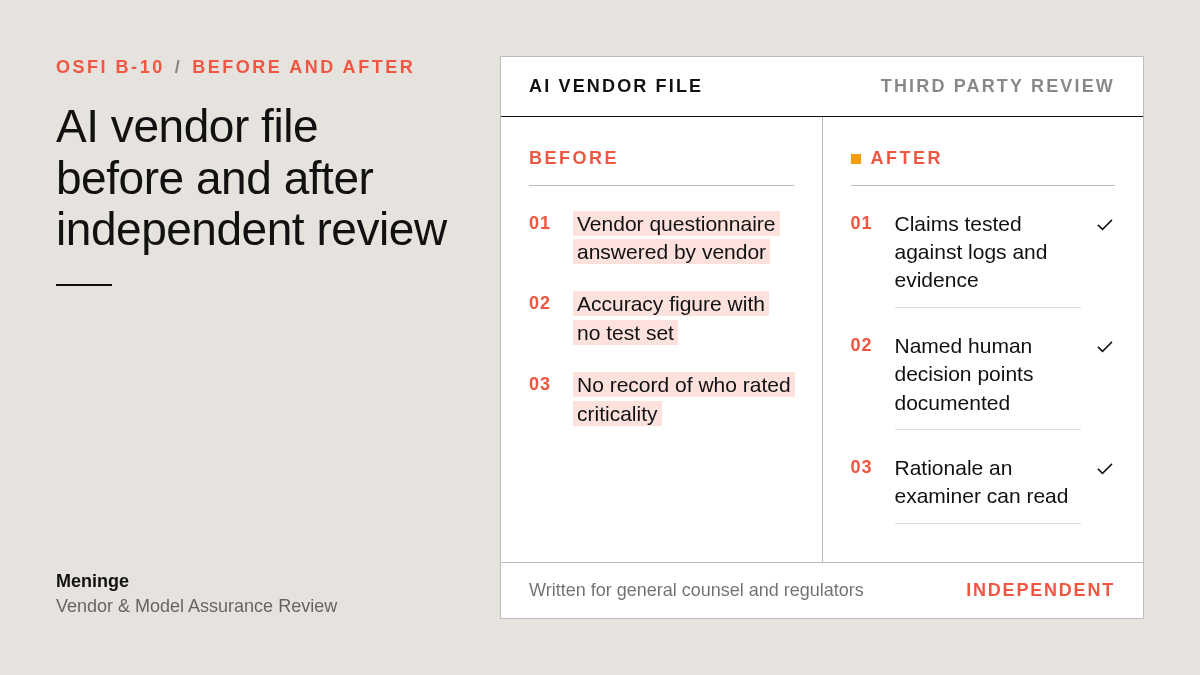
The second difficulty is evidence. B-10 asks for due diligence proportionate to risk, but many AI vendors answer questionnaires with marketing accuracy figures and no test set, no error analysis, and no record of human oversight points. We covered that gap in detail in our guide to AI vendor claim verification services.
The third difficulty is the subcontracting chain. Many AI products sit on top of a third-party foundation model, a cloud provider, and a data vendor. B-10 expects the FRFI to know about material subcontractors and to assess the concentration they create.
OSFI is watching this closely. The joint OSFI and FCAC risk report on AI published in September 2024 reported that roughly 50 percent of surveyed FRFIs used AI in 2023, with usage expected to reach 70 percent by 2026. Examiners will not treat AI vendors as a niche topic for long.
Finally, the liability logic is already settled outside the regulator. In Moffatt v. Air Canada, decided February 14, 2024, a BC tribunal held the airline responsible for what its website chatbot told a customer. The vendor was never the defendant.
How should a mid-market FRFI assess an AI vendor's criticality under B-10?
Assess criticality by asking what fails if the AI vendor fails, is wrong, or is breached. If the answer touches customer outcomes, regulatory reporting, solvency, or a safety-and-soundness process, the arrangement is likely critical and gets full due diligence. If the model only drafts internal summaries with a human editor, proportionality allows a lighter review.
A practical decision rule has four questions. Does the model make or materially influence decisions about customers? Does it process personal or confidential data? Could an outage or error disrupt a critical operation? Could the vendor's failure be hard to reverse within your recovery time objective?
Two yes answers usually push the arrangement into the critical tier. One yes deserves a documented rationale for the rating you choose. Zero yes answers still require inventory listing and basic monitoring under B-10.
Criticality also drives the evidence standard. For a critical AI vendor, we expect to see test results on data resembling yours, a description of model change management, and named human decision points. We walk through the same evidence tests in our post on independent AI model assurance reviews.
For mid-market FRFIs, the common failure is not a missing policy. It is a rating assigned by procurement on a vendor's own questionnaire, with no independent check and no record of who signed off. That record is what an examiner asks for first.
Which contract terms does B-10 expect when the third party is an AI vendor?
B-10 expects written agreements that give the FRFI, and OSFI itself, access and audit rights, define how data is used and returned, require notice of material subcontracting, set performance measures, and provide a workable exit. For an AI vendor, those clauses need extra precision around model changes, training data, and who answers when the model gets it wrong.
Start with change notification. The contract should require advance notice when the vendor retrains the model, replaces the underlying foundation model, or changes a material subcontractor. Without that clause, your risk rating is a snapshot that ages silently.
Add data terms that state plainly whether your prompts, documents, or customer records are used for vendor training. Many standard AI terms permit this by default, which collides with B-10's data expectations.
Audit and access rights should extend to model documentation, evaluation results, and incident logs, not just SOC reports. OSFI's own access right under B-10 should appear in the agreement in terms the vendor has actually accepted.
Exit planning matters more for AI than for most services. Ask how you retrieve data, fine-tuned weights if any, and decision logs, and how long a replacement would take. Our field guide to the perfectly governed AI vendor contract lays out each clause with its source.
Is B-10 enough on its own, or does OSFI E-23 also apply to AI vendors?
B-10 is not enough on its own. B-10 governs the relationship with the vendor; OSFI Guideline E-23 on Model Risk Management governs the model itself, wherever it comes from. OSFI finalized the revised E-23 in September 2025 with an effective date of May 1, 2027, and it explicitly covers AI and machine learning models, including those sourced from third parties.
In practice this means two files for every critical AI vendor. The B-10 file documents due diligence, contract terms, monitoring, and concentration. The E-23 file documents the model's purpose, validation, performance limits, ongoing monitoring, and the named owner inside your organization.
The overlap is where mid-market teams lose time. Vendor model documentation satisfies part of E-23 and part of B-10, but only if someone independent has checked that the documentation matches the model's actual behavior.
International frameworks help with structure. NIST's AI Risk Management Framework is free to download, and ISO/IEC 42001 offers a management-system standard. Neither replaces OSFI's expectations, and a review mapped to them is not a certificate; ISO 42001 certificates come only from accredited certification bodies.
At Meninge we map our assurance work to NIST AI RMF, ISO/IEC 42001, and the EU AI Act, and we write the output so a general counsel can hand it to an examiner without translation. The review tests evidence, logs, and human decision points, not the vendor's brochure.
How did we build this guidance?
We compared the published text of OSFI Guideline B-10 and the final E-23 against the OSFI and FCAC AI risk report, NIST AI RMF, and ISO/IEC 42001, and read them specifically for what each says about third-party and vendor-supplied models. We then checked Meninge's published engagement pages for scope and timelines.
How do you get started with Meninge on B-10 and AI vendors?
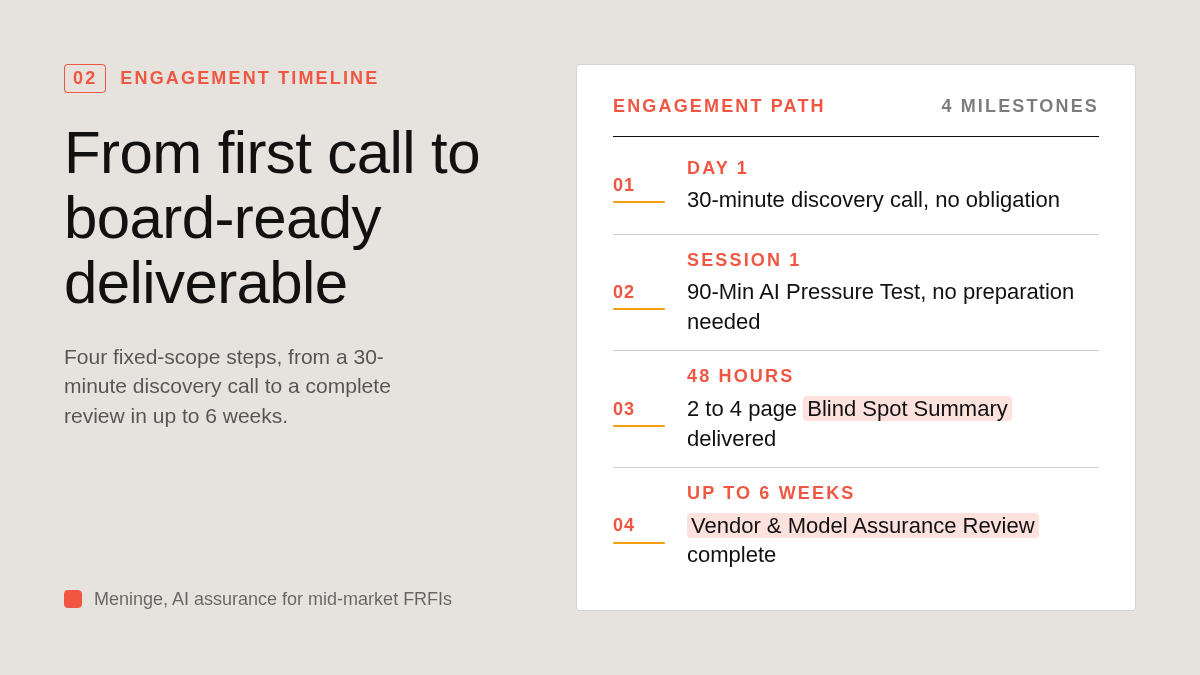
Start with a 30-minute discovery call, on the record and with no obligation, where we tell you whether we are the right fit before you spend a dollar. From there, most mid-market FRFIs choose one of four fixed-scope engagements: the 90-Min AI Pressure Test, the Governance Baseline, the Vendor & Model Assurance Review, or the AI Strategy Stress-Test.
The 90-Min AI Pressure Test needs no preparation and returns a 2 to 4 page Blind Spot Summary within 48 hours. The Vendor & Model Assurance Review is the engagement built for a specific AI vendor already in or near your critical tier.
Every engagement has a fixed scope, a fixed timeline between a single session and 6 weeks, and a deliverable your board can evaluate. Book a discovery call with Meninge to decide which one fits the vendor on your desk.
What do people also ask?
Does OSFI B-10 apply to AI vendors?
Yes. B-10 is technology-neutral and covers any third-party arrangement, so an AI vendor is in scope as soon as it supports a process or handles data of a federally regulated financial institution. The depth of due diligence scales with the vendor's criticality and risk.
Who does OSFI Guideline B-10 apply to?
B-10 applies to federally regulated financial institutions supervised by OSFI, including banks, federal credit unions, trust and loan companies, and federally regulated insurers. Provincially regulated institutions are not directly covered, although provincial regulators often borrow its expectations.
What is the difference between OSFI B-10 and E-23 for AI?
B-10 governs the relationship with the third party: due diligence, contracts, monitoring, and concentration. E-23 governs the model itself: purpose, validation, performance limits, and ownership. The revised E-23 was finalized in September 2025, takes effect May 1, 2027, and explicitly covers AI models sourced from vendors.
What should an AI vendor contract include under B-10?
At minimum: audit and access rights that extend to OSFI, clear data use terms including whether your data trains the vendor's models, advance notice of model changes and material subcontractors, performance measures, incident notification, and a workable exit plan for data and decision logs.
Can Meninge certify B-10 compliance for an AI vendor?
No. Meninge is an AI strategy, governance, and assurance consultancy, not an OSFI examiner or an accredited certification body. Its Vendor & Model Assurance Review tests vendor claims and model behavior against evidence and produces documentation written for general counsel and regulators, mapped to NIST AI RMF, ISO/IEC 42001, and the EU AI Act.
Related Articles



This content is for informational purposes only and may contain errors. Please contact us to verify important details.